
How CISOs Reduce Manual SOC 2 Evidence Collection
Summary
Manual SOC 2 evidence collection can slow audit preparation, create documentation gaps, and increase the workload for security teams. Learn how CISOs can streamline evidence collection through automation, clear ownership, repeatable workflows, and continuous control monitoring.
Why Manual SOC 2 Evidence Collection Becomes a Challenge
Preparing for a SOC 2 audit involves gathering documentation that demonstrates how an organization’s security controls operate. Teams may need access records, policy documents, employee training records, vulnerability reports, change-management tickets, and other supporting evidence.
When this process relies on spreadsheets, email requests, and manual downloads, evidence collection can become repetitive and difficult to coordinate. Security teams may spend considerable time chasing updates instead of addressing control gaps and improving security practices.
The challenge grows when evidence is stored across multiple systems. Without a consistent process, teams may collect outdated screenshots, miss reporting periods, or submit records that do not clearly demonstrate the control being tested.
For CISOs, reducing manual effort means building a repeatable evidence process that improves accuracy, accountability, and audit readiness.
What Is SOC 2 Evidence Collection?
SOC 2 evidence collection is the process of gathering and organizing records that demonstrate how an organization's controls support the applicable Trust Services Criteria: Security, Availability, Processing Integrity, Confidentiality, and Privacy, depending on the scope of the examination.
Evidence may come from identity platforms, cloud environments, HR systems, ticketing tools, endpoint management platforms, and internal policy repositories.
Examples include:
- Access reviews and user provisioning records.
- Security policies and employee acknowledgements.
- Vulnerability scans and remediation tickets.
- Change approvals and deployment records.
- Security awareness training completion.
- Incident response documentation and monitoring records.
- Backup, recovery, and availability evidence where relevant.
The exact evidence required depends on the organization's systems, selected criteria, control design, and auditor's testing approach. Collecting large amounts of documentation is not enough; each record must be relevant to the control and period being examined.
Why CISOs Should Reduce Manual Evidence Collection
Less Time Spent on Repetitive Tasks
Manually exporting reports, requesting screenshots, renaming files, and updating trackers consumes time that could be spent on security improvements. Automation can reduce repeated work for evidence sources that provide reliable integrations or scheduled reports.
Better Evidence Consistency
Different teams may provide records in different formats or use inconsistent naming conventions. Standardized evidence requirements help teams submit records with clear dates, ownership, scope, and supporting context.
Clearer Control Ownership
Evidence requests often cross security, IT, HR, engineering, and compliance teams. Assigning a named owner to each control and evidence source reduces confusion about who must provide, review, and approve the required information.
Improved Audit Readiness
When evidence is collected and reviewed throughout the year, organizations can identify missing records and control gaps earlier. This reduces dependence on last-minute evidence gathering before an audit.
How CISOs Can Automate SOC 2 Evidence Collection
1. Map Each Control to Its Evidence Source
Start by documenting each in-scope control, the evidence needed to demonstrate its operation, the system that produces it, and the responsible owner.
For example, a user-access control may require an export of active users, role assignments, and evidence of periodic access reviews. These records may come from an identity provider and an access-review workflow.
Create an evidence matrix with fields such as:
- Control ID and description.
- Evidence requirement and reporting period.
- Source system and collection method.
- Evidence owner and reviewer.
- Collection frequency and due date.
- Status, exceptions, and remediation notes.
This structure helps teams understand what needs to be collected before automating the workflow.
2. Connect Evidence Sources Where Practical
Many organizations maintain evidence across identity systems, cloud platforms, HR applications, ticketing tools, and endpoint security solutions.
Where supported, integrations or APIs can retrieve relevant records on a defined schedule. For example, an integration might collect a user-access report or retrieve approved change tickets for a specific period.
Not every source can be automated reliably. Some evidence may require a manual explanation, management approval, or confirmation that a control operated as intended. A practical approach combines automated collection with human review where judgment is necessary.
3. Standardize Evidence Formats
Automation becomes more effective when teams agree on how evidence should be named, stored, and reviewed.
Define standard conventions for filenames, timestamps, reporting periods, control identifiers, and ownership. Store evidence in an approved repository with access restrictions, version history, and appropriate retention settings.
Standardization also helps auditors and internal reviewers trace each record back to the relevant control without repeatedly asking teams for clarification.
4. Automate Reminders and Status Tracking
Evidence collection often stalls because requests have no clear owner or deadline. A centralized workflow can assign tasks, send reminders, flag overdue items, and show the status of each evidence request.
Useful statuses include Not Started, In Progress, Submitted, Under Review, Needs Correction, and Approved.
Escalation rules can notify control owners or compliance leads when critical evidence is overdue. This creates visibility into audit preparation without requiring the CISO to follow up manually on every request.
5. Validate Evidence Before It Is Accepted
Collecting a file does not automatically mean it is sufficient evidence. Teams should verify that each record is complete, relevant to the control, and aligned with the required period.
Automated checks may identify missing fields, expired records, incomplete exports, or files that do not match expected naming conventions. Reviewers should still confirm whether the evidence demonstrates the control's operation.
If a record is incomplete, the workflow should return it to the owner with a clear explanation of what needs correction.
6. Monitor Control Changes Throughout the Year
Evidence requirements may change when organizations introduce new systems, modify access permissions, change vendors, or update security policies.
Connect evidence workflows to change-management and control-review processes where possible. When a significant change occurs, review whether the affected control, evidence source, or collection frequency needs updating.
This approach helps prevent evidence processes from becoming outdated between audit cycles.
Which SOC 2 Evidence Tasks Can Be Automated?
The level of automation depends on the systems involved, available integrations, and the control requirements.
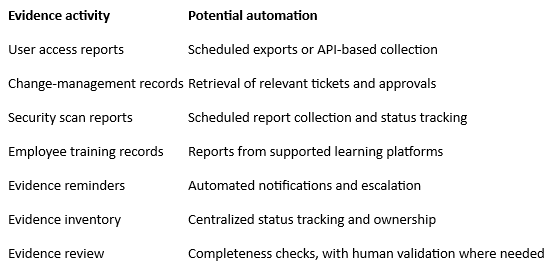
Policies, management approvals, exception explanations, and some control assessments may still require human input. Automation should support evidence quality rather than replace control owners' responsibility for accurate records.
How to Measure SOC 2 Evidence Collection Efficiency
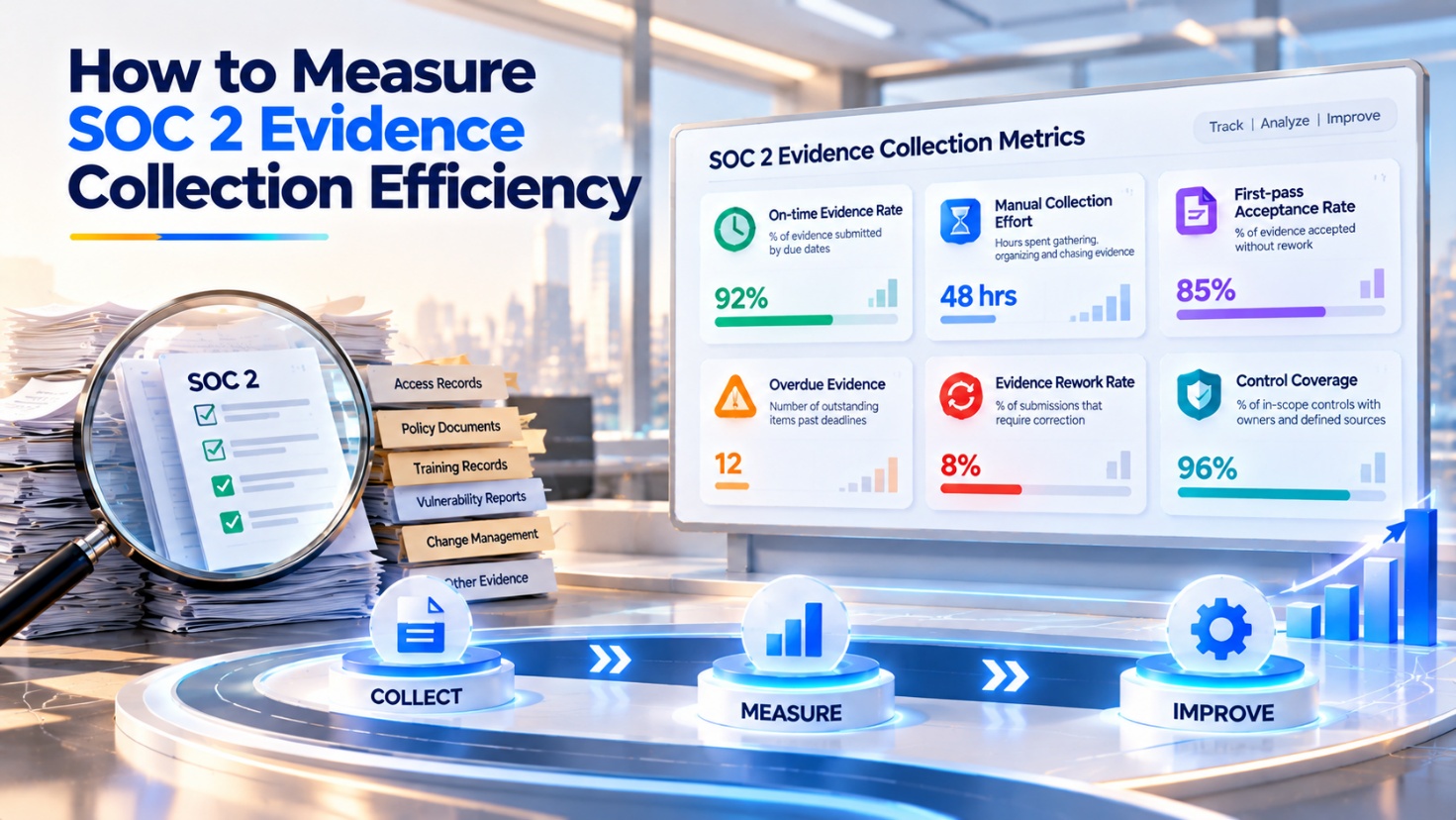
CISOs need practical metrics to understand whether the process is improving.
Consider tracking:
- On-time evidence rate: Percentage of evidence items submitted by their due dates.
- Manual collection effort: Hours spent gathering, organizing, and chasing evidence.
- First-pass acceptance rate: Percentage of evidence items accepted without rework.
- Overdue evidence: Number of outstanding items past their deadlines.
- Evidence rework rate: Percentage of submissions that require correction.
- Control coverage: Percentage of in-scope controls with assigned owners and defined evidence sources.
Establish a baseline before introducing automation and compare results over time. These metrics help identify bottlenecks and show whether automation is reducing workload while maintaining evidence quality.
Common Mistakes to Avoid
Automating Without Defining Requirements
Connecting tools before defining what evidence is required can produce large volumes of irrelevant records. Map the controls and evidence requirements first.
Treating Every Screenshot as Sufficient Evidence
A screenshot may show a configuration at a particular moment but may not demonstrate how a control operated throughout the required period. Match the evidence type to the control and the auditor's expectations.
Ignoring Access and Retention
Audit evidence may contain sensitive employee, customer, or security information. Restrict access, apply appropriate retention policies, and maintain a reliable record of evidence changes.
Assuming Automation Guarantees Compliance
Automation can improve consistency and reduce repetitive tasks, but it cannot guarantee SOC 2 compliance or a successful examination. Organizations must implement effective controls, address deficiencies, and validate evidence against their requirements.
How Indrasol Supports SOC 2 Evidence Readiness
Reducing manual evidence collection is one part of a broader SOC 2 readiness process. Organizations also need appropriate controls, clear documentation, remediation workflows, and coordination between internal stakeholders and the audit partner.
Indrasol's SOC 2 compliance services include audit preparation, evidence collection, documentation review, internal readiness reviews, and auditor coordination. These activities can help organizations establish a more structured approach to preparing for a SOC 2 examination.
The right process depends on your current controls, technology stack, examination scope, and available resources. Start by identifying the most time-consuming evidence requests and standardizing those workflows before expanding automation across the program.
SOC 2 Evidence Collection Checklist
Use this checklist to assess whether your evidence process is structured and repeatable.
- Map in-scope controls to evidence requirements.
- Identify the system and owner for each evidence source.
- Define collection frequency and reporting periods.
- Automate supported data collection and reminders.
- Standardize filenames, formats, and repository locations.
- Validate completeness and relevance before approval.
- Restrict evidence access and apply retention requirements.
- Track overdue items and recurring evidence gaps.
- Review workflows after significant system or control changes.
- Measure manual effort, rework, and on-time submission rates.
SOC 2 Evidence Collection FAQs
What is SOC 2 evidence collection?
It is the process of gathering records that demonstrate how an organization's in-scope controls are designed and operating. Evidence requirements depend on the applicable Trust Services Criteria, control design, examination scope, and testing period.
How can CISOs automate SOC 2 evidence collection?
CISOs can use integrations, APIs, scheduled reports, centralized evidence repositories, automated reminders, and workflow tracking. Human review remains important for evaluating context, exceptions, and whether evidence adequately demonstrates a control.
Which tools are used for SOC 2 evidence collection?
Organizations may use compliance automation platforms, identity providers, cloud security tools, ticketing systems, HR platforms, and document repositories. The right combination depends on the existing technology stack and the controls being examined.
Does automated evidence collection guarantee SOC 2 compliance?
No. Automation can help collect and organize records, but compliance also depends on effective controls, appropriate policies, remediation, and evidence that supports the examination requirements.
How often should SOC 2 evidence be collected?
Collection frequency depends on the control and the evidence required. Some records may be collected continuously or monthly, while others are reviewed quarterly, annually, or when a relevant event occurs. Confirm the expected period and evidence requirements with the compliance team and auditor.
Build a More Efficient SOC 2 Readiness Process
Reducing manual SOC 2 evidence collection starts with clear control mapping, reliable evidence sources, consistent ownership, and repeatable workflows. Automation can reduce administrative effort, but evidence must remain accurate, relevant, protected, and suitable for review.
By measuring collection efficiency and addressing recurring gaps, CISOs can help their teams spend less time chasing documentation and more time improving security controls.
About the Author
Brahma Guptha Illindra
Brahma Gupta is a technology entrepreneur, enterprise technology leader, and Founder & CEO of Indrasol, helping organizations adopt AI, cloud, data, and cybersecurity technologies securely, compliantly, and at scale. Over the years, he has worked across enterprise architecture, data engineering, analytics, cloud technologies, Oracle EPM, and business transformation. Today, his focus is increasingly on one of the biggest challenges facing enterprises: how to adopt AI at scale without losing visibility, security, governance, or control. At Indrasol, he and his team help organizations bridge the gap between technology innovation and business risk across: • AI Security & AI-SPM (AI Security Posture Management) • AI Governance & Responsible AI • Cloud Security & CSPM (Cloud Security Posture Management) • Cybersecurity & Risk Management • SOC 2, ISO 27001, ISO 42001 & CMMC compliance • Cloud modernization & DevOps • Data, analytics & AI transformation • Enterprise technology & automation Brahma is particularly
View Brahma Guptha Illindra's profile