
The Biggest Pain Point SOC 2 Solves for CFOs and Why It’s a Revenue Strategy, Not Just Compliance
In today’s enterprise SaaS and digital economy, SOC 2 compliance is no longer a “nice-to-have.” It has become a critical financial lever—especially from a CFO’s perspective.
While security teams view SOC 2 as a framework for controls, CFOs see something very different:

This article breaks down:
- The core pain point SOC 2 solves for CFOs
- Real-world data and statistics
- Practical business examples
- What it ultimately means for company growth
The Core Pain Point: Revenue Friction
The single biggest challenge SOC 2 solves for CFOs is:
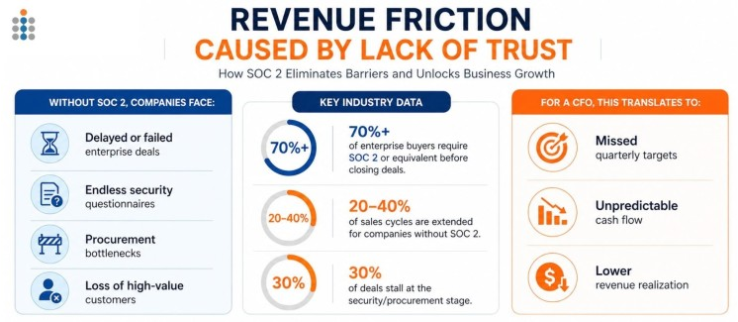
Revenue friction caused by lack of trust
Without SOC 2, companies face:
- Delayed or failed enterprise deals
- Endless security questionnaires
- Procurement bottlenecks
- Loss of high-value customers
📊 Key Industry Data
- 70%+ of enterprise buyers require SOC 2 or equivalent before closing deals
- Companies without SOC 2 experience sales cycles extended by 20–40%
- Up to 30% of deals stall at the security/procurement stage
For a CFO, this translates to:
- Missed quarterly targets
- Unpredictable cash flow
- Lower revenue realization
Why SOC 2 Matters to CFOs (Not Just Security Teams)
1. Accelerates Revenue Recognition
SOC 2 removes friction during due diligence.
Without SOC 2:
- Deals get stuck in legal/security review
- Contracts take months longer
With SOC 2:
- Pre-approved trust signal
- Faster sign-offs
Impact: Revenue hits the books faster
2. Improves Deal Conversion Rates
Enterprise buyers prefer vendors with proven compliance.
📊 Stat:
- Companies with SOC 2 see 15–25% higher enterprise win rates
CFO Outcome:
- Better ROI on sales and marketing spend
- Higher pipeline efficiency
3. Enables Predictable Forecasting
Forecasting becomes unreliable when deals stall unexpectedly.
SOC 2 brings:
- Standardized responses
- Fewer late-stage surprises
CFO Outcome:
- Accurate revenue projections
- Improved board/investor confidence
4. Reduces Hidden Operational Costs
Without SOC 2:
- Teams manually respond to security questionnaires
- Engineers pulled into compliance work
- Duplicate efforts across deals
📊 Stat: Companies spend 100–300+ hours per deal on security reviews without SOC 2
With SOC 2:
- Reusable documentation
- Centralized controls
- Automated evidence collection
- CFO Outcome:
- Lower cost per deal
- Higher operational efficiency
5. Boosts Company Valuation
SOC 2 signals:
- Mature governance
- Lower risk
- Enterprise readiness
📊 Investor Insight:
- Compliance-ready companies often command higher valuation multiples, especially in SaaS and fintech
CFO Outcome:
- Stronger fundraising position
- Better M&A attractiveness
Real-World Example
Scenario: Mid-size SaaS company (pre-SOC 2)
Before SOC 2:
- Average deal cycle: 90–120 days
- Frequent drop-offs in procurement
- Heavy engineering involvement in compliance
- Lost enterprise deals due to “security concerns”
After SOC 2 Implementation:
Results:
- Deal cycle reduced to 60–75 days
- Enterprise win rate increased by ~20%
- Security questionnaires reduced by 50%+ effort
- Faster onboarding of large clients
CFO Impact:
- Faster revenue realization
- Improved forecast accuracy
- Higher sales efficiency
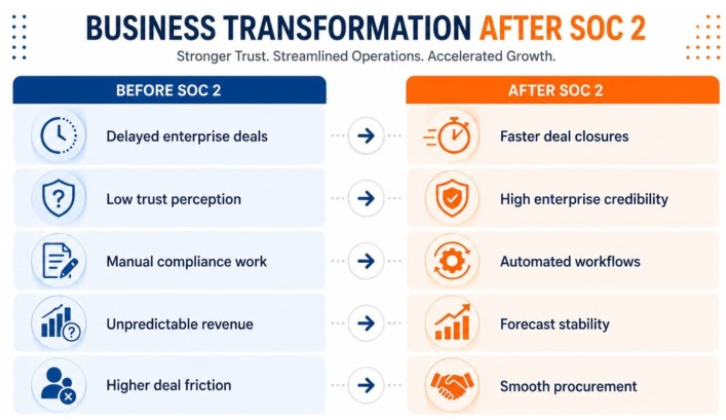
Business Transformation After SOC 2
What This Means for the Company
SOC 2 is not just about passing an audit—it fundamentally changes how a company operates.
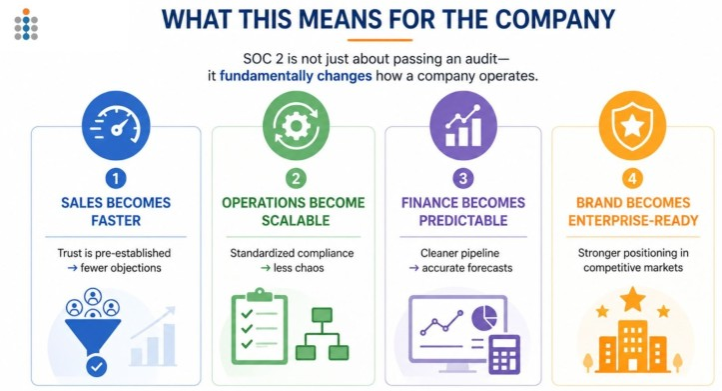
1. Sales Becomes Faster
Trust is pre-established → fewer objections
2. Operations Become Scalable
Standardized compliance → less chaos
3. Finance Becomes Predictable
Cleaner pipeline → accurate forecasts
4. Brand Becomes Enterprise-Ready
Stronger positioning in competitive markets
Final Takeaway
For CFOs, SOC 2 is not a compliance checkbox. It is a revenue accelerator, cost optimizer, and valuation enhancer.
SOC 2 transforms trust from a deal blocker into a growth driver.
How much revenue is compliance friction costing you today?
SOC 2 isn’t just about passing an audit—it’s about unlocking faster deals, predictable forecasts, and stronger valuation.
Talk to Indrasol and quantify your SOC 2 ROI
About the Author
Satish Govindappa
Satish Govindappa is an Visionary technology leader with 15+ years of experience spearheading AI/ML transformations across complex enterprise environments. Proven ability to align AI initiatives with business goals, lead global cross-functional teams, and deliver scalable, cloud-native solutions using LLMs, predictive analytics, and anomaly detection. Skilled in building AI Centers of Excellence, developing architecture standards, and ensuring responsible AI adoption across the organization. Championed a multi-million dollar Generative AI program at Synopsys, leading the development and deployment of custom large language models (LLMs) to strengthen compliance, accelerate product innovation, and streamline critical operational workflows. Facilitated architectural design sessions with IT architects and engineering leaders to build scalable, cloud-native AI infrastructure, enabling smooth integration with Synopsys and ICE Mortgage Technology’s distributed enterprise systems. Orchestrated the creation of enterprise-wide AI architecture standards, standardizing the deployment of predictive analytics, real-time anomaly detection, and large language model (LLM) solutions across diverse business units. Directed cross-functional teams of global professionals, uniting IT, operations, and business units to drive successful adoption of Generative AI applications. Experienced Generative AI Security Architect with solid background in LLM security, AI threat modeling, and machine learning to protect AI systems from prompt injection, model poisoning, and data leakage. Proficient in Cloud AI security (AWS, Azure, GCP), MLOps security, and Zero-trust AI architectures. Securing AI applications for Fortune 500 enterprises, startups, and government agencies across the US, EU, and APAC. Committed to ensuring AI compliance (SOC 2, NIST AI RMF, GDPR, ISO 27001) and enterprise AI risk management Expert in securing Generative AI and Large Language Models (LLMs) against emerging threats such as prompt injection, model poisoning, and adversarial machine learning attacks. A J2EE Developer turned Application Security Professional with unique ability to understand both the worlds better (Development and Security). Working experience in top companies like Fidelity Investments, TD Ameritrade, DTCC, MindTree, Honeywell and AOL. Specialties: GenAI Security, LLM security, Threat Modeling, Secure Code Review, Web Penetration Testing, Server Audits, Security Training, Security Automation
View Satish Govindappa's profile