
Continuous Compliance: The Death of Point-in-Time Audits
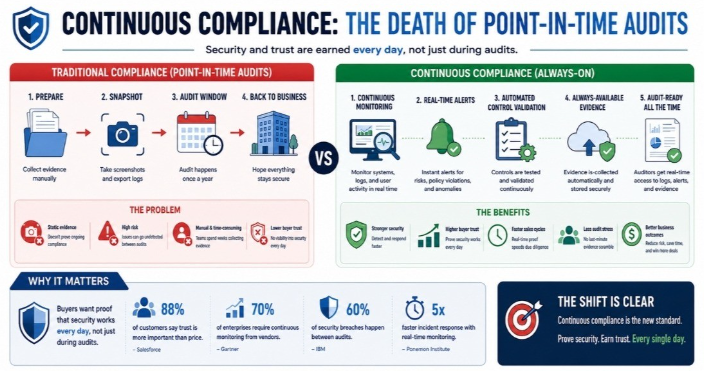
For years, SOC 2 audits followed a familiar pattern: prepare evidence, take screenshots, pass the audit, and move on.
That model is quickly becoming obsolete.
Today, organizations are shifting toward continuous compliance—a model where security controls are monitored, validated, and proven every single day, not just during an audit window.
This shift is fundamentally changing how companies approach SOC 2 compliance, cloud security, and risk management.
What Is Continuous Compliance?
Continuous compliance means maintaining and proving adherence to security standards like SOC 2 in real time.
Instead of collecting static evidence once a year, companies now:
- Continuously monitor systems and controls
- Automatically collect audit evidence
- Generate real-time alerts for control failures
- Provide ongoing visibility into security posture
In simple terms:
Why Point-in-Time Audits Are Failing
Traditional SOC 2 audits rely heavily on:
- Screenshots
- Spreadsheets
- Manual evidence collection
- One-time control validation
The problem?
These methods only show a snapshot in time.
They don’t answer critical questions like:
- Was this control working last week?
- Did anything break after the audit?
- Are alerts being monitored consistently?
Reality check:
A company can pass a SOC 2 audit and still be vulnerable the very next day.
That’s why auditors—and more importantly, buyers—are demanding more.
The Rise of Continuous Monitoring in SOC 2
Modern SOC 2 expectations now include the following:
Real-Time Log Monitoring
Organizations must track:
- User activity
- Access logs
- System changes
This ensures any suspicious activity is detected immediately.
Automated Alerts & Incident Detection
Security systems should:
- Trigger alerts for unusual behavior
- Notify teams instantly
- Enable quick response
Manual detection is too slow in today’s threat landscape.
Continuous Control Validation
Controls should not just exist—they should be
- Tested regularly
- Verified automatically
- Documented continuously
Always-Available Audit Evidence
Instead of scrambling before audits:
- Evidence is collected in real time
- Reports are always audit-ready
- Auditors can access live data
Why Screenshot-Based Compliance Is Dying
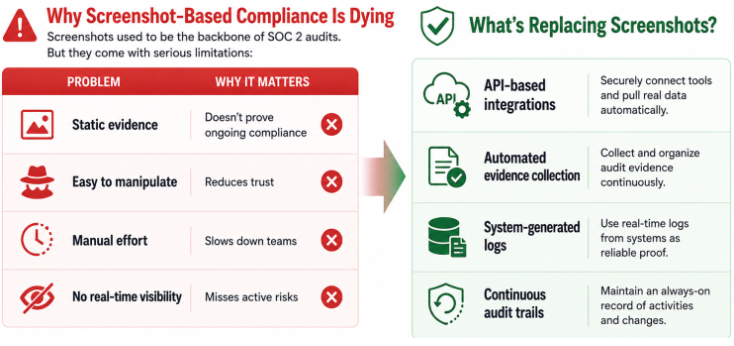
Screenshots used to be the backbone of SOC 2 audits. But they come with serious limitations:
What’s replacing screenshots?
- API-based integrations
- Automated evidence collection
- System-generated logs
- Continuous audit trails
Why Continuous Compliance Matters to Buyers
Today’s buyers—especially enterprise customers—are far more security-conscious.
They don’t just want a SOC 2 report.
They want proof that your security works every day.
Here’s what buyers are really asking:
- Can you detect threats in real time?
- Are your controls continuously monitored?
- How quickly can you respond to incidents?
- Is your compliance automated or manual?
The shift:
Business Impact of Continuous Compliance
Adopting continuous compliance isn’t just about security—it’s a growth lever.
Faster Sales Cycles
Real-time compliance data builds instant trust during due diligence.
Higher Win Rates
Buyers prefer vendors with strong, transparent security practices.
Reduced Audit Stress
No more last-minute scrambling for evidence.
Stronger Security Posture
Continuous monitoring reduces the risk of breaches.
How to Implement Continuous Compliance
Transitioning from point-in-time audits requires a strategic shift.
Step 1: Automate Evidence Collection
Use tools that:
- Integrate with your cloud stack
- Pull logs automatically
- Store audit-ready data
Step 2: Enable Continuous Monitoring
Track:
- Access controls
- Infrastructure changes
- Security events
Step 3: Set Up Real-Time Alerts
Ensure your team is notified instantly when:
- Controls fail
- Risks appear
- Policies are violated
Step 4: Align Security & Compliance Teams
Break silos between:
- Engineering
- Security
- Compliance
Step 5: Adopt a Compliance Platform
Modern platforms help the following:
- Centralize controls
- Automate workflows
- Provide auditor-ready dashboards
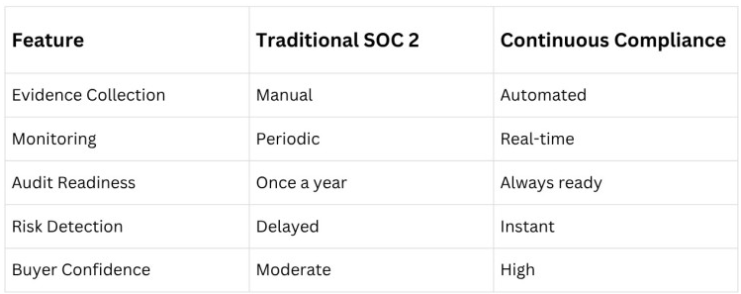
Continuous Compliance vs Traditional SOC 2
The Future of SOC 2 Compliance
The direction is clear:
- Continuous monitoring will become standard
- Manual audits will fade out
- Automation will dominate compliance workflows
Companies that adapt early will:
- Close deals faster
- Build stronger trust
- Stay ahead of competitors
Final Thoughts
The era of “audit once, relax later” is over.
Continuous compliance is not just a trend—it’s a new baseline for doing business in a security-first world.
If your organization is still relying on screenshots and point-in-time audits, you’re not just behind—you’re exposed.
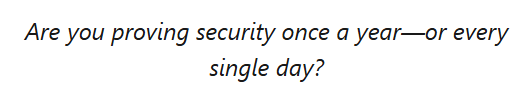
The real question is:
About the Author
Satish Govindappa
Satish Govindappa is an Visionary technology leader with 15+ years of experience spearheading AI/ML transformations across complex enterprise environments. Proven ability to align AI initiatives with business goals, lead global cross-functional teams, and deliver scalable, cloud-native solutions using LLMs, predictive analytics, and anomaly detection. Skilled in building AI Centers of Excellence, developing architecture standards, and ensuring responsible AI adoption across the organization. Championed a multi-million dollar Generative AI program at Synopsys, leading the development and deployment of custom large language models (LLMs) to strengthen compliance, accelerate product innovation, and streamline critical operational workflows. Facilitated architectural design sessions with IT architects and engineering leaders to build scalable, cloud-native AI infrastructure, enabling smooth integration with Synopsys and ICE Mortgage Technology’s distributed enterprise systems. Orchestrated the creation of enterprise-wide AI architecture standards, standardizing the deployment of predictive analytics, real-time anomaly detection, and large language model (LLM) solutions across diverse business units. Directed cross-functional teams of global professionals, uniting IT, operations, and business units to drive successful adoption of Generative AI applications. Experienced Generative AI Security Architect with solid background in LLM security, AI threat modeling, and machine learning to protect AI systems from prompt injection, model poisoning, and data leakage. Proficient in Cloud AI security (AWS, Azure, GCP), MLOps security, and Zero-trust AI architectures. Securing AI applications for Fortune 500 enterprises, startups, and government agencies across the US, EU, and APAC. Committed to ensuring AI compliance (SOC 2, NIST AI RMF, GDPR, ISO 27001) and enterprise AI risk management Expert in securing Generative AI and Large Language Models (LLMs) against emerging threats such as prompt injection, model poisoning, and adversarial machine learning attacks. A J2EE Developer turned Application Security Professional with unique ability to understand both the worlds better (Development and Security). Working experience in top companies like Fidelity Investments, TD Ameritrade, DTCC, MindTree, Honeywell and AOL. Specialties: GenAI Security, LLM security, Threat Modeling, Secure Code Review, Web Penetration Testing, Server Audits, Security Training, Security Automation
View Satish Govindappa's profile