
What is SOC 2 and Why It Matters: A Practical Guide for Modern Businesses
In today’s cloud-first, data-driven environment, trust is no longer a soft differentiator—it’s a hard requirement.
Whether you're handling customer data, running SaaS platforms, or managing enterprise infrastructure, your ability to prove security and operational integrity directly impacts revenue, partnerships, and growth.
This is where SOC 2 comes in.
WHAT IS SOC 2?
SOC 2 (System and Organization Controls 2) is a security and compliance framework developed by the American Institute of Certified Public Accountants (AICPA).
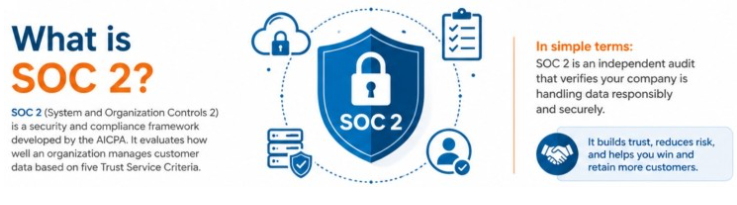
It evaluates how well an organization manages customer data based on five Trust Services Criteria (TSC):
- Security
- Availability
- Processing Integrity
- Confidentiality
- Privacy
In simple terms: SOC 2 is an independent audit that verifies your company is handling data responsibly and securely.
SOC 2 REPORTS: TYPE I vs TYPE II
Understanding the two report types is critical:
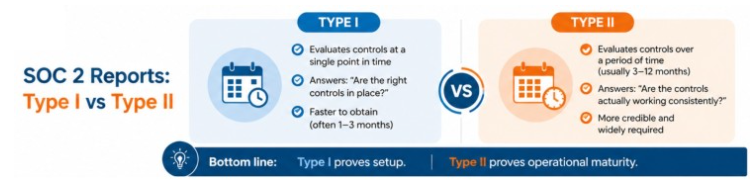
- SOC 2 Type I
- Evaluates controls at a single point in time
- Answers: “Are the right controls in place?”
- Faster to obtain (often 1–3 months)
- SOC 2 Type II
- Evaluates controls over a period of time (usually 3–12 months)
- Answers: “Are the controls actually working consistently?”
- More credible and widely required
Bottom line: Type I proves setup. Type II proves operational maturity.
The 5 Trust Service Criteria Explained
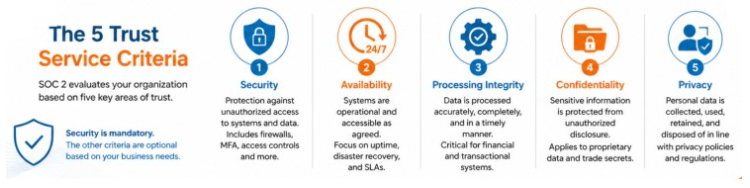
Security (Mandatory)
- Protection against unauthorized access
- Includes firewalls, MFA, access controls
Availability
- Systems are operational and accessible as agreed
- Focus on uptime, disaster recovery, SLAs
Processing Integrity
- Data is processed accurately and completely
- Critical for financial and transactional systems
Confidentiality
- Sensitive data is protected (e.g., IP, contracts)
Privacy
- Personal data is handled in line with privacy policies and regulations
WHY SOC 2 MATTERS
Builds Immediate Trust with Customers
SOC 2 acts as a third-party validation of your security posture. For enterprise clients, it’s often a non-negotiable requirement.
Accelerates Sales Cycles
Without SOC 2:
- Endless security questionnaires
- Procurement delays
With SOC 2:
- Faster vendor approvals
- Reduced friction in closing deals
Many companies report **30–50% faster enterprise sales cycles **post-certification.
Strengthens Your Security Posture
Preparing for SOC 2 forces you to:
- Identify vulnerabilities
- Formalize policies
- Implement monitoring systems
It’s not just compliance—it’s real security improvement.
Enables Enterprise & Global Expansion
SOC 2 is especially critical when:
- Selling to U.S.-based enterprises
- Handling sensitive data
- Expanding into regulated industries
Reduces Risk of Breaches and Downtime
By enforcing structured controls, SOC 2 helps mitigate:
- Data breaches
- Insider threats
- System failures
WHO NEEDS SOC 2?
SOC 2 is essential for:
- SaaS companies
- Cloud service providers
- Fintech platforms
- Healthcare tech (handling sensitive data)
- IT service providers
- Data analytics companies
If you store or process customer data in the cloud, you likely need SOC 2.
COMMON CHALLENGES IN SOC 2 COMPLIANCE
Organizations often struggle with:
Lack of Defined Processes
No formal policies for:
- Access control
- Incident response
- Vendor management
Tooling Gaps
Missing:
- Logging systems
- Monitoring tools
- Identity management
Documentation Overload
SOC 2 requires:
- Detailed evidence
- Audit trails
- Continuous tracking
Ongoing Maintenance
SOC 2 is not a one-time effort—it requires:
- Continuous monitoring
- Annual audits
HOW TO GET SOC 2 COMPLIANT (HIGH-LEVEL ROADMAP)
- Define Scope Systems, services, and data involved
- Gap Assessment Identify what’s missing vs SOC 2 requirements
- Implement Controls Security policies Monitoring tools Access management
- **Choose an Auditor **Licensed CPA firm
- Undergo Audit Type I → Type II progression
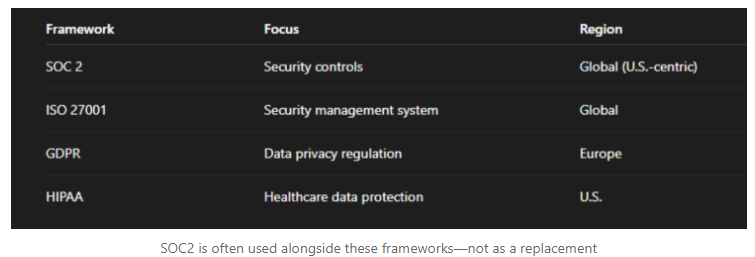
SOC 2 vs OTHER FRAMEWORKS
FINAL TAKEAWAY
SOC 2 is not just a compliance checkbox—it’s a business enabler.
It helps you:
- Build trust
- Win enterprise clients
- Strengthen security
- Scale with confidence
In a world where data breaches make headlines weekly, organizations that can prove trust—not just claim it—will always have the advantage.
About the Author
Satish Govindappa
Satish Govindappa is an Visionary technology leader with 15+ years of experience spearheading AI/ML transformations across complex enterprise environments. Proven ability to align AI initiatives with business goals, lead global cross-functional teams, and deliver scalable, cloud-native solutions using LLMs, predictive analytics, and anomaly detection. Skilled in building AI Centers of Excellence, developing architecture standards, and ensuring responsible AI adoption across the organization. Championed a multi-million dollar Generative AI program at Synopsys, leading the development and deployment of custom large language models (LLMs) to strengthen compliance, accelerate product innovation, and streamline critical operational workflows. Facilitated architectural design sessions with IT architects and engineering leaders to build scalable, cloud-native AI infrastructure, enabling smooth integration with Synopsys and ICE Mortgage Technology’s distributed enterprise systems. Orchestrated the creation of enterprise-wide AI architecture standards, standardizing the deployment of predictive analytics, real-time anomaly detection, and large language model (LLM) solutions across diverse business units. Directed cross-functional teams of global professionals, uniting IT, operations, and business units to drive successful adoption of Generative AI applications. Experienced Generative AI Security Architect with solid background in LLM security, AI threat modeling, and machine learning to protect AI systems from prompt injection, model poisoning, and data leakage. Proficient in Cloud AI security (AWS, Azure, GCP), MLOps security, and Zero-trust AI architectures. Securing AI applications for Fortune 500 enterprises, startups, and government agencies across the US, EU, and APAC. Committed to ensuring AI compliance (SOC 2, NIST AI RMF, GDPR, ISO 27001) and enterprise AI risk management Expert in securing Generative AI and Large Language Models (LLMs) against emerging threats such as prompt injection, model poisoning, and adversarial machine learning attacks. A J2EE Developer turned Application Security Professional with unique ability to understand both the worlds better (Development and Security). Working experience in top companies like Fidelity Investments, TD Ameritrade, DTCC, MindTree, Honeywell and AOL. Specialties: GenAI Security, LLM security, Threat Modeling, Secure Code Review, Web Penetration Testing, Server Audits, Security Training, Security Automation
View Satish Govindappa's profile