
 Bizradar
 Tanva
SOC 2 Readiness Checklist for CISOs: 15 Controls to Validate Before the Audit
A SOC 2 audit does not fail because a company lacks policies. It fails when security leaders cannot prove that controls work consistently in the environment the company actually operates.
For a CISO, SOC 2 readiness is therefore bigger than preparing documents for an auditor.
It is about answering five questions:
- Do we know what systems and data are in scope?
- Are the right security controls actually operating?
- Can we produce reliable evidence that they operated?
- Can we detect when those controls stop working?
- Can we demonstrate that customer data remains protected as the business changes?
That last question matters more in 2026 than it did a few years ago.
Cloud infrastructure changes continuously. SaaS integrations multiply. Developers deploy faster. AI systems are being introduced into production. Third-party vendors have privileged access to business systems.
A SOC 2 report can provide valuable assurance, but it cannot compensate for weak operational security.
The AICPA's SOC 2 framework evaluates controls against the Trust Services Criteria of Security, Availability, Processing Integrity, Confidentiality and Privacy, depending on the scope of the engagement. (AICPA)
For CISOs, the practical question is:
Are we audit-ready because our security program is working—or are we trying to become audit-ready by fixing everything at the last minute?
Why SOC 2 readiness has become a security issue—not just a compliance issue
Recent breach data makes the distinction important.
Verizon's 2026 Data Breach Investigations Report found that vulnerability exploitation accounted for 31% of breaches, becoming the leading initial access vector for the first time in the report's history. The same report found that breaches involving third parties increased by 60%, accounting for 48% of breaches. (Verizon)
The implications for a CISO are significant.
Your SOC 2 controls don't operate in a vacuum.
Your attack surface includes:
- cloud infrastructure
- identity providers
- SaaS applications
- APIs
- third-party integrations
- software dependencies
- developers and administrators
- AI applications
- customer data
- service accounts
- privileged identities
The 2025 Salesloft Drift incident is a useful example.
Attackers compromised credentials associated with the Drift application and used tokens to access connected systems. Salesforce subsequently disabled integrations with Salesloft technologies while investigating the incident.
Okta later described the incident as a reminder that a compromise of one SaaS provider can have ripple effects across interconnected enterprise systems.
For a CISO, that raises a critical SOC 2 question:
**Can your control environment identify, assess and manage the risk created by the third parties connected to your production environment? **
That's the level at which SOC 2 readiness should be evaluated.
The SOC 2 Readiness Checklist for CISOs
Use the following checklist before entering a SOC 2 examination.
1. Define exactly what is in scope
Before testing controls, determine what the SOC 2 system actually includes.
Your scope should account for:
- production applications
- cloud infrastructure
- databases
- APIs
- source-code repositories
- CI/CD pipelines
- identity providers
- employee endpoints where relevant
- logging and monitoring systems
- backup systems
- third-party services
- customer data
- support systems
- AI services connected to production systems
CISO question
**Could I draw our SOC 2 system boundary on one architecture diagram and explain every component? **
If the answer is no, you have a scope problem.
A poorly defined scope creates two risks.
Under-scoping can leave important systems outside the assurance boundary.
Over-scoping can create unnecessary controls, evidence requirements and audit workload.
Readiness test
Create a SOC 2 system inventory containing:
2. Validate access control—not just the policy
One of the easiest mistakes is having an excellent access-control policy while actual permissions tell a different story.
Review:
- MFA
- SSO
- privileged accounts
- service accounts
- dormant accounts
- terminated employees
- contractors
- administrator access
- emergency access
- API credentials
- OAuth applications
- access reviews
- least privilege
This is particularly important as organizations become increasingly dependent on SaaS and cloud identities.
The 2026 Verizon DBIR specifically highlighted insecure authentication, lack of MFA, improper credential rotation and excessive privileges as recurring contributors to cloud and third-party incidents. (Verizon)
CISO test
Don't ask:
"Do we have an access-control policy?"
Ask:
**"Show me every privileged identity that can access production today." **
Then ask:
**"Why does each one need that access?" **
That is a much more meaningful readiness test.
3. Test whether employee offboarding actually works
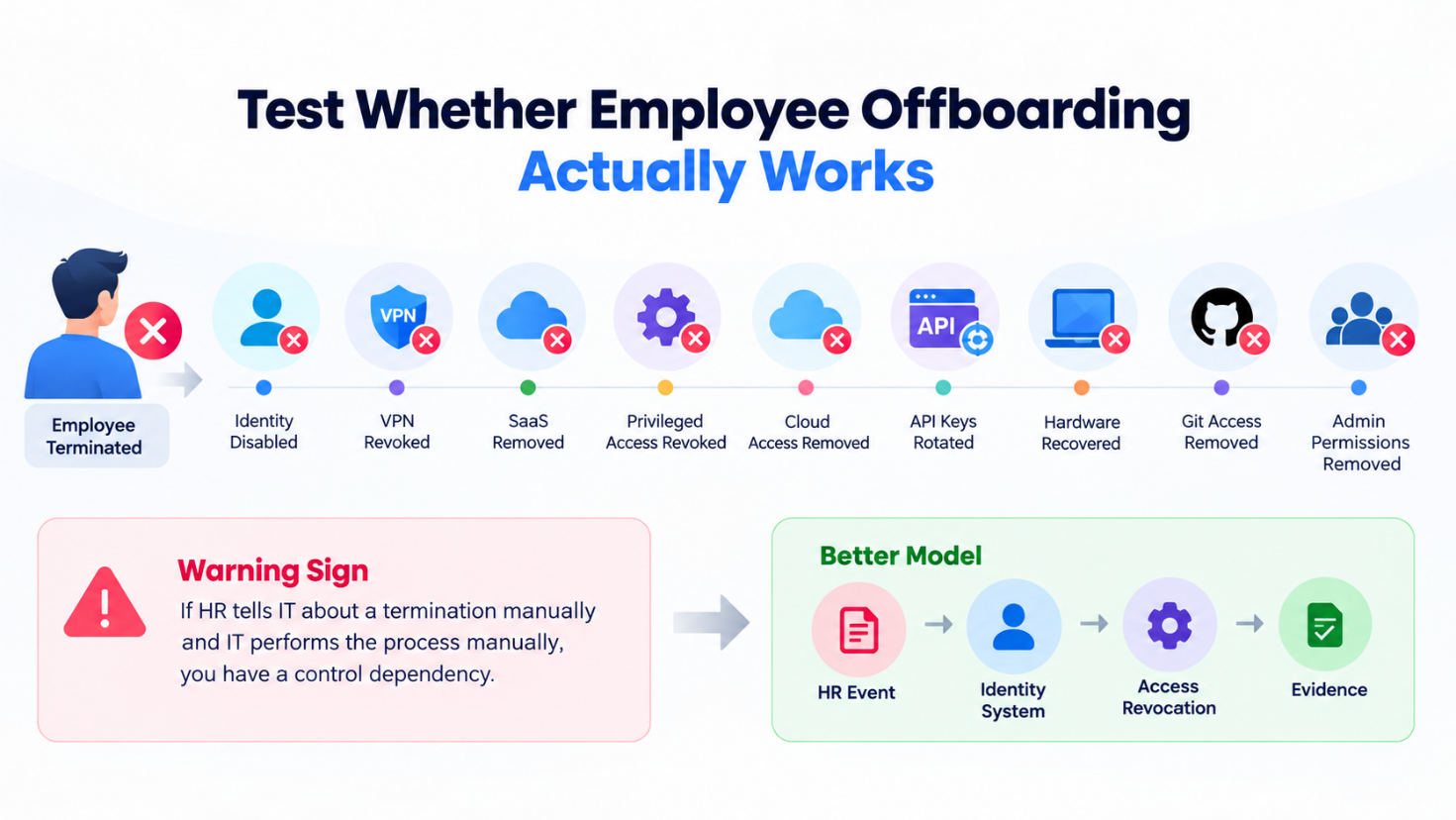
Employee lifecycle management is a classic SOC 2 control area.
But CISOs should test the process rather than simply documenting it.
Take a sample of recently terminated employees and verify:
- identity account disabled
- VPN access revoked
- SaaS access removed
- privileged credentials revoked
- cloud access removed
- API keys rotated where necessary
- hardware recovered
- GitHub/GitLab access removed
- administrative permissions removed
Warning sign
If HR tells IT about a termination manually and IT performs the process manually, you have a control dependency worth examining.
Better model
**HR event → identity system → access revocation → evidence **
The more automated this process is, the easier it becomes to demonstrate consistent operation.
4. Examine your change-management controls
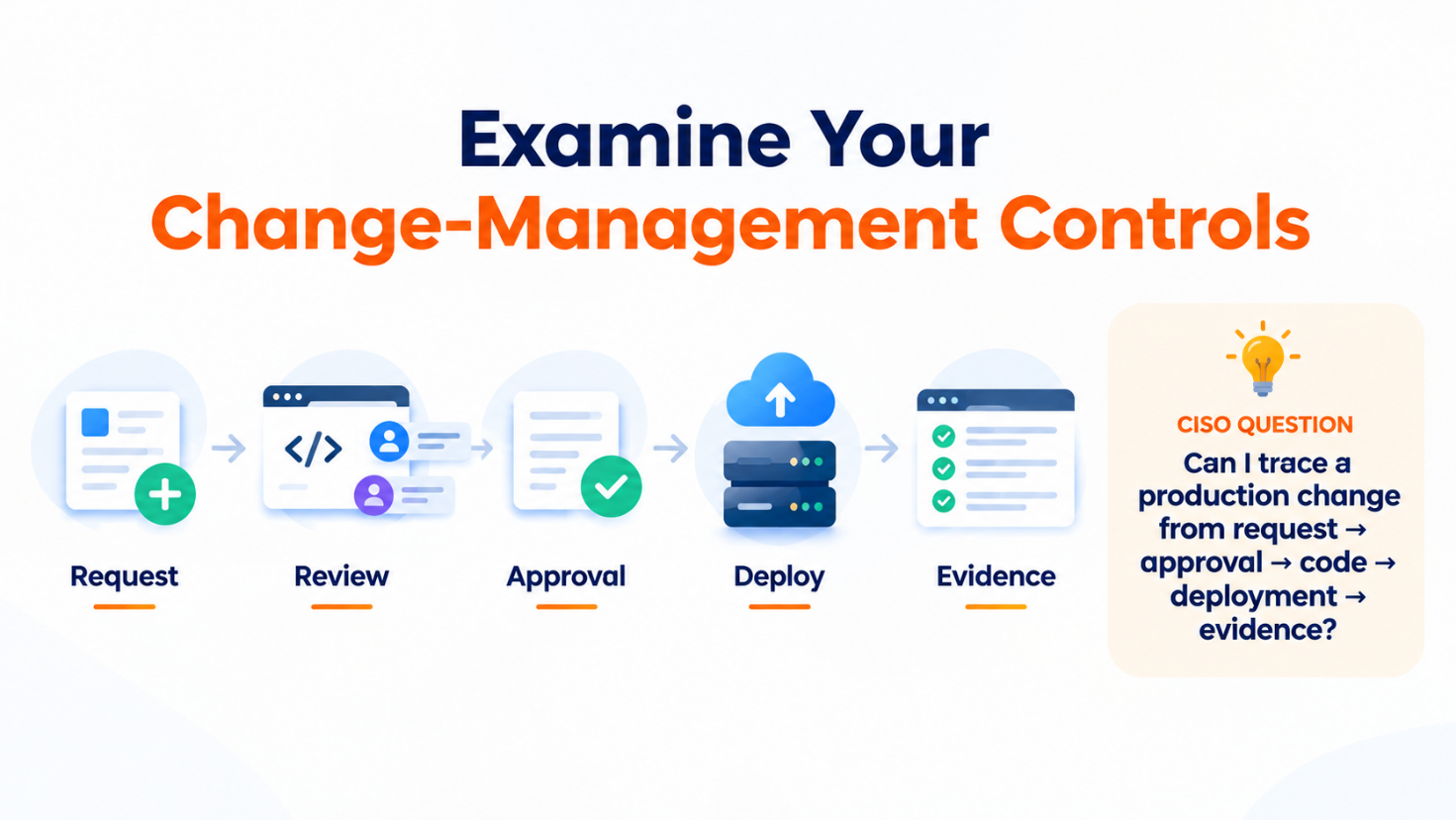
Fast-moving engineering organizations frequently struggle here.
A company can have:
- approved change-management policies
- GitHub
- Jira
- CI/CD
- code review
and still have unauthorized or poorly documented production changes.
Review:
- pull requests
- code reviews
- approval workflows
- production deployment permissions
- emergency changes
- rollback procedures
- separation of duties
- deployment logs
- infrastructure-as-code changes
CISO question
**Can I trace a production change from request → approval → code → deployment → evidence? **
If you cannot, your change-management control may look stronger on paper than it actually is.
5. Validate vulnerability management
This deserves special attention in 2026.
Verizon's latest DBIR found that vulnerability exploitation had become the leading breach entry point, at 31% of breaches. It also reported that AI is helping attackers accelerate exploitation from months to hours. (Verizon)
That makes vulnerability management an operational security issue—not simply an audit checkbox.
Your readiness review should examine:
- vulnerability scanning
- severity classification
- remediation SLAs
- internet-facing assets
- critical vulnerabilities
- cloud workloads
- containers
- dependencies
- application vulnerabilities
- exceptions
- compensating controls
- remediation evidence
Don't just ask:
"Do we scan for vulnerabilities?"
Ask:
**"Show me the critical vulnerabilities discovered last month, who owns them, why they remain open and whether the risk was accepted." **
That's a CISO-level SOC 2 conversation.
6. Test logging and monitoring
Your security team should be able to demonstrate that important events are monitored.
Review logging for:
- authentication
- privileged activity
- production changes
- administrative actions
- security events
- cloud infrastructure
- API activity
- database access
- suspicious behavior
Then ask:
**Who actually reviews these logs? **
And:
**What happens when something abnormal is detected? **
Logging without monitoring is not the same as effective security monitoring.
7. Test incident response before the auditor tests you
A SOC 2 incident-response program should not live inside a PDF.
Run a tabletop exercise.
For example:
Scenario
A privileged SaaS integration credential is compromised.
The attacker uses the credential to access customer information.
What happens?
Your team should be able to demonstrate:
- Detection
- Triage
- Containment
- Credential revocation
- Investigation
- Customer-impact assessment
- Internal escalation
- Legal/privacy review
- Customer notification decision
- Recovery
- Root-cause analysis
- Control improvement
The Salesloft Drift incident demonstrates why this scenario is no longer hypothetical. Salesforce reported unauthorized access risk involving the Drift application's connection to Salesforce and subsequently disabled the integration while remediation occurred. (Salesforce)
CISO readiness question
**If a critical SaaS integration were compromised tonight, could my team show exactly what to do without opening a policy document? **
If not, test the process before the audit.
8. Review third-party risk
This is becoming one of the most important SOC 2 readiness areas.
Your organization may have strong controls while depending on vendors that introduce significant risk.
Inventory:
- SaaS vendors
- cloud providers
- MSPs
- data processors
- payment providers
- AI providers
- security vendors
- development platforms
- customer-support platforms
- analytics platforms
For each critical vendor, determine:
- What data do they access?
- What systems do they connect to?
- What privileges do they have?
- Do they have SOC 2?
- Do they have ISO 27001?
- Do they disclose security incidents?
- How are they monitored?
- What happens when their security posture changes?
Verizon's 2026 DBIR found that third-party involvement had risen substantially, with third-party breaches accounting for 48% of breaches in its dataset. (Verizon)
CISO question
**If one of our critical SaaS vendors is compromised tomorrow, what customer data can the attacker reach? **
That's a much better vendor-risk question than:
"Does the vendor have SOC 2?"
9. Review data classification and protection
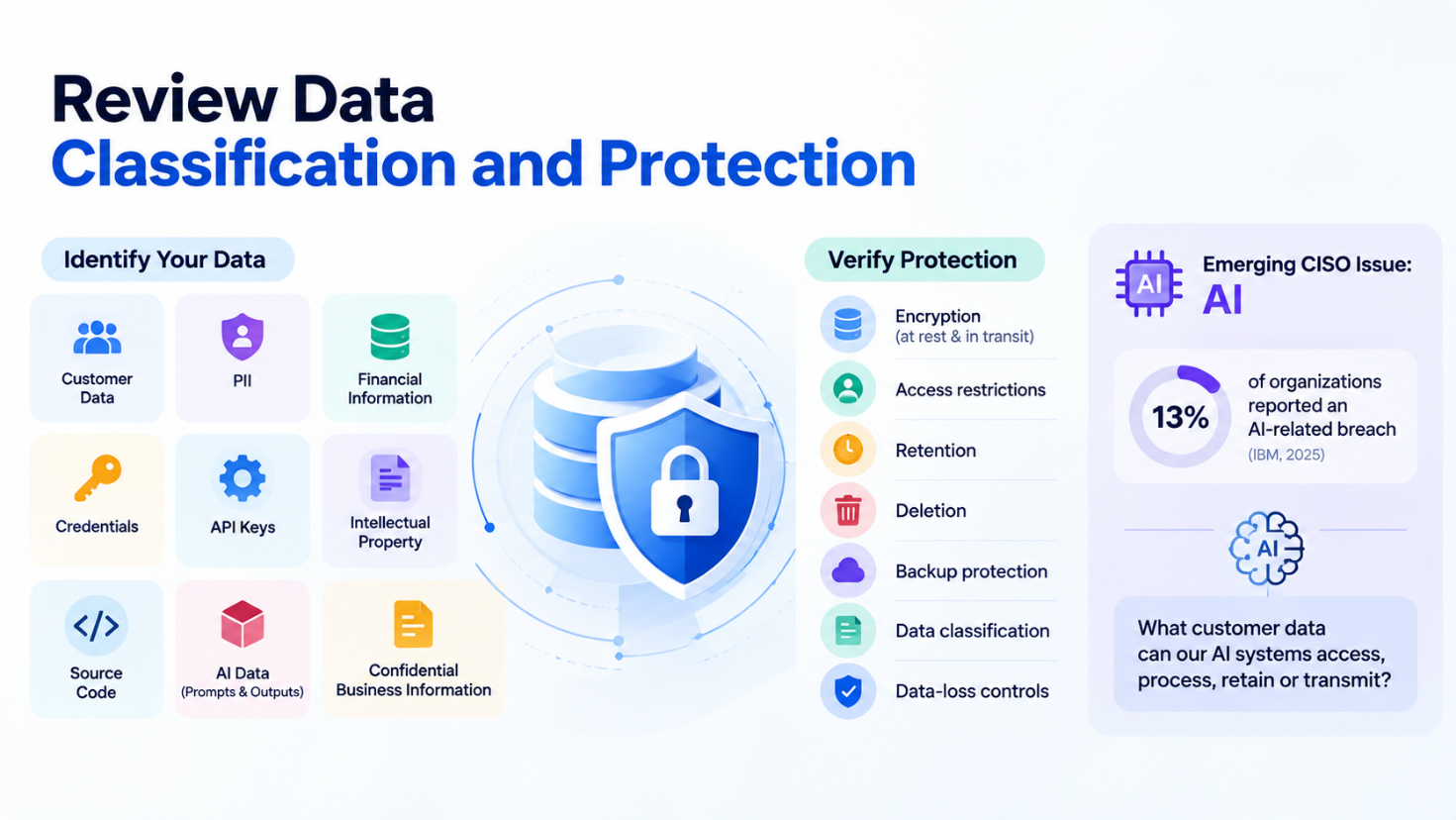
SOC 2 readiness should connect controls to the actual data your organization handles.
Identify:
- customer data
- PII
- financial information
- credentials
- API keys
- intellectual property
- source code
- proprietary models
- AI prompts
- AI outputs
- confidential business information
Then verify:
- encryption at rest
- encryption in transit
- access restrictions
- retention
- deletion
- backup protection
- data classification
- data-loss controls
Emerging CISO issue: AI
AI introduces another layer.
IBM's 2025 Cost of a Data Breach research found that 13% of organizations surveyed reported an AI-related breach, while 63% of breached organizations either lacked an AI governance policy or were still developing one. (IBM Newsroom)
For AI-enabled SaaS companies, SOC 2 readiness should therefore ask:
**What customer data can our AI systems access, process, retain or transmit? **
That question belongs in the security architecture—not just the AI policy.
10. Review backup and disaster recovery controls
Availability is one of the SOC 2 Trust Services Criteria when included in the engagement scope. (AICPA)
CISOs should validate:
- backup frequency
- backup integrity
- restoration testing
- recovery objectives
- geographic redundancy
- backup access controls
- ransomware protection
- disaster recovery procedures
- evidence of testing
- Don't accept:
"We have backups."
Ask:
"When was the last successful restoration test, and how long did recovery actually take?"
11. Test security awareness and phishing controls
Security awareness programs should be measurable.
Review:
- employee training
- onboarding training
- recurring training
- phishing simulations
- privileged-user training
- incident reporting
- training completion
- exceptions
This matters because human behavior remains a major component of enterprise risk.
The 2026 Verizon DBIR reported that mobile social-engineering attacks were succeeding at rates 40% higher than traditional email phishing in its analysis. (Verizon)
Your training program therefore shouldn't be frozen around yesterday's threat model.
12. Check policy-to-control alignment
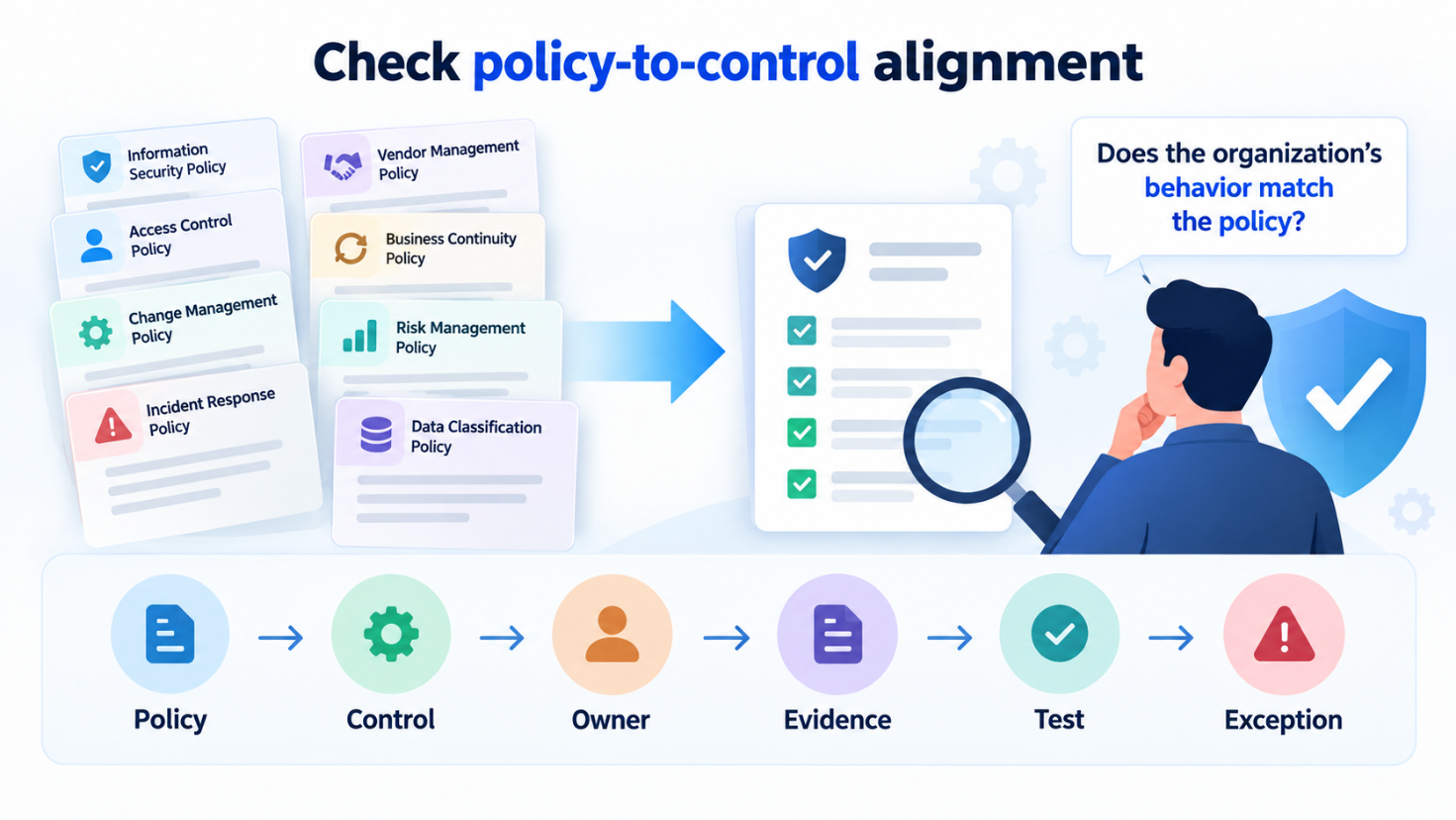
This is where many SOC 2 programs become overly documentation-heavy.
You may have:
- Information Security Policy
- Access Control Policy
- Change Management Policy
- Incident Response Policy
- Vendor Management Policy
- Business Continuity Policy
- Risk Management Policy
- Data Classification Policy
But the real question is:
**Does the organization's behavior match the policy? **
Create a simple mapping:
**Policy → Control → Owner → Evidence → Test → Exception **
If you cannot establish that chain, the control may not be operationalized sufficiently.
13. Build an evidence inventory before the auditor asks
Create an evidence matrix.
Example:
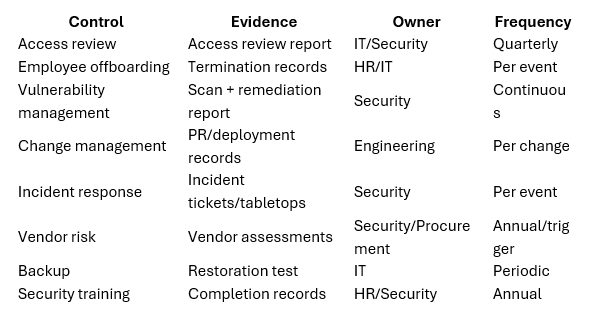
This changes the audit conversation from:
"We need to find evidence."
to:
**"The evidence already exists." **
That's where compliance starts becoming operational.
14. Identify control owners
Every important control should have an accountable owner.
Avoid:
"Security owns SOC 2."
SOC 2 typically crosses organizational boundaries.
Ownership may sit across:
- CISO
- CIO
- CTO
- Engineering
- IT
- HR
- Legal
- Procurement
- Privacy
- Finance
- Product
The CISO should own the security program and governance, but individual controls need operational ownership.
**Ask: **
**Who is accountable when this control fails? **
If nobody has a clear answer, fix the ownership model before the audit.
15. Establish continuous SOC 2 monitoring
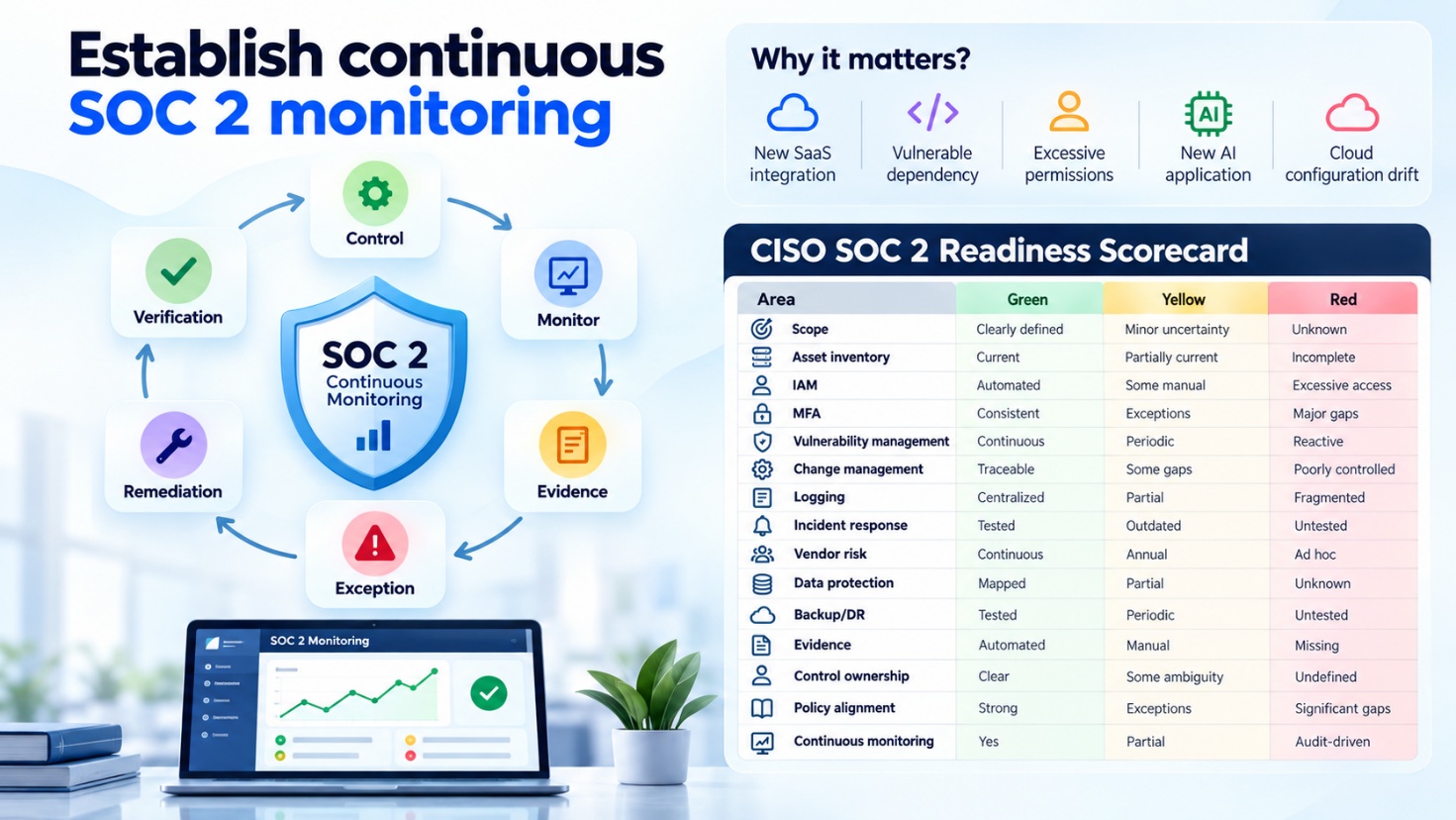
This is ultimately the biggest maturity test.
Don't treat SOC 2 as:
**Audit preparation → audit → certificate/report → forget about it. **
Instead:
**Control → continuous monitoring → evidence → exception → remediation → verification **
This matters because your environment can change immediately after the audit.
A new SaaS integration can introduce a privileged connection.
A developer can deploy a vulnerable dependency.
An employee can receive excessive permissions.
A new AI application can process sensitive data.
A cloud configuration can drift.
The SOC 2 report doesn't prevent those events.
Operational controls do.
The CISO SOC 2 Readiness Scorecard
Before starting an examination, rate each area:
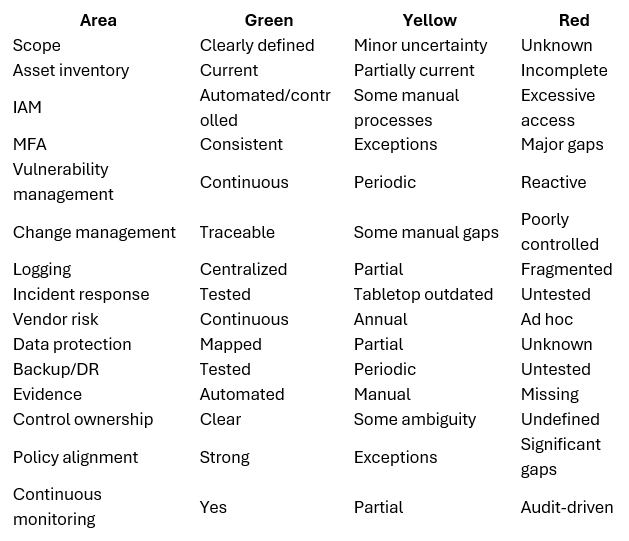
The goal isn't to make every box green overnight.
The goal is to identify the red controls that can create audit exceptions, customer risk or business disruption.
The 30-Day SOC 2 Readiness Plan for CISOs
If the audit is approaching, don't start by rewriting 30 policies.
Use a risk-based sequence.
Week 1 — Establish the baseline
- Confirm SOC 2 scope
- Inventory systems
- Map customer data
- Identify critical vendors
- Identify control owners
- Review existing policies
- Review prior audit findings
Week 2 — Test the controls
- IAM
- MFA
- privileged access
- vulnerability management
- change management
- logging
- incident response
- backups
- vendor management
Week 3 — Fix the gaps
Prioritize:
**Critical security risk → audit risk → evidence gap → documentation gap **
Don't reverse that order.
Week 4 — Validate
Run:
- evidence review
- control walkthroughs
- incident-response tabletop
- access review
- vulnerability review
- vendor-risk review
- management sign-off
Then ask:
**"If the auditor arrived tomorrow, what would we struggle to prove?" **
That question usually exposes the remaining work.
SOC 2 Readiness Is Not the Same as Being Secure
This distinction is important for CISOs.
A SOC 2 examination provides assurance over defined controls and criteria. It is not a universal certification that an organization is "secure."
The AICPA's Trust Services Criteria cover security and, when included, availability, processing integrity, confidentiality and privacy. (AICPA)
So a CISO should avoid treating:
SOC 2 = security
Instead:
**Security program → controls → evidence → independent examination → assurance **
SOC 2 becomes valuable when it reflects a functioning security program rather than a compliance project assembled for the audit.
The Business Case for Getting SOC 2 Right
There is a financial reason to take this seriously.
IBM's 2025 Cost of a Data Breach research put the **average U.S. breach cost at 4.44 million. It also found that organizations detecting breaches internally had, on average, $900,000 lower breach costs than organizations where attackers disclosed the breach. (IBM Newsroom)
Those numbers do not mean SOC 2 prevents breaches.
They do demonstrate why mature controls, monitoring and incident response matter.
And for SaaS companies, there's another business dimension:
**Enterprise customers increasingly expect evidence of security assurance before trusting a vendor with sensitive data. **
That makes SOC 2 part of the commercial infrastructure of a technology company—not simply an annual audit exercise.
SOC 2 Readiness Checklist for CISOs
Before you begin the audit, ask:
Governance
- Is the SOC 2 scope clearly documented?
- Are control owners assigned?
- Has management approved the security program?
- Are risks documented and tracked?
Identity
- Is MFA enforced?
- Are privileged accounts reviewed?
- Are terminated users removed promptly?
- Are service accounts controlled?
- Are access reviews documented?
Infrastructure
- Are cloud assets inventoried?
- Are vulnerabilities continuously monitored?
- Are critical vulnerabilities remediated within defined SLAs?
- Are production changes controlled?
- Are logs centralized and monitored?
Data
- Is sensitive data classified?
- Is data encrypted?
- Are retention requirements defined?
- Are backups protected?
- Are AI systems included in the data-flow assessment?
Third parties
- Are critical vendors assessed?
- Are vendor access privileges reviewed?
- Are vendor SOC reports reviewed?
- Are critical SaaS integrations monitored?
- Is fourth-party risk considered?
Incident response
- Is the incident-response plan current?
- Has it been tested?
- Are escalation paths defined?
- Are customer-notification procedures documented?
- Are lessons learned converted into control improvements?
Audit evidence
- Is evidence collected continuously?
- Does each control have an owner?
- Can evidence be traced to the control?
- Are exceptions documented?
- Can you demonstrate that controls operated throughout the examination period?
The CISO's Real SOC 2 Readiness Test
Forget the question:
**"Do we have all our SOC 2 documents?" **
Ask these instead:
**Can we prove who has access to production? **
**Can we prove that critical vulnerabilities are being remediated? **
**Can we prove production changes are authorized? **
**Can we prove our vendors aren't creating unmanaged risk? **
**Can we prove customer data is protected? **
**Can we prove our incident-response process works? **
**Can we produce evidence without disrupting the security and engineering teams? **
**Can we detect when a control stops working? **
If the answer to those questions is yes, you're much closer to genuine SOC 2 readiness.
If the answer is no, adding another policy document probably isn't the solution.
The solution is operationalizing the control.
What CISOs Should Do Next
For organizations preparing for SOC 2, the most useful first step isn't booking the audit.
It's establishing a readiness baseline.
Indrasol can help organizations assess their current security controls, identify readiness gaps, prioritize remediation and build an evidence-ready SOC 2 program around the systems and risks that actually matter.
**Assess your SOC 2 readiness before the auditor does. **
Indrasol SOC 2 Compliance
SEO / AEO targeting
Primary keyword: SOC 2 readiness checklist for CISOs
**Secondary keywords: **
SOC 2 readiness assessment, SOC 2 compliance checklist, SOC 2 audit preparation, SOC 2 gap assessment, SOC 2 Type II readiness, SOC 2 controls checklist, SOC 2 evidence collection, SOC 2 compliance for SaaS, SOC 2 security controls, SOC 2 readiness for startups, SOC 2 compliance automation, SOC 2 audit checklist
**Suggested title tag: **
**SOC 2 Readiness Checklist for CISOs: 15 Controls to Validate **
**Suggested meta description: **
**A practical SOC 2 readiness checklist for CISOs covering IAM, cloud security, vulnerabilities, evidence, vendors, incident response, AI risk and continuous compliance. **
**Suggested URL: **
/blog/soc-2-readiness-checklist-for-cisos
**AEO question targets: **
- What is a SOC 2 readiness checklist?
- How do CISOs prepare for a SOC 2 audit?
- What controls should be checked before a SOC 2 audit?
- How do you assess SOC 2 readiness?
- What evidence is needed for SOC 2?
- How long does SOC 2 readiness take?
- What are the biggest SOC 2 readiness gaps?
- What should a CISO review before SOC 2 Type II?
The article is deliberately structured so that the questions, direct answers, checklists, tables and CISO decision points can be extracted cleanly by Google AI Overviews and AI assistants, while the commercial sections create a natural path toward a SOC 2 readiness assessment.
About the Author
Brahma Guptha Illindra
Brahma Gupta is a technology entrepreneur, enterprise technology leader, and Founder & CEO of Indrasol, helping organizations adopt AI, cloud, data, and cybersecurity technologies securely, compliantly, and at scale. Over the years, he has worked across enterprise architecture, data engineering, analytics, cloud technologies, Oracle EPM, and business transformation. Today, his focus is increasingly on one of the biggest challenges facing enterprises: how to adopt AI at scale without losing visibility, security, governance, or control. At Indrasol, he and his team help organizations bridge the gap between technology innovation and business risk across: • AI Security & AI-SPM (AI Security Posture Management) • AI Governance & Responsible AI • Cloud Security & CSPM (Cloud Security Posture Management) • Cybersecurity & Risk Management • SOC 2, ISO 27001, ISO 42001 & CMMC compliance • Cloud modernization & DevOps • Data, analytics & AI transformation • Enterprise technology & automation Brahma is particularly interested in the emerging security challenges created by Generative AI, AI agents, Shadow AI, AI identities, model risk, data exposure, AI governance, and autonomous AI systems. His perspective is simple: AI adoption should create business advantage—not introduce unmanaged risk. He also believes security and compliance should be more than check-the-box exercises. Done correctly, they can help organizations win enterprise customers, accelerate sales cycles, strengthen trust, reduce risk, and scale technology with confidence. Brahma regularly writes about AI security, AI-SPM, cloud security, cybersecurity, AI governance, SOC 2, ISO 27001, ISO 42001, CSPM, enterprise AI adoption, and technology strategy. He enjoys connecting with CISOs, CIOs, CTOs, founders, technology leaders, security professionals, and enterprise teams building the next generation of secure AI and cloud-powered businesses. If you’re working on AI security, cloud security, enterprise AI adoption, cybersecurity, compliance, or digital transformation, connect with Brahma.
View Brahma Guptha Illindra's profile