
 Bizradar
 Tanva
What Is Cloud Exposure Management?
Summary
Cloud exposure management helps organizations identify cloud resources that may be accessible to attackers, understand how security weaknesses connect, and prioritize risks based on their potential business impact. Learn how cloud exposure management works, how it differs from CSPM, and how security teams can use it to reduce their cloud attack surface.
Understanding Cloud Exposure Management
Cloud exposure management is a security approach that helps organizations discover potentially exposed cloud assets, evaluate the weaknesses affecting them, and prioritize the risks that matter most. It considers how cloud resources, identities, network access, applications, and sensitive data relate to one another.
A cloud environment can contain thousands of resources across accounts, subscriptions, projects, and regions. Reviewing each security finding independently may not reveal how several weaknesses could combine to create a path toward a critical system or sensitive information.
Cloud exposure management helps connect these findings into a broader view of risk. Instead of focusing only on the number of alerts, security teams can investigate which assets are reachable, what access is available, and which potential attack paths deserve attention first.
Why Cloud Exposure Management Matters
Cloud environments change frequently as organizations deploy applications, create new resources, expand access, and adopt additional services. These changes can introduce new exposure points that are difficult to track using periodic reviews alone.
Several challenges make cloud exposure management important:
- Growing cloud attack surfaces: New resources, public endpoints, APIs, and cloud services can create additional entry points.
- Disconnected security findings: Configuration, identity, vulnerability, and data security tools may report risks separately.
- Limited remediation capacity: Security teams cannot investigate every finding at the same time.
- Complex access relationships: A resource that appears isolated may be reachable through another resource or identity.
- Changing business priorities: A weakness affecting a critical business application may deserve faster attention than a similar finding on a low-impact test resource.
Cloud exposure management helps teams connect technical findings with the context needed to make better remediation decisions.
What Creates Cloud Exposure?
Cloud exposure does not always mean that a resource is publicly accessible. Exposure depends on how a resource can be reached, who or what can access it, and the security controls protecting it.
Internet-Accessible Resources
Public endpoints, exposed administrative interfaces, and externally reachable services can increase the opportunities available to attackers. Teams should understand which resources need public access and whether the associated protections are appropriate.
Excessive Identity Permissions
Users, applications, and service accounts may have permissions that extend beyond their operational needs. If an identity is compromised, those permissions could allow access to additional cloud resources.
Vulnerable or Poorly Protected Workloads
Applications, virtual machines, containers, and other workloads may contain weaknesses that become more significant when combined with network reachability or excessive permissions.
Sensitive Data with Broad Access
Cloud databases, storage services, and data platforms may contain sensitive information. Exposure risk increases when access paths are broader than necessary or when protective controls do not match the sensitivity of the data.
Connected Weaknesses Across Resources
Individual findings can become more serious when they form a chain. For example, an externally reachable application, a compromised service identity, and access to a sensitive database could create a potential path to valuable information.
Understanding these relationships is a key part of evaluating cloud exposure.
How Cloud Exposure Management Works
An effective cloud exposure management process connects asset visibility, security findings, risk analysis, and remediation into a repeatable workflow.
1. Discover Cloud Assets
Start by identifying the cloud resources within scope, including virtual machines, storage services, databases, applications, identities, and network components.
Maintain an inventory that records resource ownership, environment, business purpose, and sensitivity where possible. An incomplete inventory can leave security teams unaware of resources that need assessment.
2. Collect and Correlate Security Findings
Gather relevant findings from cloud security tools, vulnerability scanners, identity systems, and asset inventories. Correlating these signals helps teams understand how different weaknesses may affect the same resource or connected environment.
The objective is not simply to collect more alerts. It is to build a more useful picture of how exposure develops across the cloud environment.
3. Analyze Reachability and Attack Paths
Evaluate whether an attacker could potentially reach a resource through the available network connections, permissions, and security weaknesses.
For example, a public-facing application might have access to a cloud identity with permissions to read a database. An exposure analysis can help determine whether those relationships create a meaningful risk and what safeguards limit the potential impact.
These paths should be validated against the actual environment rather than assumed to be exploitable based on isolated findings.
4. Prioritize Risks by Context
Risk prioritization should consider more than a finding's severity rating. Useful factors include:
- Internet accessibility and reachability.
- Exploitability and the presence of known weaknesses.
- Sensitivity and business value of affected data.
- Privileges available to relevant identities.
- Criticality of the affected application or service.
- Existing controls and the potential impact of compromise.
This approach helps teams distinguish urgent exposure from findings that require monitoring, additional investigation, or lower-priority remediation.
5. Remediate and Validate
Assign remediation tasks to the appropriate cloud, platform, application, or security owners. Corrective actions may include restricting access, removing unnecessary permissions, patching affected workloads, or changing network controls.
After making a change, verify that the exposure has been reduced and that the intended business functionality remains available. Record exceptions and reassess them when the environment or business requirements change.
6. Monitor Exposure Continuously
Cloud environments evolve, so exposure management should continue after the initial assessment. Changes to assets, permissions, network paths, and application deployments may introduce new risks or change the priority of existing findings.
Continuous monitoring helps teams identify meaningful changes and reassess remediation priorities as the environment develops.
Cloud Exposure Management vs. CSPM
Cloud Exposure Management and Cloud Security Posture Management (CSPM) are closely related, but they emphasize different aspects of cloud security.
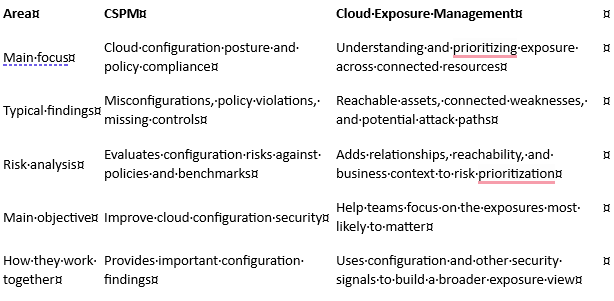
CSPM can identify a cloud resource that violates a security policy. Exposure management can help determine whether that resource is reachable, what other weaknesses connect to it, and whether it creates a path to a critical asset.
The approaches are complementary rather than mutually exclusive. The capabilities available depend on the tools, integrations, and data sources an organization uses.
To explore the underlying cloud security capabilities, visit Indrasol's Cloud Security Posture Management services.
Best Practices for Managing Cloud Exposure
Establish Clear Asset Ownership
Assign owners to cloud resources and critical applications. Clear ownership makes it easier to investigate findings, approve changes, and track remediation to completion.
Connect Security Findings with Business Context
Use resource criticality, data sensitivity, access relationships, and business purpose to determine which findings deserve the most attention. A technically severe finding does not always represent the highest business risk.
Reduce Unnecessary Access
Review public endpoints, network rules, identity permissions, and access to sensitive resources. Restrict access according to business requirements and regularly reassess privileged identities.
Integrate Security into Cloud Development
Include appropriate security validation in infrastructure-as-code reviews and deployment pipelines. Detecting risky changes before deployment can reduce the number of new exposures introduced into production.
Define Remediation Priorities and SLAs
Set clear remediation expectations based on risk, severity, exposure, and business impact. Track progress and escalate important findings that remain unresolved beyond their agreed deadlines.
Measure Progress Over Time
Track useful indicators such as high-risk exposures, time to remediate, recurring findings, overdue actions, and exposure affecting critical assets. Trends can help teams identify whether their security processes are improving.
For support with secure cloud architecture, automation, and cloud security practices, explore Indrasol's Cloud Engineering & Security services.
Cloud Exposure Management Checklist
Use this checklist as a starting point for reviewing your exposure management process.
- Maintain an inventory of cloud resources and their owners.
- Identify externally accessible assets and required access paths.
- Review identity permissions and privileged access.
- Identify sensitive data and the resources that can access it.
- Correlate relevant configuration, vulnerability, and identity findings.
- Assess potential attack paths and validate important relationships.
- Prioritize findings based on reachability and business impact.
- Assign remediation owners and target dates.
- Validate fixes and document approved exceptions.
- Monitor changes and track exposure trends over time.
Review this checklist regularly and adapt it to your cloud architecture, security requirements, and available tooling.
Cloud Exposure Management FAQs
What is cloud exposure management in cybersecurity?
Cloud exposure management is an approach to identifying, analyzing, and prioritizing risks associated with exposed cloud assets. It connects relevant security findings and resource relationships to help teams understand which potential exposures require attention.
Is cloud exposure management the same as attack surface management?
They are related but not identical in every implementation. Attack surface management generally focuses on discovering and assessing assets that may be exposed to attackers. Cloud exposure management focuses specifically on cloud environments and may also correlate identity permissions, vulnerabilities, sensitive data, and attack paths.
How does cloud exposure management help reduce risk?
It helps security teams identify important exposure points, understand how weaknesses may connect, and direct remediation toward resources with greater potential business impact. Its effectiveness depends on asset coverage, accurate context, and timely remediation.
Can CSPM tools support cloud exposure management?
Yes. CSPM tools provide valuable information about cloud configurations, policy violations, and other posture risks. Depending on their capabilities and integrations, they may support broader exposure analysis or work alongside dedicated exposure management solutions.
Which organizations need cloud exposure management?
It can be useful for organizations operating complex cloud environments, multiple cloud accounts, sensitive workloads, or business-critical applications. It is particularly relevant when security teams struggle to correlate findings or decide which cloud risks to remediate first.
What metrics should organizations track?
Useful metrics include the number of high-priority exposures, time to remediate, recurring issues, unresolved attack paths, and risks affecting critical assets. Metrics should reflect actual risk reduction rather than simply the number of alerts closed.
About the Author
Brahma Guptha Illindra
Brahma Gupta is a technology entrepreneur, enterprise technology leader, and Founder & CEO of Indrasol, helping organizations adopt AI, cloud, data, and cybersecurity technologies securely, compliantly, and at scale. Over the years, he has worked across enterprise architecture, data engineering, analytics, cloud technologies, Oracle EPM, and business transformation. Today, his focus is increasingly on one of the biggest challenges facing enterprises: how to adopt AI at scale without losing visibility, security, governance, or control. At Indrasol, he and his team help organizations bridge the gap between technology innovation and business risk across: • AI Security & AI-SPM (AI Security Posture Management) • AI Governance & Responsible AI • Cloud Security & CSPM (Cloud Security Posture Management) • Cybersecurity & Risk Management • SOC 2, ISO 27001, ISO 42001 & CMMC compliance • Cloud modernization & DevOps • Data, analytics & AI transformation • Enterprise technology & automation Brahma is particularly interested in the emerging security challenges created by Generative AI, AI agents, Shadow AI, AI identities, model risk, data exposure, AI governance, and autonomous AI systems. His perspective is simple: AI adoption should create business advantage—not introduce unmanaged risk. He also believes security and compliance should be more than check-the-box exercises. Done correctly, they can help organizations win enterprise customers, accelerate sales cycles, strengthen trust, reduce risk, and scale technology with confidence. Brahma regularly writes about AI security, AI-SPM, cloud security, cybersecurity, AI governance, SOC 2, ISO 27001, ISO 42001, CSPM, enterprise AI adoption, and technology strategy. He enjoys connecting with CISOs, CIOs, CTOs, founders, technology leaders, security professionals, and enterprise teams building the next generation of secure AI and cloud-powered businesses. If you’re working on AI security, cloud security, enterprise AI adoption, cybersecurity, compliance, or digital transformation, connect with Brahma.
View Brahma Guptha Illindra's profile