
Cloud Misconfiguration: Risks and Prevention
Summary
Cloud misconfigurations occur when cloud resources are configured in ways that weaken security or violate organizational policies. Learn about common causes, potential business risks, and practical prevention strategies that help organizations secure cloud environments and reduce exposure.
Cloud infrastructure enables organizations to deploy applications, store data, and scale services quickly. However, as cloud environments grow and change, configuration mistakes can expose sensitive information, create unnecessary access, and weaken security controls.
A single overly permissive storage setting, an exposed management interface, or an incorrectly configured identity permission can create a security weakness. Cloud misconfiguration prevention therefore requires clear security policies, continuous monitoring, and a reliable process for identifying and correcting risky settings.
What Is a Cloud Misconfiguration?
A cloud misconfiguration occurs when a cloud resource, service, identity, or security control is configured in a way that introduces unnecessary risk or fails to meet an intended security requirement.
These issues can affect cloud storage, databases, virtual machines, network controls, identity and access management (IAM), encryption, and logging. They may result from human error, inconsistent deployment practices, incomplete security reviews, or changes made without sufficient validation.
Common examples include:
- Storage resources that allow unintended public access.
- Network security rules that expose services unnecessarily.
- IAM roles with excessive permissions.
- Databases without required encryption.
- Logging and monitoring controls that are disabled or incomplete.
- Cloud resources that drift away from approved security configurations.
Not every configuration difference is a vulnerability. The risk depends on the resource, its exposure, the data it handles, and the permissions or controls surrounding it.
Why Cloud Misconfigurations Happen
Understanding the causes of cloud misconfigurations helps organizations prevent recurring problems instead of fixing individual findings repeatedly.
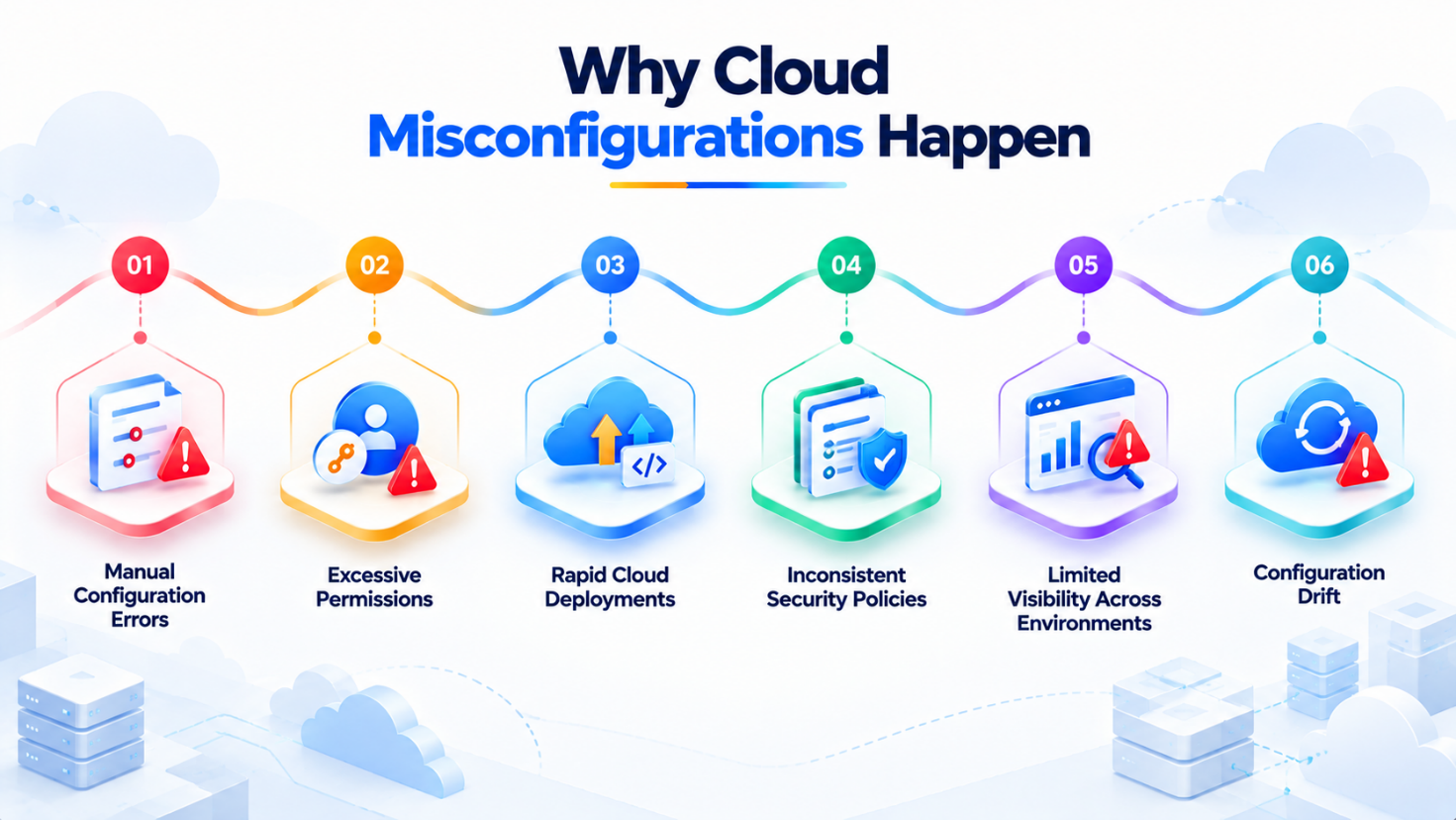
Manual Configuration Errors
Cloud teams often manage numerous resources, permissions, and security settings. A missed setting, incorrect access rule, or overlooked deployment option can introduce an unintended exposure.
These mistakes become harder to detect when teams manage multiple environments or rely on inconsistent manual procedures.
Excessive Permissions and Weak Access Controls
Users, applications, and service accounts may receive broader permissions than their responsibilities require. Overly permissive roles can increase the potential impact of compromised credentials or unintended access.
Clear role definitions, least-privilege access, and regular permission reviews help reduce this risk.
Rapid Cloud Deployments
Development teams frequently create and update cloud resources to support new applications and business requirements. When security checks are not integrated into deployment workflows, insecure configurations can reach production environments.
Embedding security policies into infrastructure-as-code and CI/CD processes helps detect configuration issues earlier.
Inconsistent Security Policies
Different teams may use different configuration standards across cloud accounts, subscriptions, projects, and regions. This inconsistency makes it difficult to maintain a common security baseline.
Organizations need documented configuration requirements and repeatable processes that apply across their cloud environments.
Limited Visibility Across Cloud Environments
Organizations using multiple cloud providers may rely on separate dashboards and native security tools. This can create gaps in visibility and make it harder to identify risks consistently.
Centralized asset inventory and Cloud Security Posture Management (CSPM) can help teams assess configurations across supported environments.
Configuration Drift
A resource may initially meet security requirements but become less secure after a manual change, deployment, or policy update. This gradual deviation from an approved configuration is known as configuration drift.
Continuous monitoring and automated configuration checks can help identify drift before it creates a significant exposure.
Common Cloud Misconfigurations to Watch For
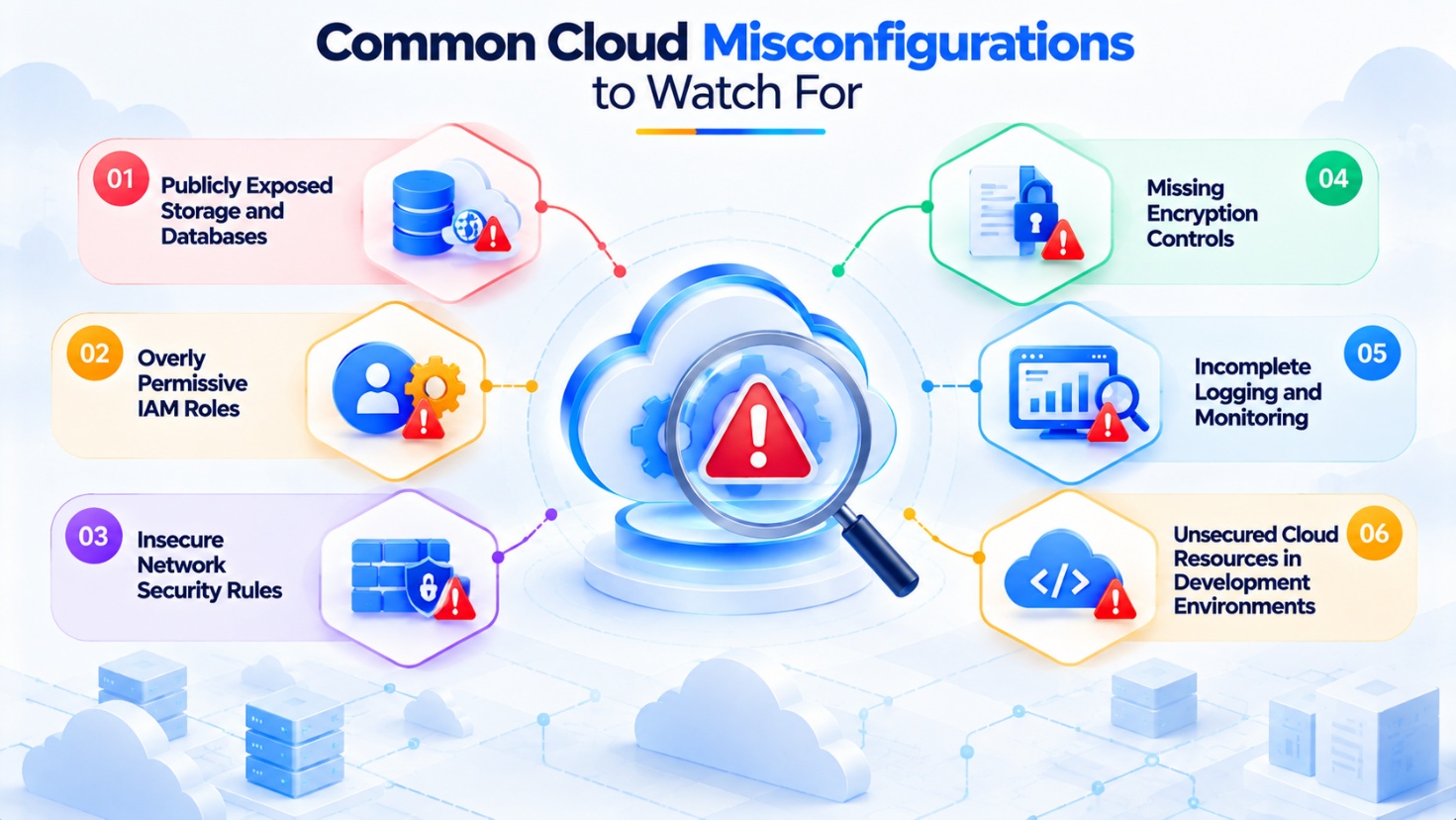
Identifying recurring configuration weaknesses helps security teams establish practical checks and prevention measures.
Publicly Exposed Storage and Databases
Storage services and databases may be configured to allow access beyond the intended users or applications. If sensitive data is involved, unintended exposure can create confidentiality, privacy, and compliance risks.
Organizations should review public access settings, resource policies, network restrictions, and permissions. Public access should be permitted only when there is a documented business requirement and suitable safeguards.
Overly Permissive IAM Roles
IAM permissions determine which users, applications, and services can access cloud resources and perform actions. Broad permissions can allow identities to make changes or access data beyond what they need.
Security teams should apply least privilege, review privileged roles, remove unused permissions, and monitor changes to identity policies.
Insecure Network Security Rules
Incorrect security group, firewall, or network access control settings can expose services to unintended sources. Management interfaces and administrative services require particular attention.
Teams should restrict inbound and outbound traffic according to application requirements, remove unnecessary rules, and regularly review externally accessible resources.
Missing Encryption Controls
Cloud resources may lack required encryption for stored data, backups, or communications. The impact depends on the data involved, the access controls in place, and the organization's security requirements.
Organizations should establish encryption standards, review key management settings, and verify that relevant services enforce the intended protections.
Incomplete Logging and Monitoring
Disabled logging, missing audit events, or incomplete monitoring can delay the detection and investigation of suspicious activity. These gaps may also make it harder to demonstrate that security controls are operating as intended.
Teams should enable appropriate logging, protect log integrity, define retention requirements, and regularly test monitoring coverage.
Unsecured Cloud Resources in Development Environments
Development and testing environments may contain outdated resources, temporary access rules, or configurations that are less restrictive than production requirements.
Organizations should apply appropriate baseline controls across environments, remove unused resources, and ensure temporary exceptions have owners and expiration dates.
What Are the Risks of Cloud Misconfigurations?
Cloud misconfigurations can affect data security, operational reliability, compliance, and business continuity. The actual impact depends on whether the weakness is exposed, exploitable, and connected to valuable resources.
Data Exposure and Unauthorized Access
Incorrect access controls can make sensitive information available to unintended users. Depending on the resource and its contents, this may expose customer information, business documents, credentials, or other confidential data.
Increased Attack Surface
Exposed services, excessive permissions, and weak network controls can give attackers additional opportunities to access cloud resources. When several weaknesses are connected, the overall risk may be greater than that of an individual finding.
Compliance and Audit Challenges
Misconfigurations may indicate that technical controls are not operating according to organizational policies or applicable requirements. This can lead to additional investigation, remediation work, and challenges when preparing audit evidence.
CSPM can support visibility into relevant technical controls, but it does not independently establish compliance with frameworks such as SOC 2 or ISO 27001.
Operational Disruption
Incorrect security changes or unauthorized access can disrupt applications, services, or business operations. Remediation itself can also cause disruption if changes are made without adequate testing or change management.
Financial and Reputational Impact
A security incident may create investigation costs, recovery expenses, contractual complications, and loss of customer trust. The impact varies by incident severity, the data involved, and the organization's response.
How to Prevent Cloud Misconfigurations
Preventing cloud misconfigurations requires a combination of secure design, consistent policies, automation, and ongoing validation.
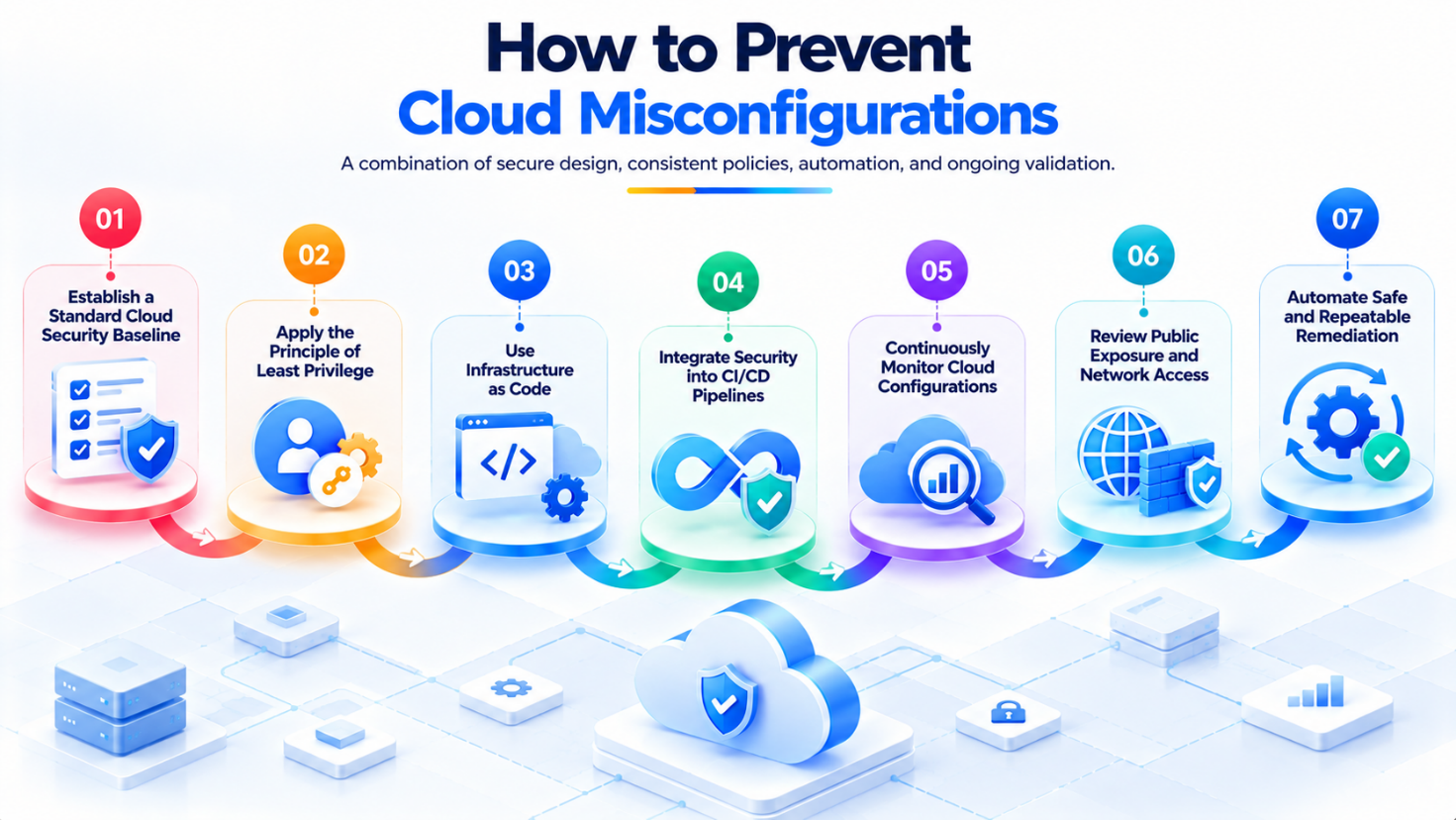
Establish a Standard Cloud Security Baseline
Define the minimum security requirements that cloud resources must meet. The baseline should reflect the organization's architecture, risk tolerance, data sensitivity, and compliance obligations.
Include requirements for:
- Identity and access permissions.
- Network exposure and segmentation.
- Encryption and key management.
- Logging and monitoring.
- Public access restrictions.
- Resource tagging and ownership.
- Approved exceptions and review schedules.
Use consistent policies across accounts, subscriptions, projects, and environments wherever appropriate.
Apply the Principle of Least Privilege
Grant users and applications only the permissions required for their responsibilities. Review privileged access regularly and remove permissions that are no longer needed.
Use role-based access, strong authentication, and appropriate controls for administrative accounts. Review service identities as well as human users.
Use Infrastructure as Code
Infrastructure as code (IaC) allows teams to define cloud infrastructure through version-controlled templates and configuration files. This makes changes easier to review, test, and reproduce.
Organizations can use policy checks and automated validation to detect insecure configurations before deployment. Approved templates also help teams create resources that follow established security standards.
Integrate Security into CI/CD Pipelines
Cloud security checks should be part of the development and deployment process rather than an activity performed only after resources are created.
Where supported, integrate configuration scanning, policy enforcement, and approval controls into CI/CD pipelines. Define how teams handle high-risk findings and documented exceptions before deployment.
Continuously Monitor Cloud Configurations
Cloud resources can change at any time. Periodic reviews alone may not identify configuration drift or newly exposed resources quickly enough for dynamic environments.
Continuous cloud posture monitoring helps detect policy violations and risky configuration changes. Teams should define alert ownership, review frequency, escalation procedures, and remediation expectations.
Review Public Exposure and Network Access
Maintain visibility into externally accessible resources and regularly review network rules. Restrict administrative services and sensitive resources to approved access paths.
When public access is necessary, document the requirement and apply appropriate safeguards. Reassess the configuration when the business need changes.
Automate Safe and Repeatable Remediation
Automation can reduce the time needed to correct recurring configuration issues. For example, an approved workflow may remove an unnecessary public access setting or create a remediation ticket when a policy violation is detected.
Automated changes should be tested, logged, and protected by appropriate approvals. High-impact fixes should follow the organization's change-management process.
How CSPM Helps Detect Cloud Misconfigurations
Cloud Security Posture Management (CSPM) helps organizations identify, assess, and prioritize configuration risks across cloud infrastructure.
CSPM tools evaluate supported cloud resources against security policies, benchmarks, and organizational requirements. They can flag issues such as public storage access, excessive permissions, insecure network rules, and missing security settings.
Depending on the platform and integrations, CSPM can support:
- Asset discovery: Identifying cloud resources across connected environments.
- Configuration assessment: Evaluating resources against defined policies.
- Risk prioritization: Helping teams focus on findings with greater potential impact.
- Continuous monitoring: Detecting configuration changes and policy violations.
- Remediation tracking: Assigning corrective actions and checking whether findings have been resolved.
- Compliance visibility: Mapping selected technical findings to relevant security controls.
CSPM is most useful when findings lead to clear action. Security teams should validate risks, assign ownership, track remediation, and confirm that the underlying configuration has been corrected.
Learn more about Indr asol's Cloud Security Posture Management services to explore approaches to cloud posture assessment, risk prioritization, and ongoing monitoring.
Cloud Misconfiguration Prevention Checklist
Use this checklist as a starting point for reviewing cloud security configurations. Adapt it to your cloud providers, resource types, and organizational requirements.
- Maintain an inventory of cloud accounts and resources.
- Review public access settings for storage, databases, and other sensitive services.
- Apply least-privilege permissions to users, roles, and service identities.
- Review network security rules and externally accessible services.
- Enforce required encryption and key management controls.
- Enable appropriate audit logging and monitoring.
- Scan infrastructure-as-code templates before deployment.
- Monitor configuration drift and policy violations.
- Assign owners and remediation deadlines to important findings.
- Reassess resources after fixes to verify that issues are resolved.
- Review exceptions and remove them when they are no longer needed.
- Track recurring misconfigurations and address their underlying causes.
Regularly reviewing these controls helps organizations maintain a more consistent security posture as cloud environments evolve.
Cloud Misconfiguration FAQs
What is an example of a cloud misconfiguration?
A common example is a storage resource configured to allow public access when the data is intended to remain private. Other examples include overly permissive IAM roles, insecure network rules, missing encryption, and incomplete logging.
What causes cloud misconfigurations?
Common causes include manual errors, excessive permissions, inconsistent security policies, rapid deployments, limited visibility, and configuration drift. Weak deployment controls can allow these issues to reach production environments.
How can organizations detect cloud misconfigurations?
Organizations can use cloud-native security tools, configuration assessments, infrastructure-as-code scanning, policy checks, and CSPM solutions. Continuous monitoring helps identify new issues as cloud resources change.
What is the difference between cloud misconfiguration and a vulnerability?
A cloud misconfiguration is an unsafe or unintended resource setting, such as excessive access permissions. A vulnerability is a weakness in software, hardware, or system design that may be exploited. Both can contribute to security risk, and they may occur together.
How does CSPM prevent cloud misconfigurations?
CSPM primarily helps detect, assess, and prioritize cloud configuration risks. Some solutions support preventive policies and automated remediation, but the available capabilities depend on the platform and how it is configured.
Can cloud misconfigurations affect SOC 2 and ISO 27001 compliance?
Yes. Misconfigurations may affect technical controls related to access, logging, encryption, and cloud security. CSPM can help identify relevant configuration gaps, but organizations must also implement and demonstrate the wider controls required by their compliance programs.
How often should cloud configurations be reviewed?
Dynamic cloud environments benefit from continuous monitoring and automated checks. Organizations should also conduct periodic reviews based on risk, changes in architecture, compliance requirements, and internal policies.
About the Author
Brahma Guptha Illindra
Brahma Gupta is a technology entrepreneur, enterprise technology leader, and Founder & CEO of Indrasol, helping organizations adopt AI, cloud, data, and cybersecurity technologies securely, compliantly, and at scale. Over the years, he has worked across enterprise architecture, data engineering, analytics, cloud technologies, Oracle EPM, and business transformation. Today, his focus is increasingly on one of the biggest challenges facing enterprises: how to adopt AI at scale without losing visibility, security, governance, or control. At Indrasol, he and his team help organizations bridge the gap between technology innovation and business risk across: • AI Security & AI-SPM (AI Security Posture Management) • AI Governance & Responsible AI • Cloud Security & CSPM (Cloud Security Posture Management) • Cybersecurity & Risk Management • SOC 2, ISO 27001, ISO 42001 & CMMC compliance • Cloud modernization & DevOps • Data, analytics & AI transformation • Enterprise technology & automation Brahma is particularly interested in the emerging security challenges created by Generative AI, AI agents, Shadow AI, AI identities, model risk, data exposure, AI governance, and autonomous AI systems. His perspective is simple: AI adoption should create business advantage—not introduce unmanaged risk. He also believes security and compliance should be more than check-the-box exercises. Done correctly, they can help organizations win enterprise customers, accelerate sales cycles, strengthen trust, reduce risk, and scale technology with confidence. Brahma regularly writes about AI security, AI-SPM, cloud security, cybersecurity, AI governance, SOC 2, ISO 27001, ISO 42001, CSPM, enterprise AI adoption, and technology strategy. He enjoys connecting with CISOs, CIOs, CTOs, founders, technology leaders, security professionals, and enterprise teams building the next generation of secure AI and cloud-powered businesses. If you’re working on AI security, cloud security, enterprise AI adoption, cybersecurity, compliance, or digital transformation, connect with Brahma.
View Brahma Guptha Illindra's profile