
 Bizradar
 Tanva
How CSPM Works: Detection and Remediation
Summary
Cloud Security Posture Management (CSPM) helps organizations detect cloud misconfigurations, prioritize security risks, and improve cloud security continuously. Learn how CSPM architecture works, how security findings are identified, and how organizations can remediate risks across cloud environments.
Cloud environments change frequently as organizations deploy applications, create resources, update permissions, and connect services. Even a small configuration error can expose sensitive data or create unnecessary security risks.
Cloud Security Posture Management (CSPM) helps security teams identify these weaknesses, assess their potential impact, and take corrective action. By connecting cloud visibility, risk assessment, and remediation, CSPM supports a more consistent approach to cloud security.
How CSPM Improves Cloud Security
CSPM helps organizations understand the security status of their cloud infrastructure. It assesses cloud configurations against defined policies and identifies settings that may create security or compliance risks.
CSPM solutions commonly support cloud environments such as Amazon Web Services (AWS), Microsoft Azure, and Google Cloud Platform (GCP). Capabilities vary by product, integration, and configuration.
Key CSPM capabilities include:
- Cloud asset discovery: Identifying cloud resources that require security monitoring.
- Configuration assessment: Checking resource settings against security policies and benchmarks.
- Misconfiguration detection: Identifying potentially insecure settings and policy violations.
- Risk prioritization: Helping teams focus on findings with greater potential impact.
- Remediation tracking: Supporting corrective actions and verification of resolved issues.
- Compliance visibility: Helping teams assess technical configurations against relevant security requirements.
The objective is not simply to generate more alerts. CSPM helps organizations understand which configuration issues matter and what actions can reduce their exposure.
How Does CSPM Work?
CSPM typically follows a structured process that includes asset discovery, configuration assessment, risk analysis, remediation, and continuous monitoring. Each stage helps security teams move from identifying cloud resources to addressing the risks associated with them.
1. Discover Cloud Assets
The first step is to identify the cloud resources that need protection. These resources may include virtual machines, databases, storage services, networks, containers, and identity configurations.
Large organizations often operate across multiple cloud accounts, subscriptions, projects, and regions. Without sufficient visibility, some resources may be overlooked during security reviews.
CSPM helps establish a cloud asset inventory so teams can understand which resources are being monitored and identify potential gaps in coverage.
2. Assess Cloud Configurations
After discovering cloud resources, CSPM evaluates their configurations against defined security policies, benchmarks, and organizational requirements.
For example, a storage resource may be flagged if its access settings allow unintended public exposure. A database may require investigation if encryption is disabled or network access is broader than necessary.
Common configuration checks include:
- Public access settings for storage and databases.
- Network rules that permit unnecessary inbound connections.
- Identity permissions that grant excessive access.
- Encryption settings for stored or transmitted data.
- Logging and monitoring configurations.
- Security requirements defined by organizational policies.
These assessments help teams identify deviations from approved security baselines. The available checks depend on the CSPM platform and the cloud services being monitored.
3. Detect Cloud Misconfigurations
CSPM identifies configurations that may introduce security weaknesses. Detection can involve configuration rules, policy evaluations, security benchmarks, and other capabilities supported by the selected platform.
For example, if a cloud storage resource becomes publicly accessible, a CSPM tool may detect that the configuration violates a security policy and create a finding for review.
Other examples include overly permissive network rules, missing encryption, excessive permissions, and disabled logging.
A finding does not automatically mean that a resource has been compromised. Security teams should validate the configuration, investigate the context, and determine the potential impact before deciding how to respond.
4. Prioritize Risks Based on Business Impact
Cloud environments can generate numerous security findings. Treating every alert as equally urgent makes it difficult for security teams to focus on the most important risks.
CSPM helps organize findings according to factors such as severity, resource importance, exposure, and policy requirements. Some platforms also correlate configuration weaknesses with identity permissions, sensitive data, vulnerabilities, or potential attack paths.
For example, an exposed resource containing sensitive information may require more urgent attention than a low-impact configuration issue in an isolated development environment.
Effective risk prioritization considers:
- The severity of the configuration weakness.
- Whether the resource is accessible from the internet.
- The sensitivity of the affected data.
- The permissions available to associated identities.
- The potential business impact of exploitation.
- Relevant compliance obligations and remediation deadlines.
Prioritizing findings in this way helps teams focus on meaningful cloud risks rather than relying only on the number of alerts generated.
5. Remediate Identified Security Issues
After a finding has been validated and prioritized, the responsible team determines the appropriate corrective action.
Remediation may involve restricting public access, tightening identity permissions, updating network rules, enabling encryption, or restoring required logging and monitoring.
For example, if a cloud resource grants broader permissions than necessary, the team can review its legitimate access requirements and adjust the configuration accordingly.
Depending on the environment, remediation may be performed manually, through approved automation, or by updating infrastructure-as-code templates. High-impact changes should follow appropriate testing, approval, and change-management procedures.
6. Validate Fixes and Monitor Continuously
Completing a remediation task does not necessarily confirm that the underlying issue has been resolved. Teams should verify that the updated configuration meets the intended security requirement.
CSPM can reassess affected resources and indicate whether previously identified findings remain open or have been resolved. Continuous assessment also helps identify configuration drift, which occurs when resources move away from their approved configurations.
This ongoing process allows security teams to detect recurring weaknesses and evaluate whether remediation activities are improving the organization's cloud security posture.
Understanding CSPM Architecture
CSPM architecture connects cloud environments with the tools and processes used to assess, prioritize, and manage security findings. Although implementation details vary, a typical architecture includes four main components.
Cloud Environments and Data Sources
The process begins with cloud accounts, subscriptions, projects, and their associated resources. CSPM tools obtain configuration and resource information through supported integrations and permissions.
Depending on the platform, data collection may use cloud provider APIs, configuration inventories, event feeds, or other supported sources.
Configuration Assessment and Policy Engine
The assessment component evaluates collected information against security rules, configuration policies, and relevant benchmarks. It identifies deviations that may indicate a security or compliance issue.
Organizations should select policies that match their architecture and risk requirements instead of enabling every available check without reviewing its relevance.
Risk Analysis and Prioritization
The risk analysis component organizes findings and may correlate related weaknesses where the platform supports these capabilities.
This helps security teams distinguish isolated configuration problems from combinations of conditions that could create more significant exposure.
The depth of risk correlation and attack path analysis depends on the CSPM solution and its integrations.
Remediation and Reporting
The final component supports investigation, corrective actions, validation, and reporting. Findings may be routed to security teams, cloud engineers, or ticketing systems according to the organization's workflow.
A simplified CSPM architecture follows this sequence:
Cloud Resources → Configuration Assessment → Risk Prioritization → Remediation → Continuous Monitoring
This workflow connects cloud visibility with practical security actions and ongoing validation.
Common Cloud Risks CSPM Can Help Identify
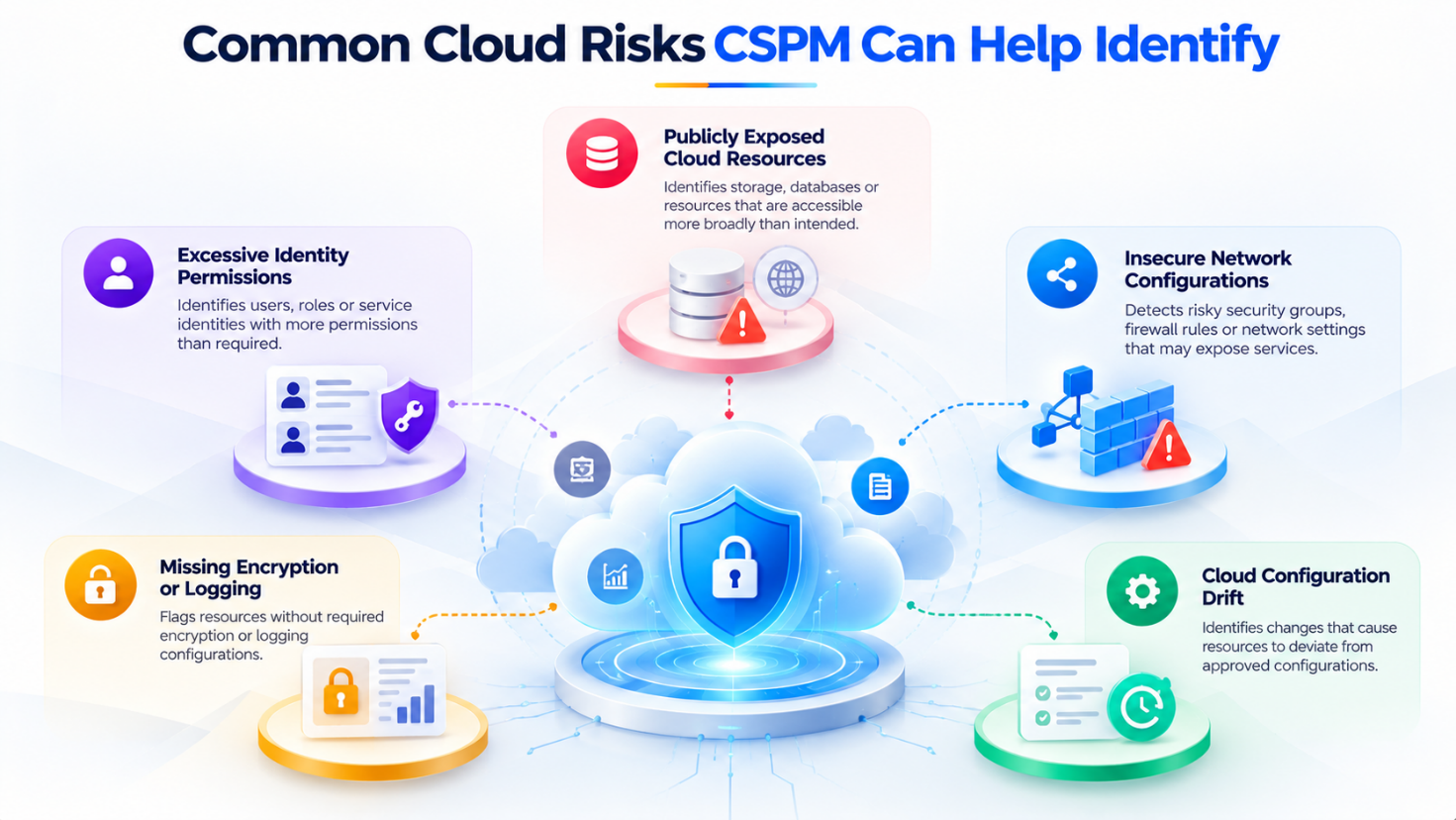
CSPM helps organizations identify several types of cloud configuration weaknesses. The exact findings depend on the connected services, enabled policies, and capabilities of the selected platform.
Publicly Exposed Cloud Resources
Storage services, databases, or other resources may become accessible more broadly than intended. CSPM can flag risky access configurations so teams can determine whether the exposure is necessary and properly controlled.
Excessive Identity Permissions
Users, roles, and service identities may receive more permissions than their responsibilities require. CSPM may identify certain permission-related risks, while deeper entitlement analysis may require Cloud Infrastructure Entitlement Management (CIEM) capabilities.
Insecure Network Configurations
Security groups, firewall rules, and network access controls can unintentionally expose services. Configuration assessments help identify rules that conflict with approved network security policies.
Missing Encryption or Logging
Resources without required encryption or logging configurations can weaken data protection and investigation capabilities. CSPM can flag these gaps when the relevant policies and integrations are available.
Cloud Configuration Drift
A cloud resource may initially meet security requirements but later become less secure because of manual changes, deployments, or updates. Continuous posture assessment helps identify deviations from approved configurations.
CSPM Remediation Best Practices
CSPM is most effective when security findings are connected to a repeatable remediation process. Organizations should define how findings are reviewed, assigned, corrected, and validated.
- Establish a security baseline: Define configuration standards for each cloud environment and resource type.
- Prioritize by business risk: Consider exposure, resource importance, data sensitivity, and potential impact rather than relying only on alert severity.
- Assign clear ownership: Ensure every important finding has a responsible team or individual.
- Use automation carefully: Automate well-understood, low-risk fixes where appropriate, with suitable safeguards and approvals.
- Integrate with engineering workflows: Connect findings with ticketing systems, deployment pipelines, and infrastructure-as-code processes where supported.
- Validate every fix: Reassess resources after remediation to confirm that the original issue has been resolved.
- Address recurring problems: Use reusable templates, policies, and guardrails to reduce repeated configuration failures.
These practices help organizations reduce recurring risks and integrate cloud security into everyday engineering operations.
How CSPM Supports Cloud Compliance
CSPM can support compliance programs by identifying technical configuration gaps and providing visibility into relevant cloud security controls.
For example, organizations preparing for SOC 2 or ISO 27001 may use CSPM to assess access settings, encryption configurations, logging, and other technical controls relevant to their security requirements.
However, CSPM alone does not establish compliance or guarantee a successful audit. Organizations must also address governance, documented procedures, risk management, access reviews, evidence requirements, and other applicable controls.
To make compliance reporting more useful, teams should map technical findings to the specific requirements they need to demonstrate. They should also verify that collected evidence is current, accurate, and appropriate for the audit scope.
How to Measure CSPM Effectiveness
The number of alerts generated is not a reliable measure of CSPM success on its own. Organizations should evaluate whether the program helps identify meaningful risks and resolve them efficiently.
Useful metrics include:
- Time to remediate: How long critical and high-priority findings remain unresolved.
- Open high-risk findings: The number and age of significant risks awaiting action.
- Recurring misconfigurations: How often previously resolved issues reappear.
- Asset coverage: The proportion of in-scope cloud accounts and resources being assessed.
- Policy compliance: The percentage of assessed resources meeting defined configuration requirements.
- Remediation validation: The proportion of completed fixes confirmed through reassessment.
Metrics should be interpreted in context. An increase in findings, for example, may reflect improved asset discovery rather than a decline in security.
Tracking these indicators over time provides a more useful picture of how cloud security practices are progressing.
What to Consider When Choosing a CSPM Solution
Selecting a CSPM solution starts with understanding the cloud environments, security requirements, and operational workflows that need support.
Organizations should evaluate whether a solution supports their cloud providers, offers suitable policy coverage, provides meaningful risk prioritization, and integrates with their remediation processes.
Important considerations include:
- Support for AWS, Azure, GCP, and other required environments.
- Quality of configuration checks and policy customization.
- Visibility into identity risks and relationships between findings.
- Support for relevant compliance frameworks and reporting requirements.
- Integration with ticketing systems, engineering workflows, and infrastructure-as-code.
- Options for approved remediation automation and continuous monitoring.
The right solution should provide actionable visibility and fit the organization's ability to investigate and resolve findings. A platform that generates extensive alerts without clear ownership or remediation workflows may deliver less value than expected.
How Indrasol Supports Cloud Security Posture Management
Organizations need more than visibility into cloud risks. They also need a practical way to prioritize findings, coordinate remediation, and maintain consistent security controls as their environments change.
Indrasol's Cloud Security Posture Management services can help organizations assess cloud security posture, identify configuration risks, and improve visibility into their cloud environments. The appropriate approach depends on the organization's infrastructure, security requirements, and service scope.
Explore Indrasol's Cloud Security Posture Management services to learn more about its CSPM approach.
Frequently Asked Questions
What is CSPM, and how does it work?
CSPM assesses cloud configurations against security policies and benchmarks to identify potential weaknesses. It helps teams prioritize findings, coordinate remediation, and reassess configurations to verify improvements.
What are the main components of CSPM architecture?
Typical components include cloud asset discovery, configuration assessment, risk prioritization, remediation tracking, and continuous monitoring. The exact capabilities vary by platform.
Can CSPM automatically fix cloud misconfigurations?
Some CSPM solutions support automated remediation for selected issues. Organizations should test these actions carefully and use appropriate approvals and safeguards to avoid disrupting legitimate workloads.
Does CSPM help with SOC 2 and ISO 27001?
CSPM can help identify technical configuration gaps and support evidence collection for relevant controls. It does not replace the wider governance, documentation, risk management, and audit activities required for compliance.
What is the difference between CSPM and CNAPP?
CSPM focuses on cloud configuration and posture risks. Cloud-Native Application Protection Platform (CNAPP) is a broader security platform category that may combine CSPM with workload protection, identity entitlement management, and other capabilities.
How often should cloud posture be assessed?
Cloud posture should be assessed frequently enough to identify meaningful configuration changes and risks promptly. Continuous monitoring is useful for dynamic environments, although the appropriate coverage and frequency depend on the organization's architecture and risk requirements.
Key Takeaways for Better Cloud Security
CSPM helps organizations move beyond periodic cloud configuration reviews toward a more continuous and structured security process. By discovering assets, assessing configurations, prioritizing risks, and validating remediation, teams can improve visibility and respond more effectively to changing cloud environments.
To strengthen cloud security posture, organizations should:
- Maintain visibility into cloud assets and configurations.
- Prioritize findings based on exposure and business impact.
- Assign clear ownership for remediation.
- Validate fixes and monitor configuration changes continuously.
- Align technical security checks with relevant compliance requirements.
A structured CSPM approach helps security and engineering teams address meaningful risks and reduce recurring configuration issues.
Want to strengthen your cloud security posture? Explore Indrasol's Cloud Security Posture Management services to learn more about cloud posture assessment and managing configuration risks.
About the Author
Brahma Guptha Illindra
Brahma Gupta is a technology entrepreneur, enterprise technology leader, and Founder & CEO of Indrasol, helping organizations adopt AI, cloud, data, and cybersecurity technologies securely, compliantly, and at scale. Over the years, he has worked across enterprise architecture, data engineering, analytics, cloud technologies, Oracle EPM, and business transformation. Today, his focus is increasingly on one of the biggest challenges facing enterprises: how to adopt AI at scale without losing visibility, security, governance, or control. At Indrasol, he and his team help organizations bridge the gap between technology innovation and business risk across: • AI Security & AI-SPM (AI Security Posture Management) • AI Governance & Responsible AI • Cloud Security & CSPM (Cloud Security Posture Management) • Cybersecurity & Risk Management • SOC 2, ISO 27001, ISO 42001 & CMMC compliance • Cloud modernization & DevOps • Data, analytics & AI transformation • Enterprise technology & automation Brahma is particularly interested in the emerging security challenges created by Generative AI, AI agents, Shadow AI, AI identities, model risk, data exposure, AI governance, and autonomous AI systems. His perspective is simple: AI adoption should create business advantage—not introduce unmanaged risk. He also believes security and compliance should be more than check-the-box exercises. Done correctly, they can help organizations win enterprise customers, accelerate sales cycles, strengthen trust, reduce risk, and scale technology with confidence. Brahma regularly writes about AI security, AI-SPM, cloud security, cybersecurity, AI governance, SOC 2, ISO 27001, ISO 42001, CSPM, enterprise AI adoption, and technology strategy. He enjoys connecting with CISOs, CIOs, CTOs, founders, technology leaders, security professionals, and enterprise teams building the next generation of secure AI and cloud-powered businesses. If you’re working on AI security, cloud security, enterprise AI adoption, cybersecurity, compliance, or digital transformation, connect with Brahma.
View Brahma Guptha Illindra's profile