
What Can Your AI Agents Do Without Human Approval?
Summary
AI agents can retrieve information, use tools, update systems, and execute multi-step tasks with limited human involvement. Learn how to define AI agent permissions, identify high-risk actions, and implement approval controls that support secure enterprise AI adoption.
Why AI Agent Autonomy Needs Clear Boundaries
AI agents are moving beyond answering questions. Organizations are using them to process customer requests, analyze business data, interact with enterprise applications, and automate repetitive workflows.
These capabilities can improve productivity, but they also introduce a critical security question: How much authority should an AI agent have to act without human approval?
An agent with access to email, customer records, cloud resources, or business applications may be able to perform actions that have real operational consequences. If its instructions are misunderstood, its connected tools are compromised, or its permissions are excessive, a routine task could become a security incident.
Organizations need to establish clear boundaries before deploying autonomous workflows. The goal is not to require human approval for every action. It is to ensure that an AI agent can act independently only within a defined, monitored, and appropriate scope.
Which Actions Can AI Agents Perform Independently?
The level of autonomy should depend on the action's risk, reversibility, data sensitivity, and business impact—not simply on the agent's technical capabilities.
For example, an agent that summarizes internal documentation presents a different level of risk from one that can approve payments or modify production infrastructure.
These categories are a starting point, not a universal policy. Organizations should adapt them to their industry, business processes, regulatory obligations, and risk tolerance.
Five Factors That Determine Whether Human Approval Is Needed
A practical AI agent security assessment should examine what an agent can do, what it can access, and what could happen if it makes a mistake.
1. Business Impact
Consider the consequences of an incorrect action. Generating a draft report is usually easy to reverse, while deleting production data or approving a large payment can cause significant damage.
Ask:
- Could the action affect customers, revenue, or business operations?
- Could it interrupt a critical service?
- Would the organization be able to reverse the action quickly?
2. Data Sensitivity
Agents should not receive unrestricted access to information simply because that information might be useful for completing a task.
Review whether the agent can access:
- Customer or employee information
- Financial records and confidential business documents
- Authentication credentials, API keys, or secrets
- Sensitive information from connected applications and data sources
Apply least-privilege access so each agent can retrieve only the information necessary for its assigned purpose.
3. Permission Scope
An agent's effective authority depends on its identity, assigned permissions, connected tools, and ability to delegate tasks.
A seemingly harmless agent may become high-risk if it inherits broad access from a service account or can call administrative APIs.
Check whether permissions are limited by task, environment, resource, and duration. Avoid shared, overly privileged credentials wherever possible.
4. Reversibility
Actions that can be safely undone may be suitable for controlled automation. Actions that are difficult or impossible to reverse generally need stronger safeguards.
For example, an agent might prepare a database update automatically but require approval before executing it against production data.
5. Uncertainty and Context
AI agents can encounter misleading instructions, incomplete information, unexpected tool responses, and prompt injection attempts.
If an agent cannot establish that a requested action is within its authorized scope, it should pause, refuse the operation, or escalate to a responsible person rather than improvising.
Where Should AI Agents Stop and Ask for Approval?
A reliable approval policy identifies specific actions that require authorization before execution. It should be enforced by the systems that control access, rather than depending only on the agent's own judgment.
Consider these common enterprise scenarios:
Customer support: An agent may classify a complaint and prepare a response independently. Issuing a high-value refund or changing account ownership may require approval.
Finance: An agent may reconcile transactions and flag discrepancies. Releasing funds or changing payment instructions should follow the organization's established authorization process.
IT operations: An agent may investigate an alert and recommend a configuration change. Applying a high-impact production change should require the appropriate change approval.
Human resources: An agent may summarize approved policies or organize recruitment information. Employment decisions and access to restricted employee records need appropriate human and policy controls.
Security operations: An agent may collect logs and recommend containment steps. Disabling critical controls or making a disruptive production change should require explicit authorization unless a separately approved emergency playbook governs that action.
The principle is straightforward: automate preparation and routine execution where appropriate, but place enforceable controls around actions with significant consequences.
How to Build a Human Approval Workflow for AI Agents
Approval should be part of the agent's operating design, not an informal step added after deployment.
Step 1: Define the Agent's Authorized Scope
Document the agent's business purpose, permitted tools, accessible data, and allowed actions.
Specify which actions are:
- Allowed without additional approval
- Allowed only under predefined conditions
- Subject to human approval
- Prohibited entirely
This creates a clear boundary between intended autonomy and excessive authority.
Step 2: Enforce Least-Privilege Access
Assign each agent only the permissions it needs to perform its task. Separate read access from write access, and restrict privileged operations to approved workflows.
Where feasible, use short-lived credentials, scoped API permissions, and separate identities for different agents or environments.
Step 3: Introduce Risk-Based Approval Gates
Not every action needs the same level of oversight. Use risk-based rules to determine when the workflow must pause.
An approval request should explain:
- What action the agent wants to perform
- Why the action is necessary
- Which systems and data are affected
- What the expected impact could be
- Whether the action can be reversed
This gives the reviewer enough context to make an informed decision.
Step 4: Enforce Approval Outside the Model
Do not rely exclusively on a prompt such as “ask for permission before deleting data.”
Enforce approval through application logic, API gateways, identity permissions, workflow engines, or other suitable controls. The agent should not be able to bypass the approval mechanism by changing its instructions or calling an alternative tool.
Step 5: Log Actions and Approval Decisions
Record the agent's identity, requested action, relevant tool calls, approval outcome, and execution result. Protect logs against unauthorized modification and avoid unnecessarily storing sensitive information.
These records help security teams investigate incidents, review access, and demonstrate how controls operate.
Step 6: Test and Reassess
Test the workflow with unexpected inputs, malicious instructions, permission changes, and attempted approval bypasses.
Reassess controls whenever the agent receives new tools, broader access, new data sources, or a different business responsibility.
AI Agent Security Risks: Warning Signs to Monitor
AI agents can introduce risks that are not obvious from the initial use case. Security teams should monitor the full workflow, including the agent's identity, connected systems, data access, and actions.
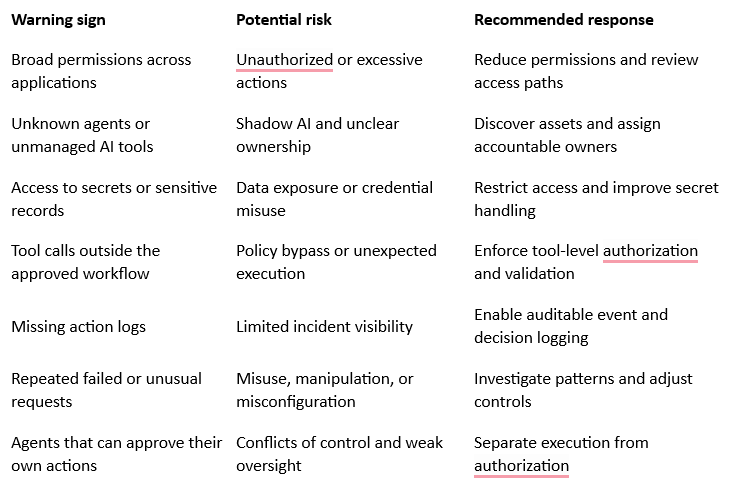
These warning signs should be evaluated in context. A single unusual event does not automatically indicate an attack, but unexplained behavior or repeated policy violations warrants investigation.
How AI Security Posture Management Helps Control Agent Autonomy
Individual agent permissions are only one part of enterprise AI security. Organizations also need to understand where AI is deployed, how agents connect to enterprise systems, who owns them, and whether their controls remain effective over time.
AI Security Posture Management (AiSPM) helps organizations discover AI assets, understand exposure, assess risks, prioritize remediation, and improve security posture across AI applications, models, agents, data flows, and integrations.
An AI security posture assessment can help teams evaluate:
- AI asset discovery: Identify deployed agents, applications, models, APIs, and integrations.
- Identity and access: Review service accounts, delegated permissions, credentials, and excessive privileges.
- Agent and tool security: Determine which systems agents can invoke and which actions they can execute.
- Data exposure: Understand access to sensitive information and movement across connected systems.
- Governance and accountability: Establish ownership, approval rules, evidence, and escalation procedures.
- Continuous monitoring: Detect changes in permissions, configurations, integrations, and risk over time.
AiSPM complements existing identity management, application security, cloud security, and governance programs. It does not replace the need for effective access controls or well-designed approval workflows.
Organizations evaluating broader AI security risk assessment for enterprises should also consider whether their assessment covers both the agent itself and the environment in which it operates.
Learn more about Indrasol's AI Security Posture Management services and its broader AI, cloud, data, and cybersecurity services.
A Practical Checklist for Safer AI Agent Deployment
Before allowing an AI agent to execute actions independently, use this checklist to review its security boundaries.
- Document the agent's purpose, owner, and authorized scope.
- Inventory its tools, APIs, integrations, and accessible data.
- Apply least-privilege access and remove unnecessary permissions.
- Classify actions by impact, sensitivity, and reversibility.
- Define which actions require explicit human approval.
- Enforce approval through systems outside the AI model.
- Prevent agents from bypassing authorization or approving their own restricted actions.
- Validate inputs and outputs before consequential actions.
- Record tool calls, decisions, approvals, and execution results.
- Test prompt injection, unexpected inputs, and unauthorized action attempts.
- Define a process to pause or disable an agent when necessary.
- Reassess controls when its capabilities or environment change.
Use this checklist as a starting point and adapt it to the organization's risk profile and applicable requirements.
Frequently Asked Questions
Can AI agents work without human approval?
Yes. AI agents can perform predefined tasks independently when they have suitable permissions, clear operating boundaries, and appropriate monitoring. High-impact actions should follow risk-based authorization rules.
Which AI agent actions should require human approval?
Actions involving significant financial impact, sensitive data disclosure, privileged access, production changes, or irreversible consequences often require approval. The exact rules should reflect business risk and established policies.
What is an AI agent security assessment?
An AI agent security assessment examines an agent's permissions, identity, tools, data access, integrations, execution behavior, and safeguards. It helps identify weaknesses that could allow unauthorized actions or expose sensitive information.
How does AI Security Posture Management support AI agent security?
AiSPM helps organizations discover AI assets, map connections and permissions, assess exposure, prioritize risks, and monitor posture changes. It provides broader visibility that can support agent security reviews and governance.
How can organizations identify shadow AI agents?
Organizations can review approved software inventories, cloud and application logs, identity records, API usage, procurement information, and other authorized discovery sources. The objective is to identify unmanaged AI usage, determine ownership, and assess associated risk.
Does human approval eliminate AI agent risk?
No. Approval is one safeguard among several. Organizations still need least-privilege access, strong authentication, input validation, monitoring, testing, and incident response procedures.
Set Clear Boundaries Before Scaling AI Autonomy
AI agents can deliver meaningful operational value when they have the right permissions and operate within clearly defined limits. The challenge is to enable useful automation without giving agents more authority than their tasks require.
Start by mapping your AI environment, identifying high-impact actions, and enforcing approval controls where they matter most. As agent capabilities and integrations evolve, reassess permissions and monitor whether safeguards continue to work as intended.
Indrasol helps organizations assess and improve their AI security posture. Explore AI Security Posture Management to learn how your organization can identify AI exposure, prioritize security risks, and build a more controlled approach to enterprise AI adoption.
About the Author
Brahma Guptha Illindra
Brahma Gupta is a technology entrepreneur, enterprise technology leader, and Founder & CEO of Indrasol, helping organizations adopt AI, cloud, data, and cybersecurity technologies securely, compliantly, and at scale. Over the years, he has worked across enterprise architecture, data engineering, analytics, cloud technologies, Oracle EPM, and business transformation. Today, his focus is increasingly on one of the biggest challenges facing enterprises: how to adopt AI at scale without losing visibility, security, governance, or control. At Indrasol, he and his team help organizations bridge the gap between technology innovation and business risk across: • AI Security & AI-SPM (AI Security Posture Management) • AI Governance & Responsible AI • Cloud Security & CSPM (Cloud Security Posture Management) • Cybersecurity & Risk Management • SOC 2, ISO 27001, ISO 42001 & CMMC compliance • Cloud modernization & DevOps • Data, analytics & AI transformation • Enterprise technology & automation Brahma is particularly
View Brahma Guptha Illindra's profile