
Secure Your Applications: Why End-to-End Application Security Is Critical in 2026
End-to-End Defense Is Critical in Application Security
Applications have become the front door to the enterprise.
Customer portals, SaaS platforms, APIs, mobile applications, cloud workloads, AI applications, third-party libraries, and internal business systems all create opportunities for attackers to gain access to data and systems.
The challenge is no longer simply finding vulnerabilities.
The bigger challenge is understanding which vulnerabilities matter, where they exist, how they connect to business-critical applications, and whether security teams can remediate them before attackers exploit them.
The latest threat data makes that challenge difficult to ignore.
Verizon's 2026 Data Breach Investigations Report reports that software vulnerabilities were involved in 31% of breaches, making vulnerability exploitation the leading initial entry point identified in the report. The report also found that third-party supply-chain breaches increased to 48% of breaches, while ransomware appeared in 48% of breaches.
For security leaders, this changes the application-security question from:
"Do we scan our applications?"
to:
**"Can we continuously understand and reduce application risk across the entire software lifecycle?" **
That is the foundation of modern application security.
Application Security Is No Longer Just a Developer Problem
Application security was once treated primarily as a secure-coding function.
- A developer writes code.
- A security team scans it.
- A vulnerability is reported.
- Someone fixes it.
That model does not scale well across modern application environments. Today's applications can contain:
- Proprietary source code
- Open-source dependencies
- APIs
- Cloud infrastructure
- Containers
- Infrastructure as Code
- CI/CD pipelines
- Secrets and credentials
- Third-party services
- SaaS integrations
- AI-generated code
- AI models and agents
- Customer data
- Privileged identities
A vulnerability in one component can create a chain of risk across several others.
This is why application security increasingly requires an end-to-end view rather than isolated security testing.
OWASP's 2025 Top 10 reflects this broader risk landscape. Its categories now include software supply chain failures, software or data integrity failures, security logging and alerting failures, and mishandling of exceptional conditions, alongside traditional risks such as broken access control and injection.
The Application Security Threat Landscape Is Changing
The threat landscape is becoming more interconnected. Three developments deserve particular attention.
1. Vulnerability exploitation is accelerating
Verizon's 2026 DBIR found that vulnerabilities accounted for 31% of breaches, surpassing stolen credentials as an initial entry point.
The implication for application-security teams is straightforward:
A vulnerability does not remain theoretical simply because it has not been exploited yet.
Organizations need to understand exposure, exploitability, asset criticality, and remediation priority.
2. Software supply chains are becoming part of the attack surface
Modern applications rarely consist entirely of code written internally.
They depend on:
- Open-source packages
- APIs
- Cloud services
- Containers
- Libraries
- Build systems
- Package repositories
- CI/CD tools
- External vendors
OWASP's 2025 Top 10 elevated Software Supply Chain Failures to its own category, recognizing risks across dependencies, build systems, and software distribution infrastructure. OWASP notes that this category had some of the highest average exploit and impact scores among the vulnerabilities represented in its data.
Verizon's 2026 DBIR also reports that third-party involvement has expanded substantially, with third-party supply-chain breaches reaching 48% of breaches in its analysis.
3. AI is changing how software is created
AI-assisted development is increasing the speed at which organizations produce software.
That can improve productivity, but it also creates new questions:
- Who reviews AI-generated code?
- Are security controls built into AI-assisted development workflows?
- Are developers introducing vulnerable dependencies?
- Can organizations trace the origin of generated code?
- Are secrets being exposed to AI development tools?
- Can security teams distinguish AI-generated vulnerabilities from conventional vulnerabilities?
NIST's Secure Software Development Framework provides a foundation for integrating security practices into the software development lifecycle, and NIST has also developed an SSDF community profile specifically addressing generative AI and dual-use foundation models.
Why Organizations Struggle With Application Security
1. Lack of Preparedness for Escalating Malware and Vulnerability Attacks
Security teams are dealing with an expanding attack surface while application portfolios continue to grow.
Verizon's 2026 DBIR found ransomware in 48% of breaches. Its findings also show that attackers are increasingly exploiting software vulnerabilities to obtain initial access.
This creates a difficult operating environment for CISOs. A security team may know that vulnerabilities exist, but that does not necessarily tell them:
- Which applications are externally exposed
- Which vulnerabilities are actively exploitable
- Which applications contain sensitive data
- Which vulnerabilities create attack paths
- Which systems are business-critical
- Which issues should be remediated first
- Whether remediation actually reduced risk
The problem becomes risk prioritization, not simply vulnerability discovery.
2. Security Debt Is Becoming an Application Security Problem
Finding vulnerabilities is easier than fixing them.
Veracode's 2025 State of Software Security found that the average time to fix security flaws has increased by 47% since 2020. It also reported that half of organizations have critical security debt, with 70% of that critical security debt stemming from third-party code and the software supply chain.
This creates a dangerous cycle:
**More code → more findings → larger backlog → slower remediation → increasing security debt. **
Security teams can deploy more scanners without necessarily solving the underlying problem.
The real objective should be: Find → prioritize → remediate → validate → continuously monitor.
3. Noncompliance With Regulatory and Customer Requirements
Application security is increasingly connected to compliance and procurement. Organizations may need to demonstrate security controls through frameworks and requirements such as:
- SOC 2
- ISO/IEC 27001
- PCI DSS
- HIPAA-related security requirements
- NIST SSDF
- NIST Cybersecurity Framework
- DORA
- NIS2
- CMMC
- Customer security questionnaires
- Software supply-chain requirements
- Compliance does not replace application security.
A company can have policies, documentation, and security controls while still carrying exploitable vulnerabilities.
NIST describes SSDF as a set of secure software development practices that can be integrated into an organization's existing SDLC. Its purpose includes reducing vulnerabilities in released software, reducing the impact of undetected vulnerabilities, and addressing the root causes of recurring vulnerabilities.
For CISOs, the objective should therefore be broader than:
**"Can we demonstrate compliance?" **It should be: "Can we demonstrate that security controls are reducing application risk?"
4. Perceived Lack of Support From Leadership
Application security often competes with product delivery, revenue initiatives, cloud migration, AI adoption, and engineering priorities.
Security teams may say: "We need to fix 10,000 vulnerabilities."
Engineering teams may respond: "Which ones actually matter?"
That gap creates friction. Security needs to communicate application risk in business terms. Instead of reporting:
**12,487 vulnerabilities **a security leader should be able to explain
- 14 internet-facing applications have critical exposure
- 3 applications contain sensitive customer information
- 7 exploitable vulnerabilities affect production
- 2 vulnerabilities create an attack path to privileged systems
- 5 high-risk third-party components require remediation
This changes the conversation from security workload to business risk.
5. Complexity of Web Application Security
Modern web applications are no longer isolated systems. A typical application may interact with:
**User → Web Application → API → Identity Provider → Cloud Infrastructure → Database → Third-Party API → SaaS Platform **
A vulnerability anywhere along this chain can affect the overall application risk profile. That is why traditional application security testing alone may not provide enough context.
Organizations increasingly need to combine:
- SAST — Static Application Security Testing
- DAST — Dynamic Application Security Testing
- SCA — Software Composition Analysis
- API security
- Secrets detection
- Container security
- Infrastructure as Code security
- Penetration testing
- Runtime application protection
- Vulnerability management
- Threat modeling
- Software supply-chain security
- Application security posture management
The goal is not necessarily to deploy every security tool.
The goal is to create continuous visibility and actionable risk context across the application lifecycle.
6. The Evolving Threat Landscape
Application security has expanded beyond traditional web vulnerabilities. OWASP's 2025 Top 10 identifies these ten major categories:
- Broken Access Control
- Security Misconfiguration
- Software Supply Chain Failures
- Cryptographic Failures
- Injection
- Insecure Design
- Authentication Failures
- Software or Data Integrity Failures
- Security Logging and Alerting Failures
- Mishandling of Exceptional Conditions
The shift is significant.
Application security increasingly requires organizations to understand architecture, identity, dependencies, data flows, software provenance, runtime behavior, and business context.
What Does End-to-End Application Security Look Like?
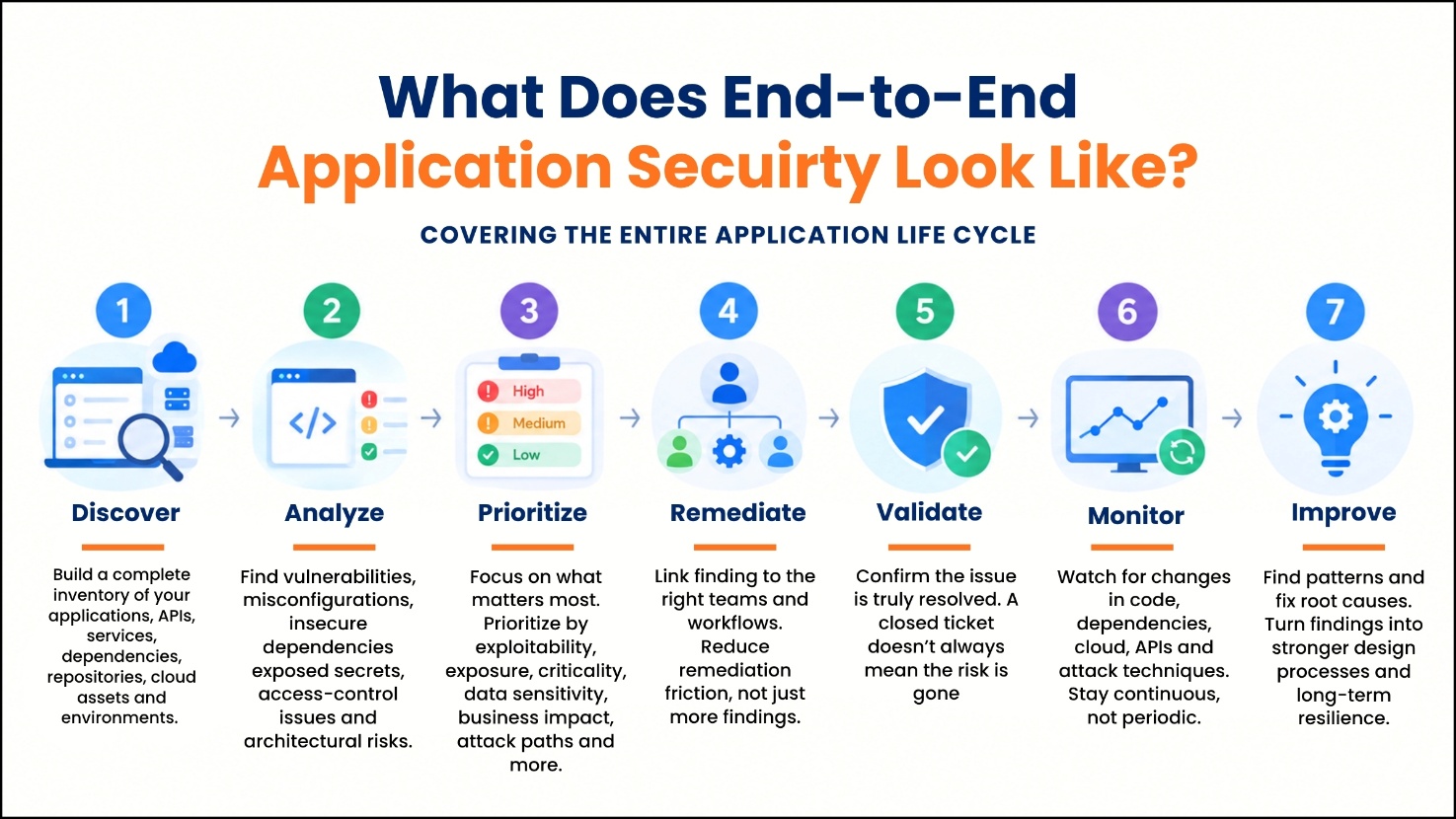
A modern application security program should cover the entire lifecycle.
1. Discover
Create an accurate inventory of applications, APIs, services, dependencies, repositories, cloud assets, and production environments.
You cannot protect what you cannot see.
2. Analyze
Identify vulnerabilities, misconfigurations, insecure dependencies, exposed secrets, access-control weaknesses, and architectural risks.
3. Prioritize
Not every vulnerability deserves the same response.
Prioritize based on factors such as:
- Exploitability
- Internet exposure
- Asset criticality
- Data sensitivity
- Business impact
- Attack paths
- Active exploitation
- Privileged access
- Dependency risk
4. Remediate
Connect security findings to the teams and workflows capable of fixing them.
The objective is to reduce remediation friction rather than simply generate more findings.
5. Validate
Confirm that the vulnerability has actually been resolved.
A ticket marked "closed" does not necessarily mean risk has disappeared.
6. Monitor
- Application environments continuously change.
- New releases introduce new code.
- Dependencies change.
- Cloud infrastructure changes.
- APIs change.
- Attack techniques change.
Application security therefore needs continuous monitoring rather than periodic testing alone.
7. Improve
Use security findings to identify systemic problems.
For example: If the same authentication vulnerability appears repeatedly, the organization may not have a vulnerability problem.
It may have a secure-design problem.
Where Application Security Posture Management Fits
This is where Application Security Posture Management (ASPM) becomes increasingly relevant.
ASPM focuses on bringing application-security signals together and providing context for understanding application risk.
Instead of security teams operating separate tools and dashboards, ASPM can help provide a more unified view across the application security lifecycle.
An ASPM strategy can bring together data from:
- SAST
- DAST
- SCA
- API security
- Cloud security
- Container security
- IaC scanning
- Secrets scanning
- Vulnerability management
- SBOM
- CI/CD
- Runtime security
- Identity and access controls
The objective is not another dashboard.
The objective is better security decisions.
For a CISO, the important question becomes:
"Which application risks can materially affect the business, and what should we do about them?"
The CISO Application Security Dashboard Should Answer Five Questions
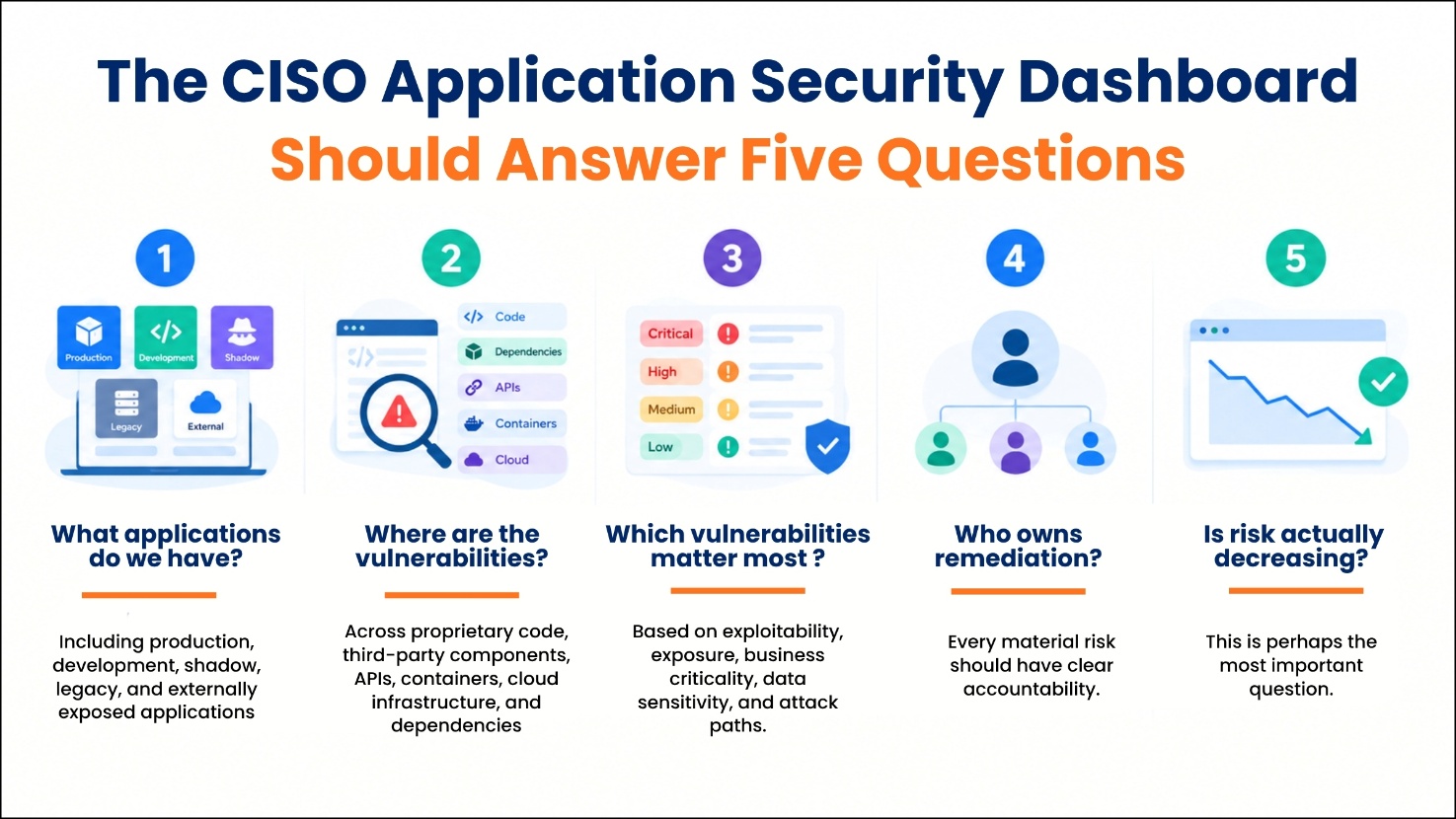
A useful application-security program should allow security leadership to answer:
1. What applications do we have?
Including production, development, shadow, legacy, and externally exposed applications.
2. Where are the vulnerabilities?
Across proprietary code, third-party components, APIs, containers, cloud infrastructure, and dependencies.
3. Which vulnerabilities matter most?
Based on exploitability, exposure, business criticality, data sensitivity, and attack paths.
4. Who owns remediation?
Every material risk should have clear accountability.
5. Is risk actually decreasing?
This is perhaps the most important question.
Security leaders need to measure outcomes—not simply the number of scans completed.
Application Security Metrics That Matter
Security teams should consider measuring:
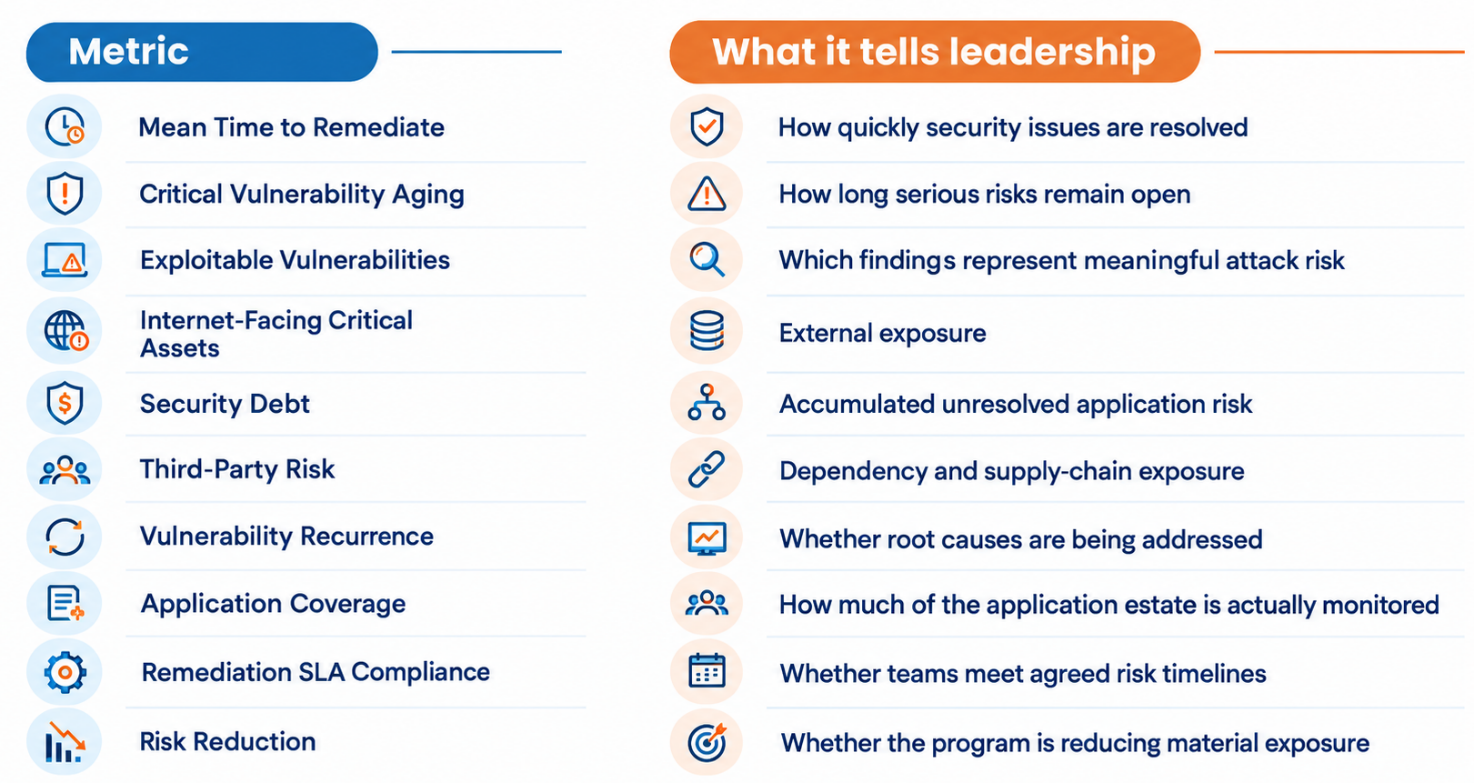
The shift is from: **"How many vulnerabilities did we find?" **to: "How much application risk did we remove?"
Frequently Asked Questions About Application Security
What is application security?
Application security is the practice of protecting software applications from vulnerabilities, unauthorized access, data exposure, malicious code, and other security threats throughout the software development and operational lifecycle.
Why is application security important?
Applications are increasingly exposed to the internet, cloud infrastructure, APIs, third-party dependencies, and sensitive business data. Verizon's 2026 DBIR found software vulnerabilities involved in 31% of breaches, demonstrating the importance of addressing vulnerabilities before attackers exploit them.
What are the biggest application security risks in 2026?
Key risks include broken access control, security misconfiguration, software supply-chain failures, cryptographic failures, injection, insecure design, authentication failures, software or data integrity failures, inadequate security logging, and mishandling of exceptional conditions. These are reflected in the OWASP Top 10:2025.
What is the difference between AppSec and ASPM?
Application security, or AppSec, is the broader discipline of securing applications throughout their lifecycle.
ASPM—Application Security Posture Management—is an approach to aggregating, contextualizing, prioritizing, and managing application-security risk across multiple security tools, applications, environments, and development workflows.
Is vulnerability scanning enough for application security?
No.
Scanning is an important part of application security, but scanning alone does not establish whether a vulnerability is exploitable, business-critical, externally exposed, connected to an attack path, or already mitigated elsewhere.
Modern application security requires discovery, testing, prioritization, remediation, validation, and continuous monitoring.
What is DevSecOps?
DevSecOps integrates security practices into development and operations workflows so that security becomes part of the software development lifecycle rather than a final-stage activity.
NIST's SSDF provides a structured foundation for integrating secure software development practices into existing SDLC processes.
What is the OWASP Top 10?
The OWASP Top 10 is a widely used awareness document describing critical web application security risks. The current release is OWASP Top 10:2025.
How can organizations reduce application security risk?
Organizations can reduce risk by establishing comprehensive application visibility, integrating security into the SDLC, prioritizing vulnerabilities based on real-world risk, securing software dependencies and APIs, improving remediation processes, and continuously monitoring application exposure.
The Application Security Strategy Needs to Change
The traditional model was:
Scan → Find Vulnerabilities → Create Tickets → Remediate
The modern model needs to be:
Discover → Contextualize → Prioritize → Remediate → Validate → Monitor → Improve
That difference matters.
The objective of application security is not to produce more vulnerability findings.
It is to **reduce the organization's exposure to material application risk. **
The 2026 threat environment reinforces why this matters. Software vulnerabilities now represent a major breach entry point, supply-chain exposure is expanding, and attackers are increasingly operating across interconnected technology ecosystems.
For CISOs, CIOs, and CTOs, application security should therefore be treated as an enterprise risk-management capability, not simply a collection of developer security tools.
Secure Your Applications Before Attackers Find the Gaps
Your application environment is changing continuously.
- New applications.
- New APIs.
- New dependencies.
- New cloud workloads.
- New AI-generated code.
- New third-party integrations.
- Your security posture needs to change with it.
Indrasol** helps organizations assess, prioritize, and improve application security across the modern software lifecycle. **
If you want to understand where your application security posture stands today, schedule an Application Security Discovery Call with Indrasol.
Assess your application security posture. Identify the gaps. Prioritize the risks that matter.
SEO Metadata
Primary Keyword:
Application Security
Secondary Keywords:
Application Security Management, Application Security Testing, Application Security Posture Management, ASPM, AppSec, DevSecOps, Web Application Security, Software Security, Application Vulnerability Management, Application Security Tools, Secure Software Development, Software Supply Chain Security, API Security, OWASP Top 10, Vulnerability Management
Long-Tail Keywords:
- what is application security
- why is application security important
- application security best practices
- application security testing
- how to secure web applications
- application security risks
- application security vulnerabilities
- application security posture management
- what is ASPM
- ASPM vs AppSec
- application security framework
- application security lifecycle
- application security for enterprises
- how to improve application security
- application security compliance
- application security and DevSecOps
- software supply chain security
- OWASP Top 10 2025
- application vulnerability management
- application security strategy for CISOs
**SEO Title: **
Secure Your Applications: End-to-End Application Security Guide 2026
**Meta Description: **
Discover why end-to-end application security matters in 2026. Explore current breach statistics, OWASP risks, AppSec, DevSecOps, ASPM, vulnerability management, and practical security strategies.
**Suggested URL Slug: **
/application-security-end-to-end-defense
**Suggested H1: **
Secure Your Applications: Why End-to-End Application Security Is Critical in 2026
**Suggested Featured Snippet Answer: **
Application security is the practice of protecting applications, APIs, code, dependencies, infrastructure, data, and development processes from security vulnerabilities and attacks throughout the software lifecycle. Modern application security combines secure development, application security testing, vulnerability management, software supply-chain security, runtime protection, and continuous application security posture management.
**Search Intent Covered: **
Informational + Commercial Investigation + Enterprise Security
**GEO/AIO/AEO Entities and Concepts: **
Application Security, AppSec, ASPM, DevSecOps, OWASP Top 10, NIST SSDF, vulnerability management, software supply-chain security, API security, SAST, DAST, SCA, SBOM, CI/CD, cloud security, secure SDLC, CISOs, CIOs, CTOs.
About the Author
Brahma Guptha Illindra
Brahma Gupta is a technology entrepreneur, enterprise technology leader, and Founder & CEO of Indrasol, helping organizations adopt AI, cloud, data, and cybersecurity technologies securely, compliantly, and at scale. Over the years, he has worked across enterprise architecture, data engineering, analytics, cloud technologies, Oracle EPM, and business transformation. Today, his focus is increasingly on one of the biggest challenges facing enterprises: how to adopt AI at scale without losing visibility, security, governance, or control. At Indrasol, he and his team help organizations bridge the gap between technology innovation and business risk across: • AI Security & AI-SPM (AI Security Posture Management) • AI Governance & Responsible AI • Cloud Security & CSPM (Cloud Security Posture Management) • Cybersecurity & Risk Management • SOC 2, ISO 27001, ISO 42001 & CMMC compliance • Cloud modernization & DevOps • Data, analytics & AI transformation • Enterprise technology & automation Brahma is particularly interested in the emerging security challenges created by Generative AI, AI agents, Shadow AI, AI identities, model risk, data exposure, AI governance, and autonomous AI systems. His perspective is simple: AI adoption should create business advantage—not introduce unmanaged risk. He also believes security and compliance should be more than check-the-box exercises. Done correctly, they can help organizations win enterprise customers, accelerate sales cycles, strengthen trust, reduce risk, and scale technology with confidence. Brahma regularly writes about AI security, AI-SPM, cloud security, cybersecurity, AI governance, SOC 2, ISO 27001, ISO 42001, CSPM, enterprise AI adoption, and technology strategy. He enjoys connecting with CISOs, CIOs, CTOs, founders, technology leaders, security professionals, and enterprise teams building the next generation of secure AI and cloud-powered businesses. If you’re working on AI security, cloud security, enterprise AI adoption, cybersecurity, compliance, or digital transformation, connect with Brahma.
View Brahma Guptha Illindra's profile