
10 Best AI-SPM practices every enterprise should implement before scaling AI
AI adoption is accelerating. But can your security team see, measure, and manage the risks that come with it?
You can't secure what you can't see.
And you can't manage AI risk if you don't know which models, applications, agents, identities, data sources, APIs, and integrations are operating across your enterprise.
As AI moves from experimentation into production, security teams need more than AI governance policies. They need a continuously measurable AI security posture.
That's where AI Security Posture Management (AiSPM) comes in.
AiSPM provides a way to continuously discover AI assets, understand their risk, prioritize exposures, implement controls, monitor changes, and improve security posture over time.
The goal isn't to slow down AI adoption. It's to make secure AI adoption possible at enterprise scale.
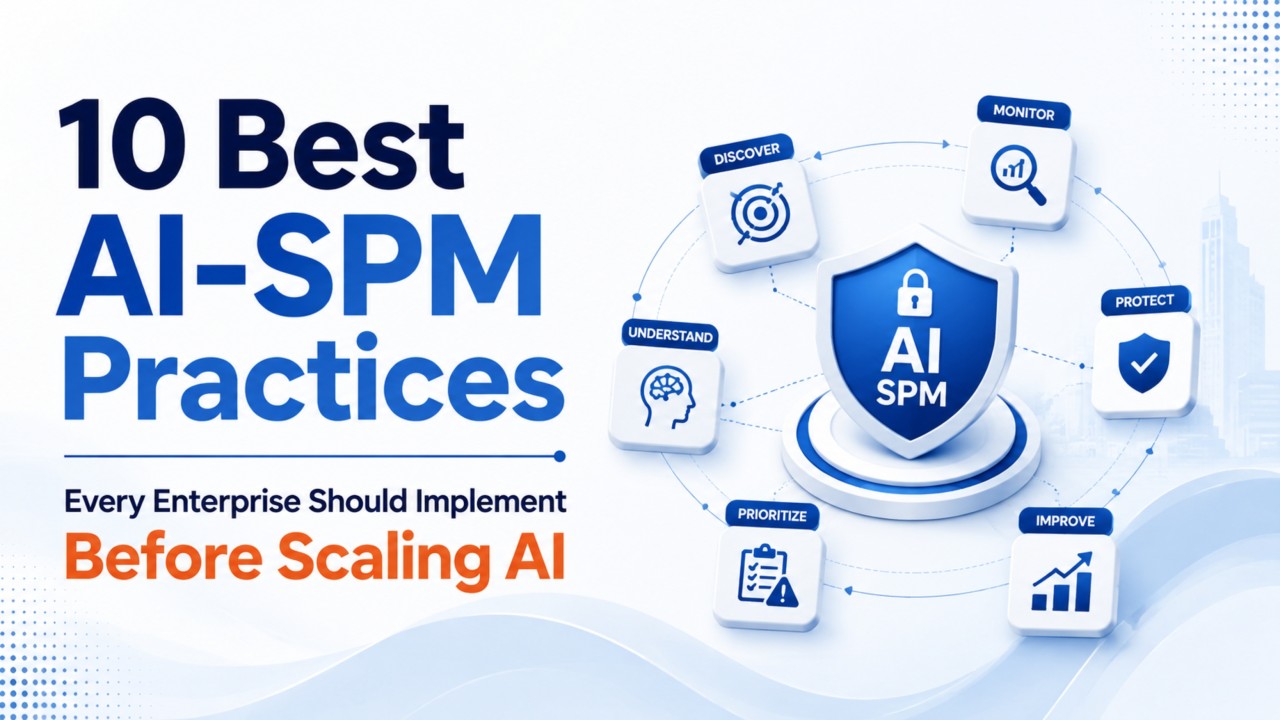
A practical AiSPM strategy can be organized around six stages:
Discover → Understand → Prioritize → Protect → Monitor → Improve
Here are 10 practices enterprises should consider before scaling AI.
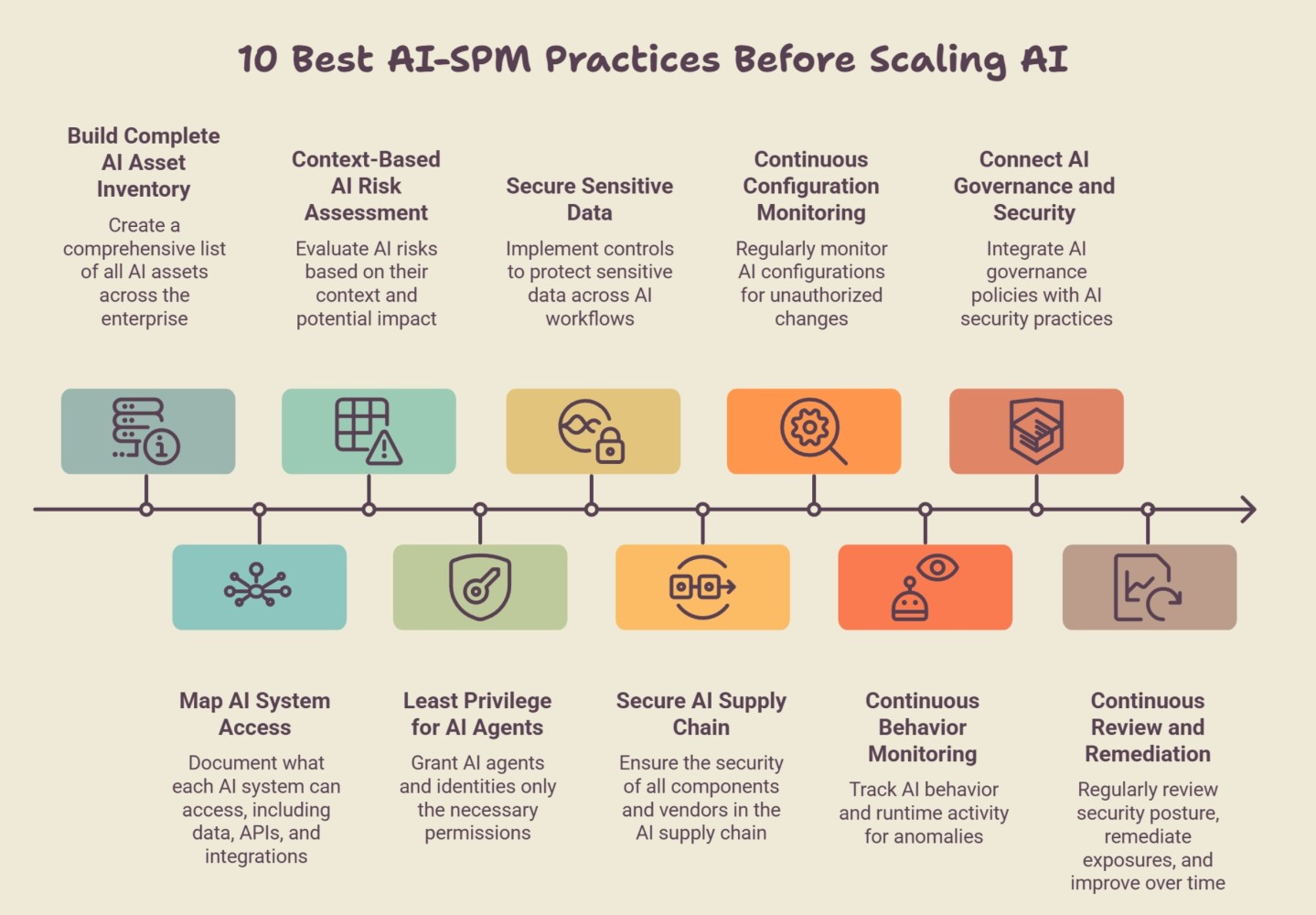
1. Build a complete AI asset inventory
You can't manage an AI security posture without knowing what you're managing.
The first step is discovering the AI systems operating across the organization. That includes more than officially approved AI applications.
Your inventory may need to include:
- AI and LLM applications
- Foundation models
- Machine learning models
- AI agents
- AI APIs
- AI-powered SaaS applications
- Vector databases
- AI development environments
- Model repositories
- Data pipelines
- Plugins and extensions
- Third-party AI services
- AI integrations
- AI-generated code
- Shadow AI
An AI inventory is only useful if you can trust that it reflects what’s actually in use. An outdated inventory creates a blind spot at the foundation of the security program.
2. Map what each AI system can access
Knowing that an AI application exists isn't enough. Security teams need to understand its relationships and permissions.
- What data can it access?
- Which applications can it connect to?
- Which APIs can it call?
- Which users can interact with it?
- Can an AI agent take actions?
- Can it modify records?
- Can it send messages?
- Can it execute code?
- Can it access sensitive enterprise information?
This is where AI security starts moving beyond traditional asset discovery. The security posture of an AI system depends heavily on the ecosystem around it.
A relatively low-risk model can become a high-risk system when it is connected to sensitive data and powerful enterprise tools.
Model risk + data access + identity + permissions + integrations = AI security posture.
3. Establish context-based AI risk assessment
Not every AI vulnerability represents the same level of business risk. Consider two AI applications with a similar prompt-injection weakness.
One is an internal assistant that only processes public information. The other is an AI agent connected to customer records and financial systems.
The technical issue might be similar. The potential business impact is dramatically different.
That's why enterprises should evaluate AI risk using context. Consider factors such as:
- Business criticality
- Data sensitivity
- User privileges
- AI permissions
- Internet exposure
- Number of integrations
- Potential attack paths
- Regulatory considerations
- Customer impact
- Financial impact
- Operational impact
- Existing security controls
Finding a vulnerability is only the starting point. What matters is understanding the risk it creates for the business.
This makes AI risk prioritization far more useful to CISOs and security teams.
4. Apply least privilege to AI agents and identities
AI agents change the security equation. A traditional application may respond to a request. An AI agent can potentially interpret a goal, use tools, access information, and take actions.
That makes identity and authorization particularly important. Every AI agent should have only the access it needs to perform its intended function. Security teams should evaluate:
- Agent identities
- Service accounts
- API keys
- OAuth permissions
- Tool access
- Database permissions
- Administrative privileges
- Cross-system access
- Human-to-agent relationships
Assess, What could this AI agent access or change if its credentials were compromised? Then apply the minimum permissions required for its job.
The principle is simple: Give AI the minimum access required and continuously verify that it still needs that access.
5. Protect sensitive data across AI workflows
AI security and data security are becoming increasingly interconnected. Sensitive information can enter AI workflows through prompts, documents, APIs, databases, retrieval systems, applications, and integrations.
That creates several questions:
- What sensitive data is being processed?
- Where is the data stored?
- Which model receives it?
- Who can access the AI system?
- Is data being retained?
- Which third parties process the information?
- Can AI-generated outputs expose sensitive information?
- Can an AI agent retrieve information a user should not have access to?
Organizations should establish appropriate controls around sensitive data, including:
- Data classification
- Access controls
- Encryption
- Data loss prevention
- Segmentation
- Retention policies
- Secure retrieval
- Output controls
A critical principle is:

Data access should be intentional, governed, and aligned with business need.
6. Secure the AI supply chain
Your AI security posture doesn't stop at systems you built internally. Enterprise AI increasingly depends on an ecosystem of:
- Model providers
- Open-source models
- APIs
- Datasets
- AI frameworks
- Plugins
- Libraries
- Vector databases
- Cloud services
- AI SaaS providers
- External development teams
Each dependency can introduce risk. Security teams should understand:
- Where did the model come from?
- What dependencies does it have?
- What data does the provider process?
- How are model updates managed?
- What happens if a third-party service changes its behavior or security posture?
Third-party AI risk should therefore become part of the broader AI-SPM program. The question isn't simply whether a vendor is approved.
It's whether the vendor's AI security posture remains acceptable over time.
7. Monitor AI configuration and security posture continuously
AI security posture can change without a new application being deployed.
- A configuration changes.
- A permission expands.
- A new integration is enabled.
- A model is updated.
- A new data source is connected.
- An API becomes externally accessible.
- An employee changes an AI workflow.
The result? The risk profile changes.
That's why periodic assessments alone are insufficient for dynamic AI environments. Continuous posture monitoring should identify changes such as:
- Misconfigurations
- Excessive permissions
- Exposed APIs
- Unauthorized integrations
- Policy violations
- New AI assets
- Model changes
- Data-access changes
- Identity changes
- Security control gaps
The objective is to identify posture drift before it becomes a security incident.
8. Monitor AI behavior and runtime activity
Posture management shouldn't stop at configuration. Organizations also need to understand what AI systems are actually doing.
Runtime monitoring can help security teams identify:
- Suspicious AI interactions
- Prompt injection attempts
- Abnormal data access
- Unexpected agent behavior
- Unauthorized tool usage
- Policy violations
- Unusual API activity
- Data leakage patterns
- Attempts to bypass security controls
This matters because a system can look secure on paper while behaving unexpectedly in production.
For example, an AI agent might have an approved integration with a business application. But is it using that integration within its intended boundaries?
Configuration tells you what the system is supposed to do. Monitoring helps you understand what it is actually doing.
Both matter.
9. Connect AI Governance with AI Security
AI governance and AI security shouldn't operate as separate programs. Governance defines expectations.
Security helps enforce and monitor them.
For example, an organization might establish a policy stating that sensitive customer information cannot be processed by an unapproved AI service.
That policy becomes far more valuable when security teams can identify:
- Which AI services are being used
- Which users are accessing them
- What data is being processed
- Whether policy violations are occurring
- Which systems require remediation
This creates a feedback loop:
Policy → Visibility → Detection → Remediation → Measurement
AiSPM can therefore complement broader AI governance initiatives by connecting policy expectations with technical security posture.
10. Continuously review, remediate, and improve
The final AiSPM practice may be the most important: Don't treat AI security as a finished project.
- AI environments evolve.
- New models appear.
- New agents are deployed.
- New capabilities are added.
- New data sources are connected.
- New vulnerabilities emerge.
- New attack techniques develop.
Business processes change. That means an AI risk assessment that was accurate six months ago may no longer reflect the current environment.
Enterprises should establish a continuous cycle:
Discover --> Understand --> Prioritize --> Protect --> Monitor --> Improve --> Discover again
This is the fundamental idea behind AI security posture management. The objective isn't to achieve a permanently “secure” state.
The objective is to maintain visibility, context, control, and continuous improvement as the AI environment changes.
WHAT SHOULD ENTERPRISES MEASURE?
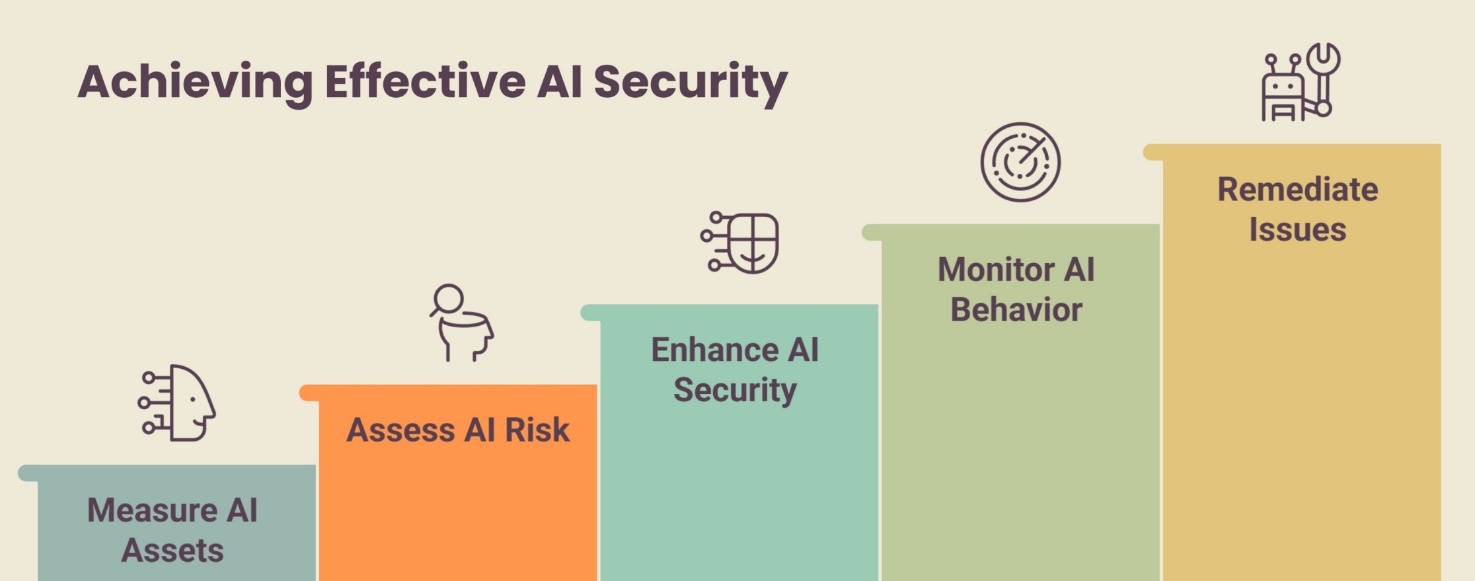
An effective AiSPM program should go beyond counting AI assets. Security leaders should consider measuring:
Visibility
- Percentage of known AI assets
- Unknown or unauthorized AI systems
- AI applications discovered across the enterprise
- Third-party AI dependencies
Risk
- High-risk AI systems
- Critical AI exposures
- AI systems with sensitive data access
- AI agents with excessive privileges
Security
- Misconfigurations
- Policy violations
- Exposed APIs
- Unnecessary permissions
- Unresolved vulnerabilities
Monitoring
- AI security events
- Anomalous behavior
- Prompt injection attempts
- Unauthorized data access
- Unexpected agent actions
Remediation
- Open AI security findings
- Time to remediation
- Recurring findings
- Control effectiveness
- Risk reduction over time
An AI inventory shows what you’re running. AI risk monitoring shows how exposed you are and whether that exposure is changing.
THE CISO's AISPM CHECKLIST
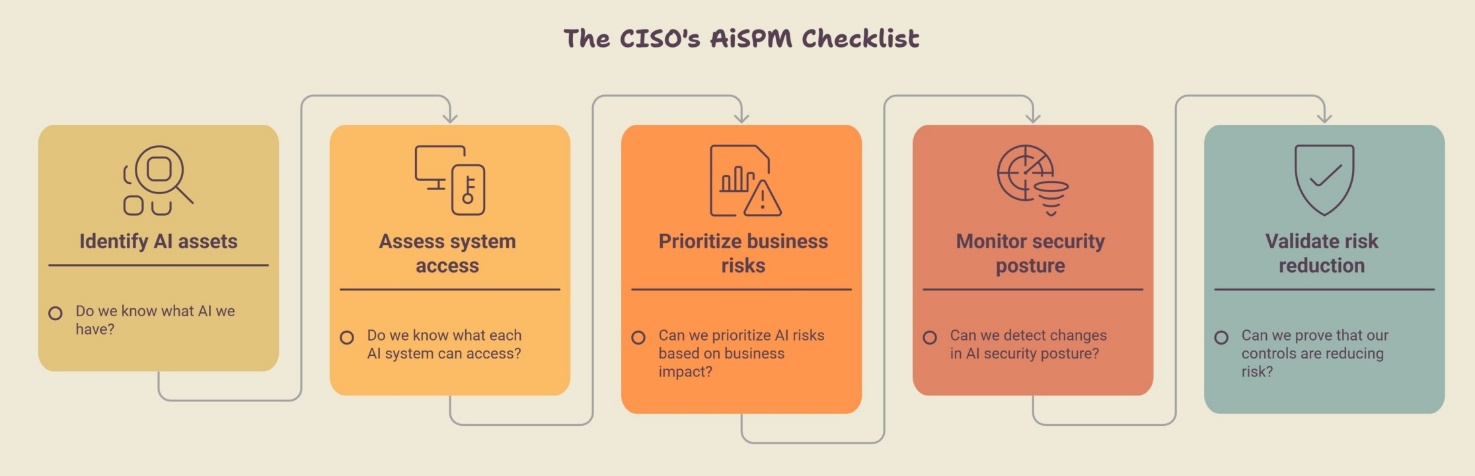
Before scaling enterprise AI, security leaders should be able to answer five questions:
1. Do we know what AI we have?
If not, start with discovery.
2. Do we know what each AI system can access?
Map data, identities, applications, APIs, tools, and permissions.
3. Can we prioritize AI risks based on business impact?
If everything is critical, nothing is prioritized.
4. Can we detect changes in AI security posture?
A static assessment won't capture continuous change.
5. Can we prove that our controls are reducing risk?
Security controls should be measured by effectiveness not simply implementation.
AI-SPM IS ABOUT MORE THAN AI SECURITY
The larger opportunity isn't simply preventing AI attacks. It's enabling enterprises to scale AI with confidence.
Organizations want to use AI to improve productivity, automate workflows, accelerate development, analyze data, and create new products.
Security shouldn't become the reason those initiatives stop. But uncontrolled AI adoption creates unnecessary exposure.
That's why the future of enterprise AI security will increasingly require a combination of:
AI visibility + risk context + identity + data security + governance + continuous monitoring + remediation
AI-SPM brings these capabilities together around the AI environment.
THE BOTTOM LINE
AI adoption is moving from experimentation toward increasingly connected and business-critical systems.
That changes the security question.
Approval is a point-in-time decision. AI security requires continuous visibility into posture, changes, exposure, and remediation priorities.
That's the shift from AI governance alone to continuous AI security posture management.
The organizations that make this shift early will be better positioned to scale AI while keeping security risk visible and manageable.
- Discover the AI environment.
- Understand the context.
- Prioritize what matters.
- Protect what matters most.
- Monitor continuously.
- Improve relentlessly.
That's how enterprises move from AI adoption to secure AI adoption.
KEY TAKEAWAYS
- You can't manage AI risk without AI visibility.
- AI risk depends on context—not vulnerabilities alone.
- AI agents require identity and least-privilege controls.
- AI data security must extend across the entire AI workflow.
- Third-party AI dependencies are part of your security posture.
- AI posture can drift even when applications don't change.
- Runtime monitoring complements configuration and posture monitoring.
- AI governance and AI security should work together.
- AiSPM should be continuous, not a one-time assessment.
- The ultimate objective is secure AI adoption at enterprise scale.
IS YOUR AI SECURITY POSTURE READY FOR SCALE?
Before deploying more AI agents, connecting more enterprise data, or moving AI workloads into production, understand your current exposure.
Indrasol helps enterprises strengthen AI security, governance, cloud, data, and cybersecurity capabilities so they can adopt AI securely and at scale.
Start by asking one question:

If the answer isn't clear, that's where the assessment should begin.
About the Author
Brahma Gupta Illindra
Brahma Gupta is a technology entrepreneur, enterprise technology leader, and Founder & CEO of Indrasol, helping organizations adopt AI, cloud, data, and cybersecurity technologies securely, compliantly, and at scale. Over the years, he has worked across enterprise architecture, data engineering, analytics, cloud technologies, Oracle EPM, and business transformation. Today, his focus is increasingly on one of the biggest challenges facing enterprises: how to adopt AI at scale without losing visibility, security, governance, or control. At Indrasol, he and his team help organizations bridge the gap between technology innovation and business risk across: • AI Security & AI-SPM (AI Security Posture Management) • AI Governance & Responsible AI • Cloud Security & CSPM (Cloud Security Posture Management) • Cybersecurity & Risk Management • SOC 2, ISO 27001, ISO 42001 & CMMC compliance • Cloud modernization & DevOps • Data, analytics & AI transformation • Enterprise technology & automation Brahma is particularly interested in the emerging security challenges created by Generative AI, AI agents, Shadow AI, AI identities, model risk, data exposure, AI governance, and autonomous AI systems. His perspective is simple: AI adoption should create business advantage—not introduce unmanaged risk. He also believes security and compliance should be more than check-the-box exercises. Done correctly, they can help organizations win enterprise customers, accelerate sales cycles, strengthen trust, reduce risk, and scale technology with confidence. Brahma regularly writes about AI security, AI-SPM, cloud security, cybersecurity, AI governance, SOC 2, ISO 27001, ISO 42001, CSPM, enterprise AI adoption, and technology strategy. He enjoys connecting with CISOs, CIOs, CTOs, founders, technology leaders, security professionals, and enterprise teams building the next generation of secure AI and cloud-powered businesses. If you’re working on AI security, cloud security, enterprise AI adoption, cybersecurity, compliance, or digital transformation, connect with Brahma.
View Brahma Gupta Illindra's profile