
 Bizradar
 Tanva
SOC 2 Type II Readiness for CISOs
Summary
SOC 2 Type II readiness goes beyond implementing security controls. CISOs must demonstrate that controls operate consistently throughout the examination period through reliable evidence, effective monitoring, clear ownership, and timely remediation. This guide explains how organizations can strengthen control effectiveness, manage exceptions, and prepare for a successful SOC 2 Type II examination.
Why SOC 2 Type II Requires More Than Implemented Controls
Organizations preparing for SOC 2 often begin by creating security policies, defining responsibilities, implementing access controls, and documenting internal procedures. These activities establish an important foundation, but they do not automatically demonstrate that the controls operate effectively.
SOC 2 Type II examines whether relevant controls are suitably designed and operating effectively over a defined examination period. This means an organization must demonstrate that its security processes are performed consistently, by the right people, and with evidence that supports their execution.
For CISOs, the challenge is moving from control implementation to operational assurance. A policy may require quarterly access reviews, but the organization must also demonstrate that those reviews occurred, exceptions were investigated, and corrective actions were completed.
This distinction is particularly important for SaaS companies, technology providers, and startups seeking enterprise customers. Their readiness depends not only on having security controls but also on proving that those controls work in everyday operations.
A successful SOC 2 Type II readiness program connects policies, people, technology, and evidence into a repeatable operating model.
SOC 2 Type I vs. Type II: What Changes for CISOs?
The difference between SOC 2 Type I and Type II affects how security teams prepare and manage their compliance programs.
A Type I examination evaluates the suitability of control design at a specified point in time. A Type II examination evaluates both control design and operating effectiveness over a defined period.
For a Type II examination, evidence from an earlier period does not automatically demonstrate that controls operated effectively during the current examination period. Organizations need evidence relevant to the period being examined.
The examination period should be discussed with the independent service auditor based on business requirements and the ability to obtain sufficient appropriate evidence. It should not be assumed that every organization has the same mandatory observation period.
Why the examination period matters
A control that is implemented shortly before an examination may not have sufficient operating history to demonstrate consistent performance. For example, if an organization introduces a quarterly access review process shortly before the examination period ends, it may not have enough evidence to demonstrate that the control operated as intended throughout the period.
CISOs should therefore plan control implementation, testing, and evidence collection around the examination timeline. This helps avoid last-minute changes and provides teams with enough time to identify and address operational weaknesses.
Define the Scope Before Evaluating Control Effectiveness
A common readiness problem is starting control testing before clearly defining which systems, services, processes, and teams are included in the examination.
CISOs should first establish the boundaries of the system being examined. This includes understanding how customer data is processed, where it is stored, which infrastructure supports the service, and which third parties contribute to its delivery.
A clear scope helps prevent two common issues: missing relevant controls and collecting large amounts of evidence that do not support the examination.
Key scoping considerations
- Services: Identify the products, platforms, and services covered by the SOC 2 examination.
- Infrastructure: Document relevant cloud environments, production systems, databases, and network components.
- People: Identify employees, contractors, and teams responsible for operating controls.
- Third parties: Determine which vendors and service providers affect the organization's system.
- Data: Understand how customer, employee, confidential, and sensitive information is handled.
- Trust Services Criteria: Determine which applicable criteria are relevant to the organization's commitments and system requirements.
Security, Availability, Processing Integrity, Confidentiality, and Privacy are the five Trust Services Categories. Security is included in every SOC 2 examination, while the other categories are selected based on the organization's circumstances and commitments.
Build a system description that reflects actual operations
The system description should explain how the service operates, what infrastructure supports it, how information flows through the environment, and which controls are relevant to the service.
CISOs should check whether the documented system description matches the current production environment. New cloud services, infrastructure changes, outsourced activities, and additional integrations can affect the scope.
A practical scope review should involve security, engineering, IT operations, and business stakeholders. This helps ensure that important systems and dependencies are not overlooked during the SOC 2 readiness assessment.
Translate Security Policies Into Controls That Can Be Tested
Policies describe what an organization intends to do. Controls define the activities that make those requirements operational.
For example, an access management policy may require employees to receive only the permissions necessary for their responsibilities. However, the organization must establish repeatable activities that demonstrate how this requirement is enforced.
CISOs should ensure that every important policy requirement is connected to a clearly defined control.
Example: From policy to operating control
Each control should identify:
- The risk or requirement it addresses.
- The person or team responsible for performing it.
- How frequently it must operate.
- The system or process used to execute it.
- The evidence that demonstrates completion.
- How exceptions are identified and resolved.
Make control descriptions specific and measurable
A control description such as "the organization reviews user access regularly" is too broad to guide consistent execution.
A more useful description identifies the responsible owner, review frequency, population being reviewed, approval requirements, and how exceptions are tracked.
For example, a quarterly access review control might specify that designated application owners review active user access, confirm whether permissions remain appropriate, and document removal or modification requests.
This level of detail makes controls easier to operate, monitor, and test during a SOC 2 Type II examination.
Establish Evidence Collection Before the Examination Period
Evidence collection is one of the most demanding parts of SOC 2 Type II readiness. Organizations often discover that their controls are being performed, but the supporting records are incomplete, scattered across systems, or difficult to retrieve.
A control without reliable supporting evidence can become difficult to demonstrate during an examination.
CISOs should establish an evidence collection process before the examination period begins. Evidence should be generated as part of normal business operations rather than reconstructed when an auditor requests it.
Common SOC 2 evidence sources
What makes evidence useful?
Evidence should be:
- Relevant: Directly connected to the control being tested.
- Complete: Includes the necessary information to understand the activity.
- Traceable: Identifies the responsible person, system, or process.
- Time-aligned: Falls within the examination period where applicable.
- Reliable: Comes from a source that can be trusted and reviewed.
- Consistent: Demonstrates that the control was performed according to its defined frequency.
For example, a screenshot showing that MFA is enabled may support the configuration of an authentication control. However, additional evidence may be necessary to demonstrate that the control applied to the relevant users and systems throughout the examination period.
Avoid common evidence collection problems
Security teams should avoid relying entirely on manually created screenshots or documents without source context. Evidence should make it possible to understand what happened, when it happened, who performed the activity, and whether the required action was completed.
A centralized evidence repository can help organize records by control, owner, period, and source system. Teams should also establish naming conventions and retention practices so that evidence can be retrieved without depending on individual employees.
Validate Whether Controls Actually Operate as Designed
Control implementation and control effectiveness are not the same.
A company may have an access review procedure, but if the review is not performed on schedule or exceptions remain unresolved, the control may not operate as intended.
CISOs should establish internal control validation activities to identify these weaknesses before the independent examination.
Practical control validation examples
Access management
- Review whether new user access was approved.
- Verify that terminated employees were deprovisioned appropriately.
- Confirm that privileged access is restricted and reviewed.
- Check whether access changes are documented.
Change management
- Verify that production changes have appropriate approvals.
- Review whether code changes receive required reviews.
- Check whether emergency changes are documented and evaluated.
- Confirm that deployment records can be traced to approved changes.
Vulnerability management
- Review whether vulnerability scans are performed at the defined frequency.
- Check whether findings are assigned to responsible owners.
- Verify whether remediation timelines are followed.
- Confirm that overdue vulnerabilities receive documented risk decisions.
Incident response
- Check whether reported incidents are recorded and classified.
- Review whether investigations include relevant details.
- Verify whether corrective actions are assigned and tracked.
- Confirm that response procedures are periodically tested.
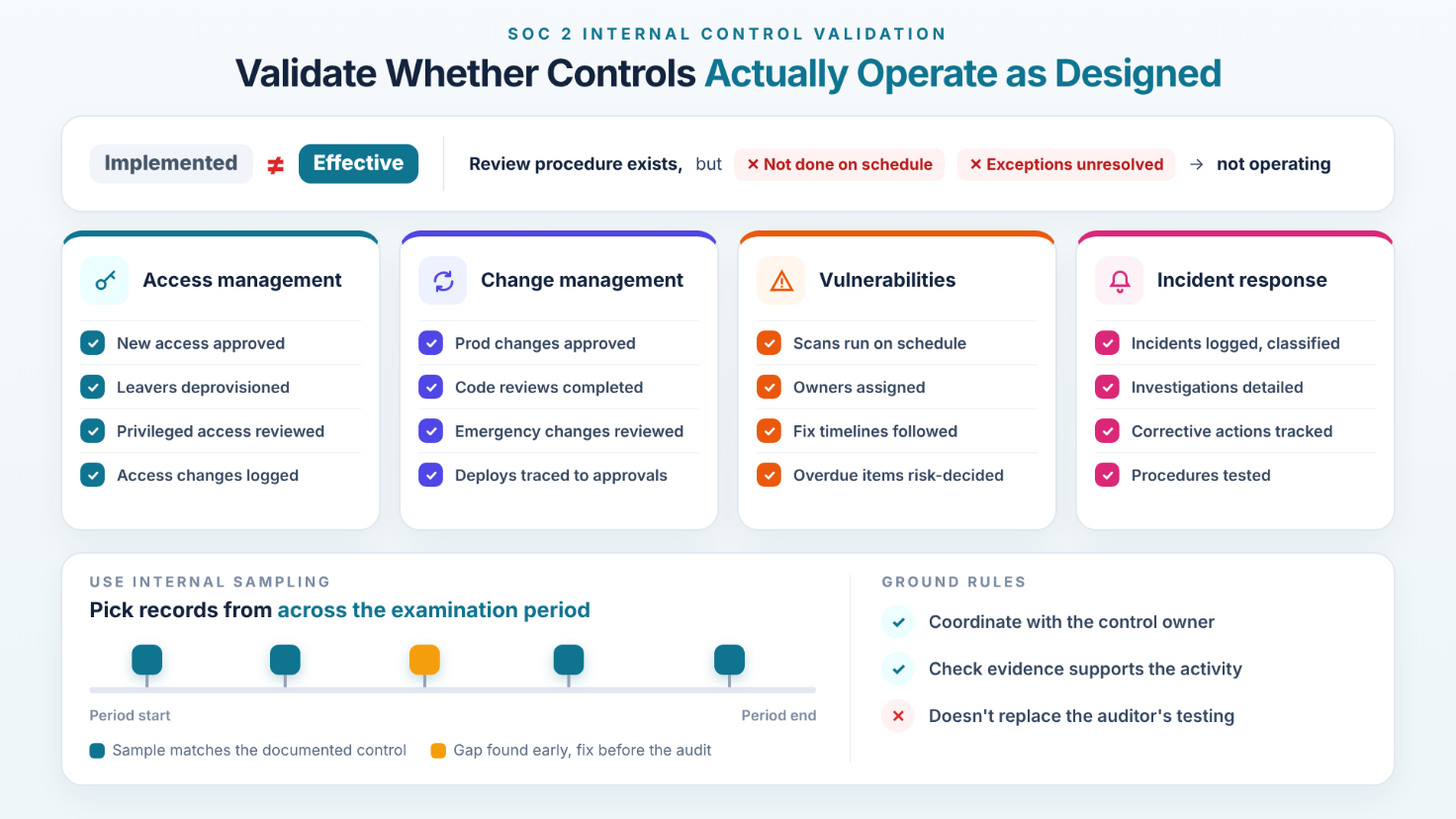
Use sampling to identify operational weaknesses
CISOs can introduce internal testing that examines selected records from different points in the examination period. For example, an internal reviewer may examine a selection of user access requests, production changes, or vulnerability remediation records.
The objective is to determine whether the control was performed according to its documented requirements and whether the evidence supports that activity.
Internal sampling should be coordinated with the control owner and designed to identify gaps early. It does not replace the independent auditor's testing or determine the auditor's sample size.
These internal reviews help identify operational weaknesses before they affect the examination outcome.
Manage Control Exceptions Before They Become Audit Findings
Even well-managed organizations can experience control failures. An employee may miss a scheduled review, a security update may be delayed, or an approval may not be documented correctly.
The important factor is how the organization identifies, evaluates, and addresses these exceptions.
CISOs should avoid treating every exception as an isolated documentation problem. They should understand whether it represents a one-time deviation, a recurring process weakness, or a broader control design issue.
A structured exception management process
- Identify: Record the control deviation and the date it occurred.
- Assess: Determine the affected systems, users, data, and potential risk.
- Investigate: Understand why the control did not operate as expected.
- Remediate: Correct the issue and define preventive actions.
- Assign: Identify the person responsible for completing remediation.
- Verify: Confirm that the corrective action has been implemented.
- Document: Maintain evidence of the exception, decision, and resolution.
Example exception register
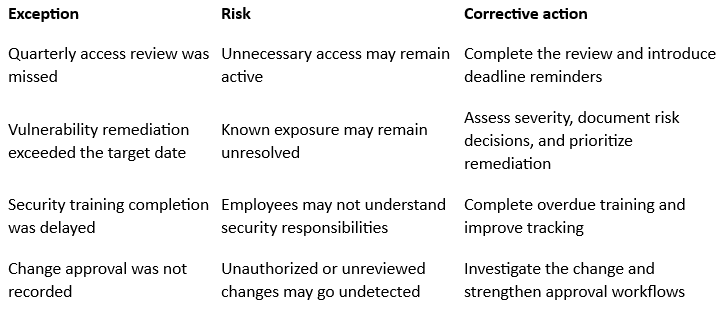
Understand the root cause, not just the symptom
If a quarterly access review is repeatedly delayed, sending another reminder may not address the underlying issue. The responsible team may lack a clear owner, the review population may be inaccurate, or the process may depend on manual spreadsheets.
A stronger corrective action addresses the reason the control failed. This could involve assigning a permanent owner, improving identity data, automating review notifications, or introducing escalation procedures.
A documented exception does not automatically guarantee an unmodified audit opinion. The independent auditor evaluates the nature and significance of deviations and their effect on the examination.
Build Accountability Across Security, IT, and Business Teams
SOC 2 Type II readiness cannot be managed by the security team alone. Many controls depend on activities performed by engineering, HR, IT operations, legal, procurement, and business leadership.
When ownership is unclear, controls may be missed even when the organization has appropriate policies and tools.
CISOs should establish a control ownership model that connects each requirement to a responsible team.
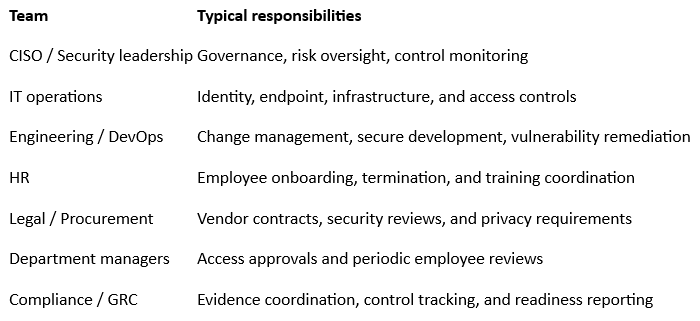
Establish clear escalation paths
Control owners should know what to do when an activity cannot be completed on time or when evidence is unavailable.
For example, if an application owner cannot complete an access review, the issue should be escalated to the designated manager or security owner. If a vulnerability cannot be remediated within the defined timeframe, the responsible team should document the risk, mitigation measures, and approval for any exception.
A centralized control register can help leadership track ownership, execution frequency, evidence availability, and remediation progress.
This also reduces dependency on individual employees who may otherwise become the only people capable of explaining or demonstrating a particular control.
Review Third-Party Dependencies and Changes to the Environment
SOC 2 readiness also depends on understanding the service providers that support an organization's system.
Cloud hosting providers, identity platforms, monitoring services, payment processors, and other external vendors may contribute to the delivery or security of a service.
CISOs should identify relevant third-party dependencies and understand how responsibilities are divided between the organization and its service providers.
Third-party review considerations
- Does the vendor support a critical business or security function?
- Is a current vendor risk assessment available?
- Are relevant independent assurance reports reviewed?
- Are contractual security and privacy responsibilities documented?
- Are vendor access permissions appropriate?
- Are complementary user entity controls identified where relevant?
- Are changes in vendor services or dependencies reviewed?
Organizations should also evaluate changes within their own environment during the examination period. New applications, cloud migrations, changes in infrastructure ownership, and significant changes to access management may affect how controls operate.
Maintaining a record of significant changes helps the organization assess whether existing controls remain appropriate and whether additional evidence is required.
Monitor Readiness Throughout the Examination Period
SOC 2 Type II readiness should not be treated as a final audit preparation exercise. Controls need to operate throughout the defined period, and security teams need visibility into whether they continue to work as expected.
A practical monitoring process should identify missed activities, overdue remediation, and changes that could affect control effectiveness.
Metrics CISOs should monitor
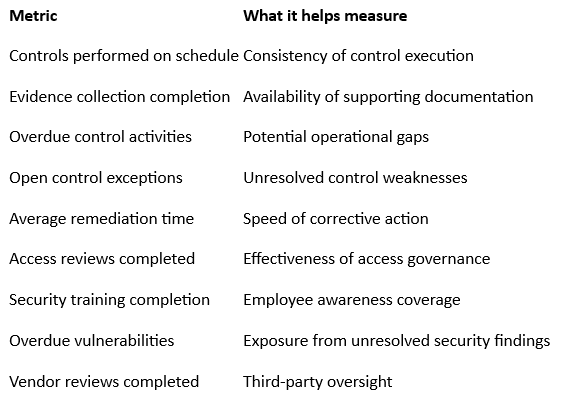
These metrics should be reviewed regularly by control owners and security leadership.
Use dashboards to support decisions
A centralized readiness dashboard can show which controls are operating as expected, which evidence items are pending, and which exceptions require management attention.
However, a dashboard should not become a substitute for actual control evidence. A green status or a high readiness percentage does not independently prove that a control operated effectively.
CISOs should use metrics to identify problems, assign owners, and prioritize corrective actions. Supporting records should remain traceable to the systems and activities that generated them.
Prepare for Audit Testing With an Internal Readiness Review
Before the independent examination, CISOs should conduct an internal readiness review to evaluate whether the organization can demonstrate control performance using appropriate evidence.
This is more than checking whether documents exist. The review should test whether evidence supports the actual operation of each control.
Internal readiness review checklist
- Are all in-scope systems and services documented?
- Are controls mapped to relevant risks and Trust Services Criteria?
- Does every control have an identified owner?
- Are control activities performed at the required frequency?
- Is evidence available for the relevant examination period?
- Can evidence be traced to the original source?
- Are control exceptions recorded and evaluated?
- Are remediation actions assigned and tracked?
- Have significant system and control changes been documented?
- Are relevant third-party dependencies reviewed?
- Can control owners explain how their controls operate?
- Are evidence retrieval and auditor request processes tested?
Prioritize gaps based on risk and timing
Not every readiness gap has the same impact. A missing record for a critical access control may require more immediate attention than a minor documentation improvement.
CISOs should prioritize gaps based on the affected control, potential exposure, frequency of failure, and time remaining in the examination period.
A practical gap register should include the finding, risk rating, responsible owner, corrective action, target date, and verification status.
Where gaps are identified, the organization should prioritize remediation based on risk and the time remaining before the examination. CISOs should also coordinate with the independent service auditor to understand evidence expectations and examination logistics.
Internal readiness reviews support preparation but do not replace the auditor's independent testing.
How Indrasol Supports SOC 2 Type II Readiness
Organizations often need support connecting compliance requirements with the everyday activities of security, IT, and engineering teams.
Indrasol's SOC 2 compliance services support organizations through readiness assessment, control implementation, evidence preparation, and audit coordination.
The approach focuses on helping organizations move from identifying gaps to implementing practical controls and establishing repeatable compliance processes.
Key areas of support include:
- SOC 2 readiness assessment: Evaluate the existing security posture and identify gaps against applicable Trust Services Criteria.
- SOC 2 policies and controls implementation: Develop and implement policies and operational controls aligned with business requirements.
- Evidence collection support: Organize supporting records and improve evidence readiness.
- SOC 2 audit preparation services: Conduct internal readiness reviews and support coordination with the independent auditor.
- Type I and Type II support: Help organizations prepare for the examination approach that aligns with their business objectives.
- Ongoing compliance support: Improve control monitoring and maintain readiness as systems and processes change.
For SaaS companies, startups, and technology organizations, a structured readiness program can reduce last-minute preparation and improve visibility into control performance.
Learn more about Indrasol SOC 2 compliance services.
Move From Control Implementation to Demonstrated Effectiveness
SOC 2 Type II readiness is ultimately about demonstrating that an organization's controls operate as intended over time.
For CISOs, this requires more than approving policies or purchasing compliance tools. It involves establishing ownership, validating operational activities, maintaining reliable evidence, managing exceptions, reviewing third-party dependencies, and monitoring control performance throughout the examination period.
Organizations that integrate these activities into normal operations are better positioned to identify gaps early and respond to audit requests with confidence.
The objective should be to build a security program that can demonstrate consistent control performance—not simply assemble documentation when an examination approaches.
Frequently Asked Questions
What is SOC 2 Type II readiness?
SOC 2 Type II readiness is the process of preparing an organization to demonstrate that its relevant controls are suitably designed and operating effectively throughout a defined examination period. It includes scoping, control implementation, evidence collection, internal validation, and exception management.
How is SOC 2 Type II different from Type I?
SOC 2 Type I evaluates the suitability of control design at a specific point in time. Type II evaluates both control design and operating effectiveness over a defined period.
What evidence is required for SOC 2 Type II?
Evidence depends on the controls and systems in scope. Common examples include access approvals, access review records, security training records, vulnerability reports, change management tickets, incident logs, backup records, and vendor assessments.
How long does SOC 2 Type II readiness take?
The timeline depends on the organization's existing security maturity, scope, control gaps, and ability to operate controls consistently. Organizations should plan their examination period with their independent service auditor rather than assume a universal minimum duration.
Can a company prepare for SOC 2 Type II without a Type I report?
Yes. A Type I report is not a universal prerequisite for a Type II examination. Organizations can prepare directly for Type II if their controls and evidence are ready for the defined examination period.
Why is evidence collection important for SOC 2 Type II?
Evidence helps demonstrate how controls were performed, when they operated, and who was responsible. Without reliable evidence, an organization may find it difficult to support claims about control effectiveness during the examination period.
How can CISOs improve SOC 2 audit readiness?
CISOs can improve readiness by assigning control owners, defining execution frequencies, automating evidence collection where appropriate, monitoring control performance, documenting exceptions, and conducting internal readiness reviews.
Does SOC 2 Type II certify that an organization is secure?
No. SOC 2 Type II results in an independent attestation report, not a security certification or guarantee against incidents. The report provides an opinion on the controls and examination period covered.
About the Author
Brahma Guptha Illindra
Brahma Gupta is a technology entrepreneur, enterprise technology leader, and Founder & CEO of Indrasol, helping organizations adopt AI, cloud, data, and cybersecurity technologies securely, compliantly, and at scale. Over the years, he has worked across enterprise architecture, data engineering, analytics, cloud technologies, Oracle EPM, and business transformation. Today, his focus is increasingly on one of the biggest challenges facing enterprises: how to adopt AI at scale without losing visibility, security, governance, or control. At Indrasol, he and his team help organizations bridge the gap between technology innovation and business risk across: • AI Security & AI-SPM (AI Security Posture Management) • AI Governance & Responsible AI • Cloud Security & CSPM (Cloud Security Posture Management) • Cybersecurity & Risk Management • SOC 2, ISO 27001, ISO 42001 & CMMC compliance • Cloud modernization & DevOps • Data, analytics & AI transformation • Enterprise technology & automation Brahma is particularly
View Brahma Guptha Illindra's profile