
 Bizradar
 Tanva
SOC 2 Continuous Compliance: A CISO Guide
Summary
SOC 2 compliance should not become an annual exercise that begins shortly before an audit. CISOs need a continuous approach to control monitoring, risk management, evidence collection, and remediation to maintain security and audit readiness throughout the year. This guide explains how organizations can move from periodic compliance activities to a sustainable SOC 2 compliance program.
Why CISOs Need to Move Beyond Annual SOC 2 Preparation
Many organizations approach SOC 2 compliance as a project with a defined start and end date. Teams prepare policies, collect evidence, review controls, and coordinate with auditors when an assessment approaches.
However, security risks and business operations do not remain unchanged throughout the year. Employees join and leave, cloud environments change, vendors introduce new services, and applications receive frequent updates.
A control that was effective during the previous audit may no longer operate as expected. If organizations identify these changes only during the next audit preparation cycle, they may face unexpected compliance gaps and additional remediation work.
SOC 2 continuous compliance shifts the focus from preparing for an audit to maintaining effective controls throughout the year. For CISOs, this means building processes that connect security operations, governance, risk management, and compliance activities.
What Does SOC 2 Continuous Compliance Actually Mean?
SOC 2 continuous compliance is an ongoing approach to maintaining, monitoring, and reviewing the controls that support an organization's SOC 2 requirements.
It does not mean conducting an audit every day. Instead, it means ensuring that relevant controls continue to operate as intended and that organizations can demonstrate their effectiveness when required.
A continuous compliance program generally includes:
- Control monitoring: Regularly checking whether security controls remain effective.
- Evidence management: Maintaining relevant records instead of collecting everything at the last minute.
- Risk assessments: Identifying changes that could affect the organization's security posture.
- Access reviews: Validating user permissions and removing unnecessary access.
- Vendor oversight: Reviewing third-party risks and changes in service providers.
- Remediation tracking: Assigning ownership and verifying that identified gaps are resolved.
- Policy reviews: Updating documentation when business processes or technology environments change.
The objective is to make compliance part of normal business operations rather than a separate activity performed only before an audit.
Why Annual Audit Preparation Creates Compliance Gaps
Annual preparation can help organizations organize documentation and address known issues. However, relying entirely on periodic preparation creates several challenges.
1. Security Controls May Become Outdated
Organizations frequently change their applications, infrastructure, access requirements, and internal processes.
When controls are not reviewed after these changes, documented procedures may no longer reflect actual operations.
For example, a company may update its employee onboarding process but continue using an older access approval procedure in its compliance documentation.
2. Evidence Collection Becomes Time-Consuming
When evidence is collected only before an audit, teams may need to retrieve records from multiple systems and departments.
This can involve searching for access approvals, reviewing change management tickets, gathering monitoring records, and confirming that required activities were completed.
Maintaining evidence throughout the year reduces last-minute effort and makes documentation easier to validate.
3. Remediation Gets Delayed
A security issue identified during an audit preparation exercise may require coordination between IT, engineering, security, and management teams.
If there is no continuous remediation process, findings can remain unresolved for longer than necessary.
4. Third-Party Risks May Go Unnoticed
SaaS companies and technology providers depend on cloud platforms, software vendors, and external service providers.
A vendor's security posture, access requirements, or service arrangements may change during the year. Without ongoing vendor reviews, organizations may overlook risks that affect their own compliance responsibilities.
5. Management Has Limited Compliance Visibility
When compliance information is available only during periodic reviews, leadership may not have a clear view of outstanding issues, control performance, or remediation progress.
CISOs need timely information to understand whether the organization's security and compliance program is operating effectively.
How CISOs Can Build a Continuous SOC 2 Compliance Program
Moving beyond annual preparation requires a structured approach. The following activities help establish continuous oversight without creating unnecessary administrative work.
1. Establish a Centralized View of SOC 2 Controls
Start by identifying the controls that support the organization's selected Trust Services Criteria.
The relevant criteria depend on the organization's services, commitments, systems, and scope. Security is central to SOC 2, while availability, processing integrity, confidentiality, and privacy may also apply.
Create a centralized control register that records:
- Control description and objective
- Applicable SOC 2 criteria
- Responsible control owner
- Required operating frequency
- Evidence requirements
- Current implementation status
- Last review date
- Open issues and remediation actions
This register helps CISOs understand who is responsible for each control and whether the required activities are being performed.
2. Monitor Control Effectiveness Throughout the Year
Having a documented policy does not automatically demonstrate that a control is operating effectively.
Organizations need to verify that control activities are performed consistently and that exceptions are identified and addressed.
Examples include:
Control owners should document the activities they perform and retain appropriate supporting evidence.
3. Maintain Audit Evidence as Activities Occur
Evidence collection should be connected to the systems and processes where control activities take place.
For example, access approvals may be available in identity management systems, change records in ticketing platforms, and security events in monitoring tools.
Rather than collecting these records shortly before an audit, organizations should define what evidence is required and how frequently it must be retained.
A practical evidence management process should include:
- Evidence source and description
- Related control or requirement
- Collection frequency
- Responsible owner
- Relevant reporting period
- Review and approval status
- Retention requirements
SOC 2 evidence collection support can help organizations organize these records, reduce manual follow-ups, and maintain a more consistent audit trail.
Evidence should be relevant, complete, and traceable to the activity it supports. Automated collection can reduce manual work, but the evidence still needs appropriate review and validation.
4. Integrate Compliance Into Change Management
Technology changes can affect the controls an organization relies on.
New applications, infrastructure deployments, cloud configuration updates, and changes to business workflows should be evaluated for their potential compliance impact.
For example, introducing a new cloud service may require updates to access policies, vendor documentation, risk assessments, and monitoring procedures.
CISOs should ensure that change management processes include compliance considerations.
Before significant changes are introduced, teams should ask:
- Does this change affect systems within the SOC 2 scope?
- Are additional security controls required?
- Does the change introduce a new vendor or data processor?
- Should policies or procedures be updated?
- What evidence should be retained?
This helps prevent gaps between documented controls and actual technology operations.
5. Establish Continuous Risk and Vendor Reviews
Risk assessments should not remain static documents created only during initial SOC 2 readiness.
Organizations should reassess risks when important changes occur, such as new business services, infrastructure changes, security incidents, or new third-party dependencies.
Vendor reviews should also consider changes in service scope, security documentation, data access, and contractual responsibilities.
A consistent process helps security leaders identify risks before they affect business operations or compliance commitments.
6. Track Remediation Until Issues Are Resolved
Identifying a compliance gap is only the beginning. Organizations need to ensure that corrective actions are assigned, completed, and validated.
A remediation register can help track:
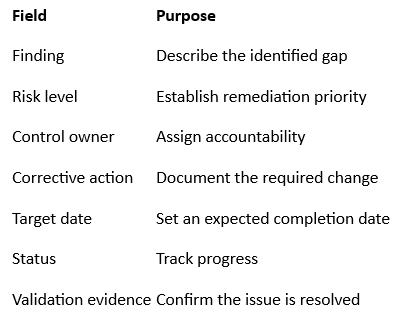
CISOs should review overdue findings and recurring issues as part of regular compliance governance meetings.
SOC 2 Type I vs. Type II: Why Continuous Compliance Matters
Organizations should understand how their SOC 2 engagement type affects their compliance planning.
A Type I examination evaluates the design of controls at a specified point in time. A Type II examination evaluates both control design and operating effectiveness over a specified period.
This distinction makes ongoing control operation and evidence management particularly important when preparing for a Type II examination.
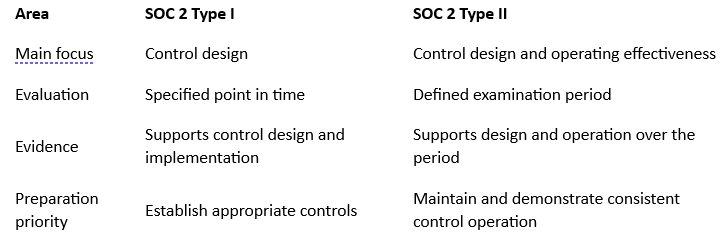
Organizations seeking SOC 2 Type 1 compliance consulting or SOC 2 Type 2 compliance consulting should align their readiness activities with the intended examination.
Continuous compliance practices can help with both, but they are especially valuable for maintaining control consistency and evidence across a Type II examination period.
Key SOC 2 Compliance Metrics CISOs Should Monitor
CISOs need more than a report showing how many controls have been documented. They need metrics that demonstrate whether compliance activities are being performed and whether identified issues are being addressed.
The following indicators can help leadership assess program performance.
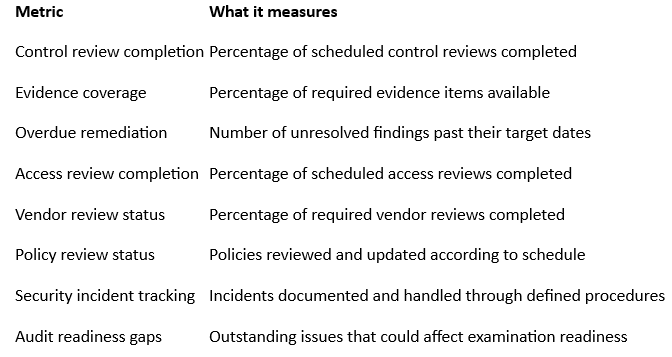
Metrics should have clear definitions, accountable owners, and review frequencies.
For example, a high evidence coverage percentage does not necessarily mean controls are operating effectively. Leadership should review evidence quality and control performance alongside completion metrics.
Common Mistakes That Weaken Continuous SOC 2 Compliance
Even organizations with established compliance programs can struggle to maintain consistent control operation.
Watch for these common mistakes:
- Treating compliance as an annual project: This encourages last-minute preparation instead of ongoing oversight.
- Assigning unclear control ownership: Activities may be missed when responsibilities are not documented.
- Collecting evidence without validation: Records may exist but fail to demonstrate that the required control operated.
- Ignoring operational changes: New systems and vendors can introduce risks that existing controls do not address.
- Leaving remediation open: Identified gaps may remain unresolved without clear deadlines and follow-up.
- Relying only on spreadsheets: Manual tracking can become difficult as the organization and control environment grow.
- Updating policies without changing processes: Documentation should reflect how controls actually operate.
Addressing these issues requires coordination between security, IT, engineering, HR, legal, and business teams.
How SOC 2 Compliance Services Support Continuous Readiness
Organizations may have the internal expertise to manage security operations but still need structured support to establish and maintain their compliance program.
Professional SOC 2 compliance services can help organizations evaluate existing controls, identify gaps, establish documentation, and prepare for independent examinations.
Depending on the organization's requirements, support may include:
- SOC 2 readiness assessment: Evaluate current practices against applicable SOC 2 requirements.
- SOC 2 gap assessment: Identify missing or ineffective controls and prioritize improvements.
- SOC 2 consulting: Develop a practical compliance roadmap and guide implementation.
- SOC 2 implementation services: Establish the policies, processes, and controls required for the organization's scope.
- SOC 2 policies and controls implementation: Develop and operationalize security documentation and control activities.
- SOC 2 audit preparation services: Organize evidence, review documentation, and coordinate readiness activities.
- SOC 2 evidence collection support: Improve evidence organization and traceability.
- SOC 2** continuous compliance services:** Support ongoing control reviews, monitoring, and remediation.
The right support model depends on the organization's maturity, internal resources, technology environment, and examination goals.
Building Continuous SOC 2 Compliance for SaaS Companies and Startups
SaaS companies and technology startups often operate with rapidly changing infrastructure, distributed teams, and multiple third-party services.
As they grow, security requirements become more complex. Enterprise customers may request evidence of security controls, vendor oversight, access management, and incident response processes before signing contracts.
For these organizations, SOC 2 compliance should develop alongside business operations rather than becoming a separate project once enterprise opportunities arise.
A practical approach includes:
For startups:
- Complete an initial SOC 2 readiness assessment.
- Define the systems and services within scope.
- Establish essential policies and control owners.
- Implement appropriate access and change management processes.
- Maintain evidence from the beginning.
For growing SaaS companies:
- Review controls as infrastructure and teams expand.
- Monitor cloud security and access changes.
- Reassess third-party service providers.
- Track remediation and recurring findings.
- Maintain evidence across the examination period.
A structured program helps organizations establish SOC 2 compliance for startups and maintain SOC 2 compliance for SaaS companies as their technology and customer requirements evolve.
How Indrasol Supports Ongoing SOC 2 Compliance
Maintaining SOC 2 readiness requires more than preparing documents before an examination. Organizations need a structured approach to assess controls, address gaps, organize evidence, and maintain security practices.
Indrasol provides SOC 2 consulting and implementation support for technology companies, SaaS businesses, and startups.
Its SOC 2 services include:
- Readiness assessments and gap analysis
- Security policies and control implementation
- Type I and Type II readiness support
- Evidence collection and documentation review
- Audit preparation and auditor coordination
- Support for resolving identified findings
Organizations looking for a SOC 2 compliance consultant for technology companies can explore Indrasol SOC 2 compliance services to understand the available support.
For broader compliance requirements, explore Indrasol's cloud compliance services for support related to cloud controls, monitoring, and audit readiness.
Frequently Asked Questions
What is SOC 2 continuous compliance?
SOC 2 continuous compliance is an ongoing approach to maintaining and reviewing security controls, monitoring risks, collecting evidence, and addressing compliance gaps throughout the year.
Why is annual SOC 2 audit preparation not enough?
Annual preparation may identify issues only when an examination approaches. Continuous oversight helps organizations detect control failures, operational changes, and evidence gaps earlier.
What is the difference between SOC 2 readiness and continuous compliance?
SOC 2 readiness focuses on evaluating and preparing controls before an examination. Continuous compliance focuses on maintaining those controls, reviewing their effectiveness, and addressing changes over time.
How does continuous compliance help with SOC 2 Type II?
A Type II examination evaluates control design and operating effectiveness over a specified period. Continuous control monitoring and evidence management help organizations demonstrate that relevant activities were performed consistently during that period.
Can SOC 2 compliance be automated?
Some activities, such as evidence collection, configuration monitoring, reminders, and workflow tracking, can be automated. However, organizations still need human oversight to validate evidence, evaluate risks, approve decisions, and ensure controls operate effectively.
Do startups need SOC 2 continuous compliance?
Startups that handle customer data or sell to enterprise customers can benefit from establishing compliance processes early. Maintaining controls and evidence as the business grows can reduce the effort required for future readiness and examinations.
How can a CISO measure SOC 2 compliance performance?
CISOs can monitor control review completion, evidence coverage, overdue remediation, access review status, vendor review completion, and outstanding compliance gaps.
Make SOC 2 Compliance an Ongoing Business Practice
SOC 2 should not be treated as a deadline-driven activity that begins when an audit approaches. Security controls, business processes, and technology environments continue to change throughout the year.
CISOs need a structured approach that connects control ownership, continuous monitoring, evidence management, risk reviews, and remediation.
By making these activities part of normal operations, organizations can improve visibility into their security posture and maintain a more consistent state of audit readiness.
Build a sustainable compliance program with Indrasol SOC 2 compliance services.
About the Author
Brahma Guptha Illindra
Brahma Gupta is a technology entrepreneur, enterprise technology leader, and Founder & CEO of Indrasol, helping organizations adopt AI, cloud, data, and cybersecurity technologies securely, compliantly, and at scale. Over the years, he has worked across enterprise architecture, data engineering, analytics, cloud technologies, Oracle EPM, and business transformation. Today, his focus is increasingly on one of the biggest challenges facing enterprises: how to adopt AI at scale without losing visibility, security, governance, or control. At Indrasol, he and his team help organizations bridge the gap between technology innovation and business risk across: • AI Security & AI-SPM (AI Security Posture Management) • AI Governance & Responsible AI • Cloud Security & CSPM (Cloud Security Posture Management) • Cybersecurity & Risk Management • SOC 2, ISO 27001, ISO 42001 & CMMC compliance • Cloud modernization & DevOps • Data, analytics & AI transformation • Enterprise technology & automation Brahma is particularly
View Brahma Guptha Illindra's profile