
 Bizradar
 Tanva
SOC 2 Compliance Automation: Build vs Buy
Summary
Should your organization build its own SOC 2 compliance automation system or invest in an existing platform? This guide compares both approaches across cost, implementation effort, integrations, evidence management, security, and scalability to help technology companies make a practical decision.
Why SOC 2 Automation Needs a Build vs Buy Decision
SOC 2 compliance involves more than preparing documents before an audit. Organizations need to manage security controls, monitor activities, collect evidence, review access, track changes, and demonstrate that their controls operate consistently.
As companies grow, managing these activities through spreadsheets and manual processes can become difficult. Teams may spend significant time collecting screenshots, following up with control owners, reviewing access records, and organizing evidence for auditors.
This is where SOC 2 compliance automation becomes valuable. Organizations generally have two options:
- Build: Develop an internal system to manage compliance workflows and evidence collection.
- Buy: Purchase an existing compliance automation platform and configure it around the organization's requirements.
Both approaches can support SOC 2 compliance. However, the right choice depends on the organization's technical capabilities, compliance requirements, budget, and long-term operating model.
What Does SOC 2 Compliance Automation Actually Do?
SOC 2 compliance automation uses software, integrations, and repeatable workflows to simplify compliance activities. It helps organizations collect evidence, monitor controls, manage policies, and track remediation tasks.
Instead of depending entirely on employees to gather information manually, automation connects relevant business and technical systems to collect information more consistently.
Common automation capabilities include:
- Evidence collection: Retrieving relevant records from cloud platforms, identity providers, HR systems, and development tools.
- Control monitoring: Checking whether selected technical controls meet defined requirements.
- Access management: Tracking user access, permissions, and periodic access reviews.
- Policy management: Maintaining policies, approvals, and employee acknowledgements.
- Task management: Assigning responsibilities and tracking outstanding compliance activities.
- Audit preparation: Organizing supporting evidence and making it easier to review.
However, automation does not make an organization SOC 2 compliant automatically. Teams must still define appropriate controls, investigate exceptions, approve changes, and address security gaps. An independent auditor also performs the examination and issues the SOC 2 report.
Option 1: Building Your Own SOC 2 Automation System
Building an internal compliance automation solution gives organizations greater control over how their compliance workflows operate.
Instead of adapting business processes to an existing platform, engineering teams can develop tools around their specific infrastructure, applications, and control requirements.
For technology companies with specialized environments, this approach may provide flexibility that standard platforms cannot always offer.
Advantages of Building an Internal Solution
1. Greater customization
An internal solution can be designed around the organization's actual technology stack and compliance requirements. Teams can create custom workflows, evidence formats, approval processes, and reporting dashboards.
2. Control over data and architecture
Organizations can decide where compliance data is stored, who can access it, and how information moves between systems. This can be useful when internal security policies impose specific data-handling requirements.
3. Flexible integrations
Engineering teams can develop integrations for internal applications, proprietary infrastructure, and systems that may not be supported by commercial platforms.
4. Control over development priorities
The organization can prioritize features based on its changing compliance requirements. It does not have to wait for a third-party vendor to introduce a particular capability.
Challenges of Building SOC 2 Automation
The flexibility of an internal solution comes with additional responsibilities.
An important consideration is that the automation system itself becomes part of the organization's technology environment. It needs appropriate security controls, documentation, access restrictions, and ongoing maintenance.
A system that works during the first audit may become difficult to maintain as the company adds new applications, employees, and infrastructure.
Option 2: Buying a SOC 2 Compliance Automation Platform
Purchasing an existing compliance automation platform allows organizations to use established workflows and integrations instead of developing everything internally.
These platforms commonly provide control libraries, evidence collection capabilities, policy management, monitoring, and audit preparation features.
For startups and growing SaaS companies, buying can reduce the initial engineering effort required to organize compliance activities.
Advantages of Buying a Compliance Platform
1. Faster implementation
Organizations can start with existing workflows and supported integrations. This may reduce the time needed to establish evidence collection and compliance tracking processes.
2. Prebuilt integrations
Many platforms connect with commonly used cloud providers, identity systems, HR applications, and development tools. These integrations can reduce manual evidence collection.
3. Centralized compliance management
Teams can manage policies, control owners, evidence requests, and remediation tasks through a common interface.
4. Easier collaboration
Security, engineering, HR, and management teams can work from shared compliance records. This improves visibility into responsibilities and outstanding tasks.
5. Ongoing platform updates
The vendor is responsible for maintaining the product and improving supported integrations. Organizations can benefit from these updates without managing the entire software development lifecycle themselves.
Challenges of Buying a Platform
Buying a platform does not remove every compliance responsibility. Organizations should evaluate the limitations and long-term costs before selecting a vendor.
- Subscription costs: Licensing fees may increase as the organization adds employees, integrations, or frameworks.
- Integration limitations: Some internal applications may require custom development or manual evidence uploads.
- Customization constraints: Predefined workflows may not match every organization's processes.
- Vendor dependency: Teams depend on the provider for product availability, support, and feature updates.
- Data security considerations: Compliance evidence may contain sensitive employee, infrastructure, or business information.
Before purchasing, organizations should review the vendor's security documentation, data handling practices, access controls, retention policies, and evidence export capabilities.
Build vs Buy: A Side-by-Side Comparison
The best approach becomes clearer when both options are evaluated against the same business requirements.
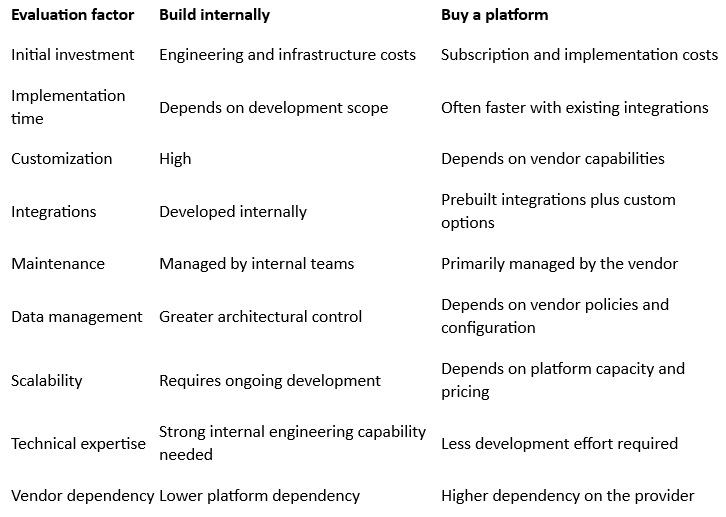
Neither option is automatically better. A company should compare the total effort and cost of operating each solution over time rather than focusing only on the initial investment.
How Much Does SOC 2 Automation Cost?
Cost is one of the most important considerations in a SOC 2 compliance automation decision. However, comparing only software development expenses with subscription fees can produce an incomplete picture.
Organizations should calculate the total cost of ownership for both approaches.
Costs Involved in Building
An internally developed solution may require investment in:
- Software engineers and developers.
- Cloud infrastructure and hosting.
- Integration development and testing.
- Security reviews and maintenance.
- Documentation and employee training.
- Ongoing technical support.
These expenses continue after the initial development phase. Teams must also account for the time required to update integrations when connected systems change.
Costs Involved in Buying
A commercial compliance platform may involve:
- Annual or monthly subscription fees.
- Implementation and onboarding charges.
- Additional integration or customization costs.
- Employee training and support.
- Costs for additional frameworks or features.
- Internal time spent reviewing evidence and resolving exceptions.
The subscription fee is only one part of the overall investment.
Compare the Total Cost of Ownership
Use the following framework before making a decision:
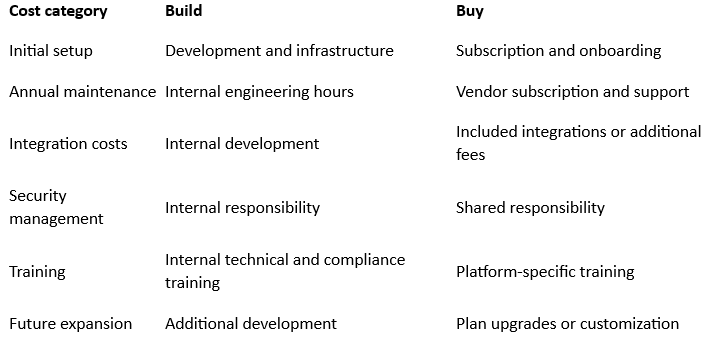
For a realistic comparison, estimate costs over at least two or three years. Include internal employee time, maintenance, and the effort required to resolve incomplete evidence.
Which Approach Is Better for SaaS Companies and Startups?
The right decision often depends on the organization's size, technical environment, and compliance maturity.
SOC 2 Compliance for Startups
Startups generally have limited engineering resources and need to establish compliance without diverting too much time from product development.
Buying an existing platform may be a practical starting point when the organization uses common cloud and business applications. Prebuilt integrations and templates can help establish basic compliance workflows.
However, startups should avoid purchasing more features than they currently need. The platform should support their actual audit scope and expected growth.
SOC 2 Compliance for Growing SaaS Companies
Growing SaaS companies often manage more employees, cloud resources, customer information, and internal applications.
A commercial platform can simplify recurring evidence collection and control monitoring. However, companies with specialized infrastructure may need additional integrations or custom workflows.
A hybrid approach can be useful when standard platform capabilities cover most requirements but certain internal systems need specialized automation.
SOC 2 Compliance for Large Technology Companies
Large organizations may have complex infrastructure, multiple business units, and several compliance frameworks.
They may benefit from a hybrid model that combines commercial automation platforms with internally developed integrations. This provides a balance between standardized compliance management and organization-specific requirements.
When Should You Choose Build, Buy, or Hybrid?
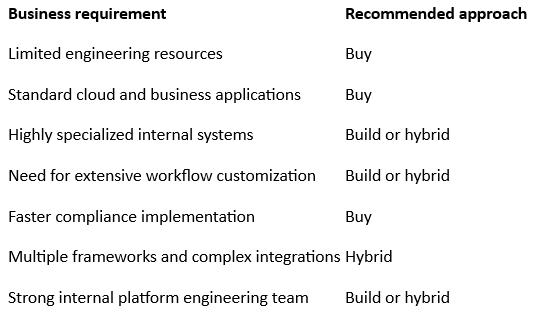
Use the following decision framework to identify the approach that best matches your requirements.
Consider a Hybrid SOC 2 Automation Strategy
For many organizations, the decision does not have to be limited to building or buying.
A hybrid strategy combines a commercial compliance platform with selected internal tools and integrations.
For example, an organization might:
- Use a commercial platform for policy management and compliance tracking.
- Connect cloud and identity systems through supported integrations.
- Develop custom scripts to collect evidence from internal applications.
- Use internal dashboards for specialized reporting.
- Maintain centralized ownership of evidence review and remediation.
This approach can reduce development effort while providing flexibility where standard platform capabilities are insufficient.
However, hybrid solutions also require clear ownership. Teams must understand which system is responsible for collecting, validating, storing, and maintaining each piece of evidence.
What to Evaluate Before Selecting a SOC 2 Automation Solution
Before investing in a solution, organizations should evaluate more than the number of integrations or features listed on a vendor's website.
The following considerations can help security and compliance teams make a more informed decision.
1. Integration coverage
Check whether the solution supports the systems that generate your compliance evidence. Identify which integrations are native, which require additional configuration, and which still need manual uploads.
2. Evidence quality and traceability
Confirm whether collected evidence includes relevant timestamps, ownership details, source information, and historical records. Teams should be able to explain where evidence came from and how it supports a particular control.
3. Access and security controls
Review role-based access, authentication, encryption, logging, and administrative permissions. Restrict access to sensitive compliance information based on business requirements.
4. Control mapping
Evaluate whether the platform supports the controls relevant to your SOC 2 scope. Generic templates should be reviewed and adapted to reflect how your organization actually operates.
5. Scalability and pricing
Understand how pricing changes as the organization adds users, integrations, or compliance frameworks. Also consider whether the solution can support future business and infrastructure changes.
6. Evidence portability
Check whether the organization can export its evidence, records, and documentation in usable formats. This reduces the risk of becoming dependent on a single platform.
Common Mistakes to Avoid When Automating SOC 2 Compliance
Automation can improve compliance operations, but poor implementation can create additional work and unreliable evidence.
Watch out for these common mistakes:
- Choosing a platform based only on price: A low subscription cost may hide expensive integration and maintenance requirements.
- Automating before defining controls: Teams should understand their control requirements before configuring automation workflows.
- Assuming every control can be automated: Activities such as management approvals, employee reviews, and vendor assessments may still require human involvement.
- Ignoring integration failures: Failed or incomplete evidence collection should be identified and assigned for resolution.
- Treating dashboards as proof of compliance: A successful automated check does not necessarily demonstrate that every aspect of a control operated effectively.
- Overlooking internal ownership: Every control and evidence workflow needs a responsible owner.
A successful automation strategy combines technology with documented processes, employee accountability, and regular control reviews.
How Indrasol Supports SOC 2 Compliance
Selecting an automation approach is only one part of building an effective SOC 2 program. Organizations also need to assess their security posture, implement appropriate controls, maintain documentation, and prepare evidence for independent examination.
Through its SOC 2 compliance services, Indrasol supports organizations with readiness assessments, security controls and policies, evidence collection, internal reviews, and audit preparation.
Organizations can also explore Cloud Engineering and Security services to support cloud compliance, control implementation, automated evidence collection, and ongoing monitoring.
Whether an organization chooses to build, buy, or adopt a hybrid approach, the objective should remain the same: establish reliable compliance processes that support business growth and security requirements.
Frequently Asked Questions
1. Should a startup build or buy SOC 2 compliance automation?
For many startups, buying an existing platform is a practical option because it reduces the need for internal software development. However, the decision should depend on the startup's infrastructure, budget, integration requirements, and internal expertise.
2. Can SOC 2 compliance be managed without automation software?
Yes. Organizations can manage compliance using spreadsheets, documentation repositories, internal workflows, and manual evidence collection. However, these processes may become difficult to maintain as the number of controls, systems, and employees increases.
3. Does SOC 2 automation software replace an auditor?
No. Automation software helps organize compliance activities and collect supporting evidence. An independent auditor evaluates the controls and issues the SOC 2 report.
4. What should organizations automate first?
Start with recurring activities that generate structured evidence, such as user access records, employee onboarding and offboarding, change management, security training records, and selected cloud configuration checks.
5. Is a hybrid approach suitable for growing SaaS companies?
Yes. A hybrid approach can help SaaS companies use existing platform capabilities while developing custom integrations for specialized systems. It requires clear ownership and consistent evidence management.
6. How do organizations measure the ROI of SOC 2 automation?
Measure the reduction in manual evidence collection hours, time spent following up with control owners, evidence preparation effort, and time taken to resolve exceptions. Compare these improvements against subscription, development, implementation, and maintenance costs.
Make the Right SOC 2 Automation Investment
The build vs buy decision should be based on the organization's long-term requirements, not just the immediate need to prepare for an audit.
Building provides greater customization and architectural control, while buying can reduce development effort and accelerate implementation. A hybrid strategy can offer a practical balance when organizations need both standard compliance workflows and specialized integrations.
The most effective SOC 2 compliance automation strategy is one that improves evidence reliability, supports control ownership, and scales with the organization's security and business requirements.
Looking to strengthen your SOC 2 readiness? Explore Indrasol SOC 2 compliance services to understand how your organization can improve control implementation, evidence management, and audit preparation.
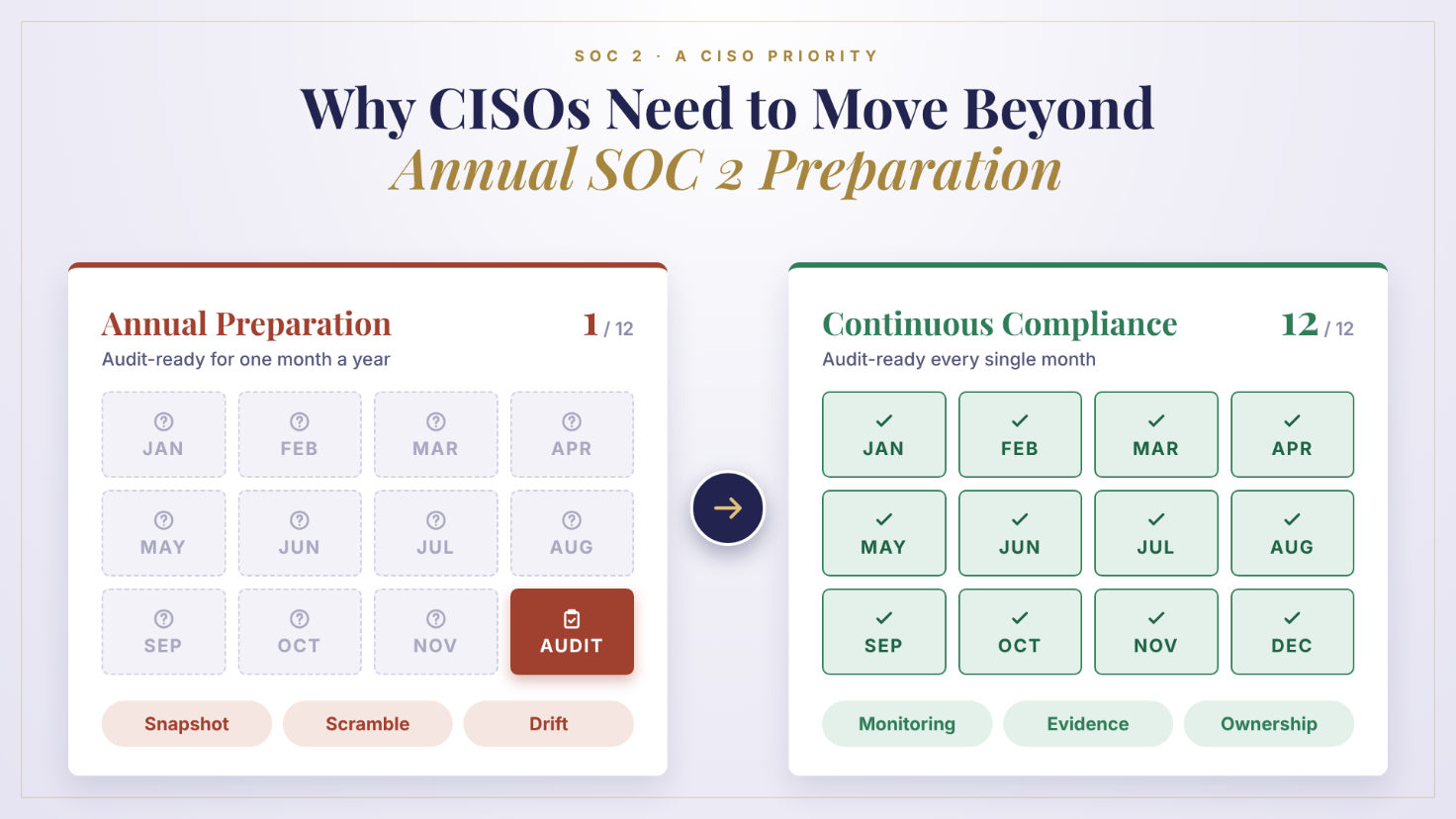
Many organizations approach SOC 2 compliance as a project with a defined start and end date. Teams prepare policies, collect evidence, review controls, and coordinate with auditors when an assessment approaches.
However, security risks and business operations do not remain unchanged throughout the year. Employees join and leave, cloud environments change, vendors introduce new services, and applications receive frequent updates.
A control that was effective during the previous audit may no longer operate as expected. If organizations identify these changes only during the next audit preparation cycle, they may face unexpected compliance gaps and additional remediation work.
SOC 2 continuous compliance shifts the focus from preparing for an audit to maintaining effective controls throughout the year. For CISOs, this means building processes that connect security operations, governance, risk management, and compliance activities.
What Does SOC 2 Continuous Compliance Actually Mean?
SOC 2 continuous compliance is an ongoing approach to maintaining, monitoring, and reviewing the controls that support an organization's SOC 2 requirements.
It does not mean conducting an audit every day. Instead, it means ensuring that relevant controls continue to operate as intended and that organizations can demonstrate their effectiveness when required.
A continuous compliance program generally includes:
- Control monitoring: Regularly checking whether security controls remain effective.
- Evidence management: Maintaining relevant records instead of collecting everything at the last minute.
- Risk assessments: Identifying changes that could affect the organization's security posture.
- Access reviews: Validating user permissions and removing unnecessary access.
- Vendor oversight: Reviewing third-party risks and changes in service providers.
- Remediation tracking: Assigning ownership and verifying that identified gaps are resolved.
- Policy reviews: Updating documentation when business processes or technology environments change.
The objective is to make compliance part of normal business operations rather than a separate activity performed only before an audit.
Why Annual Audit Preparation Creates Compliance Gaps
Annual preparation can help organizations organize documentation and address known issues. However, relying entirely on periodic preparation creates several challenges.
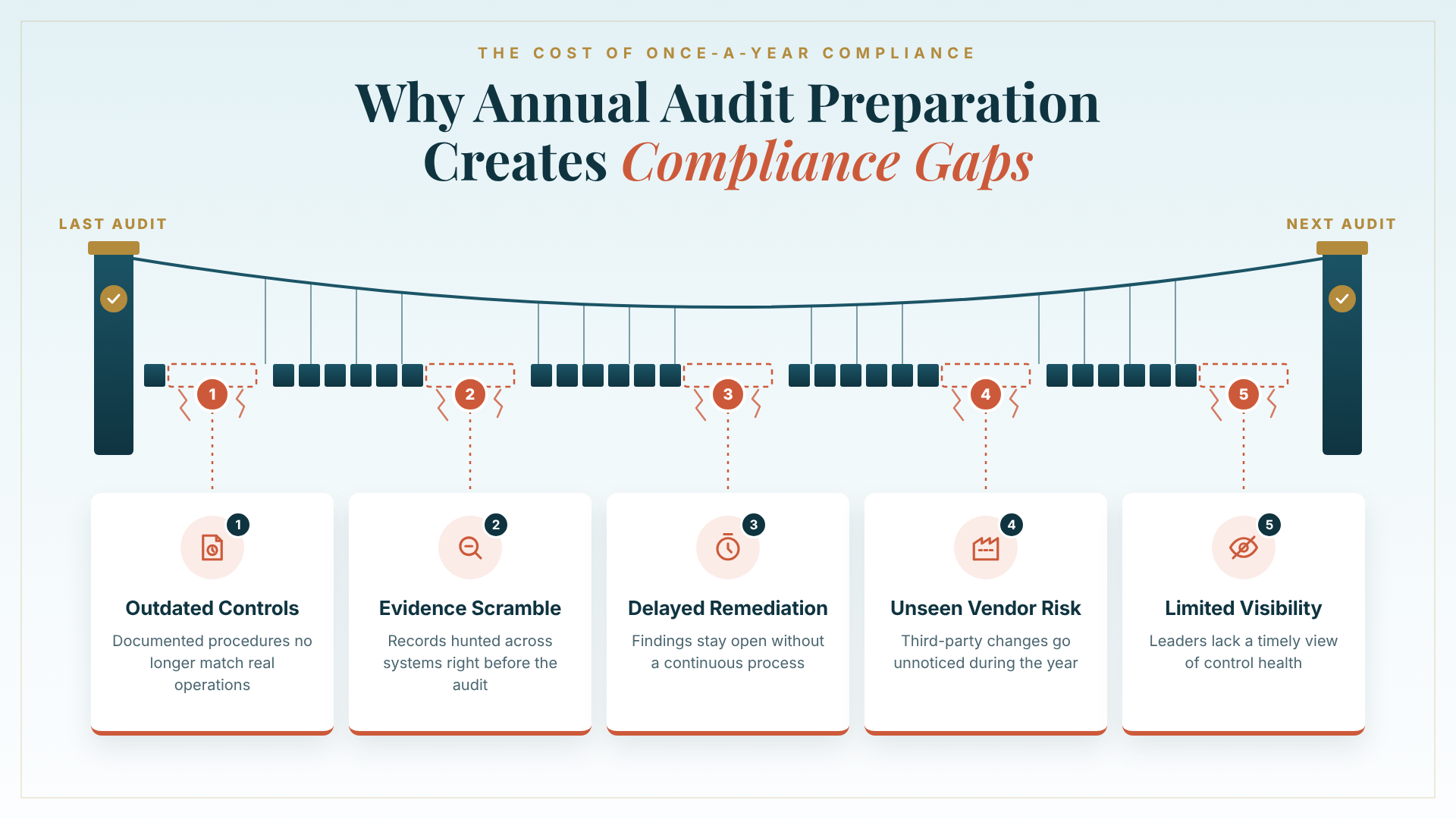
1. Security Controls May Become Outdated
Organizations frequently change their applications, infrastructure, access requirements, and internal processes.
When controls are not reviewed after these changes, documented procedures may no longer reflect actual operations.
For example, a company may update its employee onboarding process but continue using an older access approval procedure in its compliance documentation.
2. Evidence Collection Becomes Time-Consuming
When evidence is collected only before an audit, teams may need to retrieve records from multiple systems and departments.
This can involve searching for access approvals, reviewing change management tickets, gathering monitoring records, and confirming that required activities were completed.
Maintaining evidence throughout the year reduces last-minute effort and makes documentation easier to validate.
3. Remediation Gets Delayed
A security issue identified during an audit preparation exercise may require coordination between IT, engineering, security, and management teams.
If there is no continuous remediation process, findings can remain unresolved for longer than necessary.
4. Third-Party Risks May Go Unnoticed
SaaS companies and technology providers depend on cloud platforms, software vendors, and external service providers.
A vendor's security posture, access requirements, or service arrangements may change during the year. Without ongoing vendor reviews, organizations may overlook risks that affect their own compliance responsibilities.
5. Management Has Limited Compliance Visibility
When compliance information is available only during periodic reviews, leadership may not have a clear view of outstanding issues, control performance, or remediation progress.
CISOs need timely information to understand whether the organization's security and compliance program is operating effectively.
How CISOs Can Build a Continuous SOC 2 Compliance Program
Moving beyond annual preparation requires a structured approach. The following activities help establish continuous oversight without creating unnecessary administrative work.
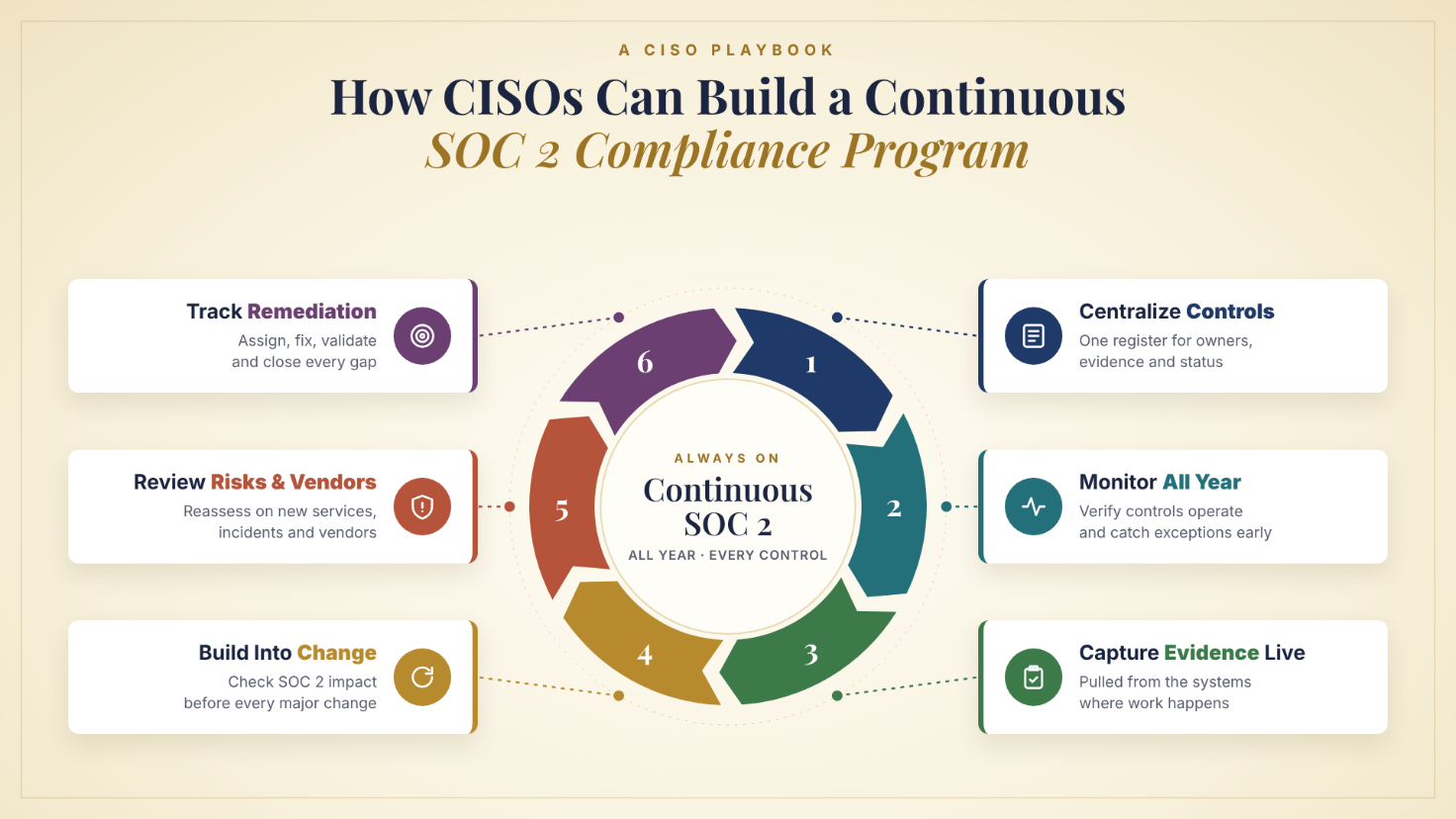
1. Establish a Centralized View of SOC 2 Controls
Start by identifying the controls that support the organization's selected Trust Services Criteria.
The relevant criteria depend on the organization's services, commitments, systems, and scope. Security is central to SOC 2, while availability, processing integrity, confidentiality, and privacy may also apply.
Create a centralized control register that records:
- Control description and objective
- Applicable SOC 2 criteria
- Responsible control owner
- Required operating frequency
- Evidence requirements
- Current implementation status
- Last review date
- Open issues and remediation actions
This register helps CISOs understand who is responsible for each control and whether the required activities are being performed.
2. Monitor Control Effectiveness Throughout the Year
Having a documented policy does not automatically demonstrate that a control is operating effectively.
Organizations need to verify that control activities are performed consistently and that exceptions are identified and addressed.
Examples include:
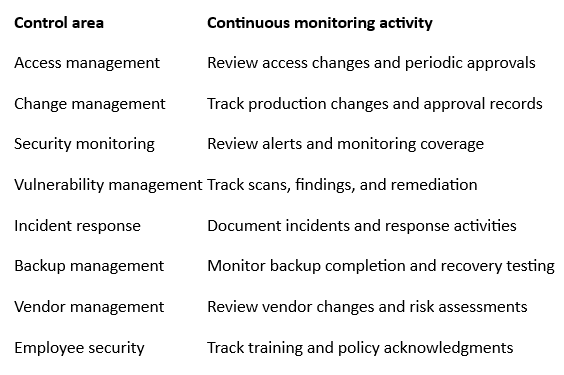
Control owners should document the activities they perform and retain appropriate supporting evidence.
3. Maintain Audit Evidence as Activities Occur
Evidence collection should be connected to the systems and processes where control activities take place.
For example, access approvals may be available in identity management systems, change records in ticketing platforms, and security events in monitoring tools.
Rather than collecting these records shortly before an audit, organizations should define what evidence is required and how frequently it must be retained.
A practical evidence management process should include:
- Evidence source and description
- Related control or requirement
- Collection frequency
- Responsible owner
- Relevant reporting period
- Review and approval status
- Retention requirements
SOC 2 evidence collection support can help organizations organize these records, reduce manual follow-ups, and maintain a more consistent audit trail.
Evidence should be relevant, complete, and traceable to the activity it supports. Automated collection can reduce manual work, but the evidence still needs appropriate review and validation.
4. Integrate Compliance Into Change Management
Technology changes can affect the controls an organization relies on.
New applications, infrastructure deployments, cloud configuration updates, and changes to business workflows should be evaluated for their potential compliance impact.
For example, introducing a new cloud service may require updates to access policies, vendor documentation, risk assessments, and monitoring procedures.
CISOs should ensure that change management processes include compliance considerations.
Before significant changes are introduced, teams should ask:
- Does this change affect systems within the SOC 2 scope?
- Are additional security controls required?
- Does the change introduce a new vendor or data processor?
- Should policies or procedures be updated?
- What evidence should be retained?
This helps prevent gaps between documented controls and actual technology operations.
5. Establish Continuous Risk and Vendor Reviews
Risk assessments should not remain static documents created only during initial SOC 2 readiness.
Organizations should reassess risks when important changes occur, such as new business services, infrastructure changes, security incidents, or new third-party dependencies.
Vendor reviews should also consider changes in service scope, security documentation, data access, and contractual responsibilities.
A consistent process helps security leaders identify risks before they affect business operations or compliance commitments.
6. Track Remediation Until Issues Are Resolved
Identifying a compliance gap is only the beginning. Organizations need to ensure that corrective actions are assigned, completed, and validated.
A remediation register can help track:
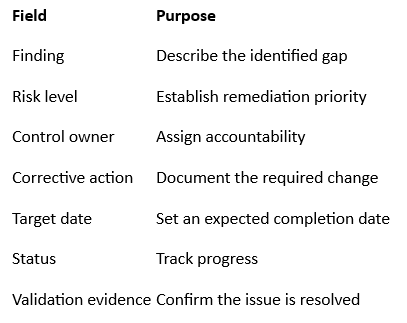
CISOs should review overdue findings and recurring issues as part of regular compliance governance meetings.
SOC 2 Type I vs. Type II: Why Continuous Compliance Matters
Organizations should understand how their SOC 2 engagement type affects their compliance planning.
A Type I examination evaluates the design of controls at a specified point in time. A Type II examination evaluates both control design and operating effectiveness over a specified period.
This distinction makes ongoing control operation and evidence management particularly important when preparing for a Type II examination.
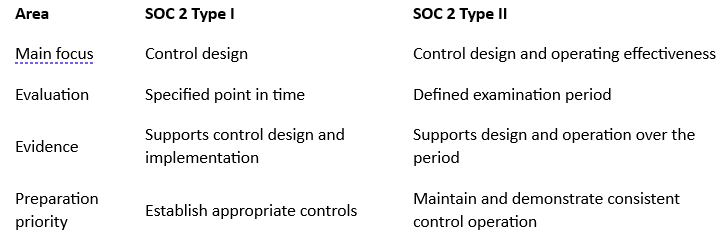
Organizations seeking SOC 2 Type 1 compliance consulting or SOC 2 Type 2 compliance consulting should align their readiness activities with the intended examination.
Continuous compliance practices can help with both, but they are especially valuable for maintaining control consistency and evidence across a Type II examination period.
Key SOC 2 Compliance Metrics CISOs Should Monitor
CISOs need more than a report showing how many controls have been documented. They need metrics that demonstrate whether compliance activities are being performed and whether identified issues are being addressed.
The following indicators can help leadership assess program performance.
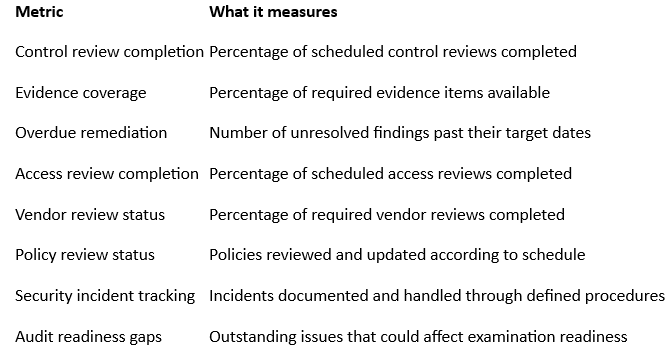
Metrics should have clear definitions, accountable owners, and review frequencies.
For example, a high evidence coverage percentage does not necessarily mean controls are operating effectively. Leadership should review evidence quality and control performance alongside completion metrics.
Common Mistakes That Weaken Continuous SOC 2 Compliance
Even organizations with established compliance programs can struggle to maintain consistent control operation.
Watch for these common mistakes:
- Treating compliance as an annual project: This encourages last-minute preparation instead of ongoing oversight.
- Assigning unclear control ownership: Activities may be missed when responsibilities are not documented.
- Collecting evidence without validation: Records may exist but fail to demonstrate that the required control operated.
- Ignoring operational changes: New systems and vendors can introduce risks that existing controls do not address.
- Leaving remediation open: Identified gaps may remain unresolved without clear deadlines and follow-up.
- Relying only on spreadsheets: Manual tracking can become difficult as the organization and control environment grow.
- Updating policies without changing processes: Documentation should reflect how controls actually operate.
Addressing these issues requires coordination between security, IT, engineering, HR, legal, and business teams.
How SOC 2 Compliance Services Support Continuous Readiness
Organizations may have the internal expertise to manage security operations but still need structured support to establish and maintain their compliance program.
Professional SOC 2 compliance services can help organizations evaluate existing controls, identify gaps, establish documentation, and prepare for independent examinations.
Depending on the organization's requirements, support may include:
- SOC 2 readiness assessment: Evaluate current practices against applicable SOC 2 requirements.
- SOC 2 gap assessment: Identify missing or ineffective controls and prioritize improvements.
- SOC 2 consulting: Develop a practical compliance roadmap and guide implementation.
- SOC 2 implementation services: Establish the policies, processes, and controls required for the organization's scope.
- SOC 2 policies and controls implementation: Develop and operationalize security documentation and control activities.
- SOC 2 audit preparation services: Organize evidence, review documentation, and coordinate readiness activities.
- SOC 2 evidence collection support: Improve evidence organization and traceability.
- SOC 2** continuous compliance services:** Support ongoing control reviews, monitoring, and remediation.
The right support model depends on the organization's maturity, internal resources, technology environment, and examination goals.
Building Continuous SOC 2 Compliance for SaaS Companies and Startups
SaaS companies and technology startups often operate with rapidly changing infrastructure, distributed teams, and multiple third-party services.
As they grow, security requirements become more complex. Enterprise customers may request evidence of security controls, vendor oversight, access management, and incident response processes before signing contracts.
For these organizations, SOC 2 compliance should develop alongside business operations rather than becoming a separate project once enterprise opportunities arise.
A practical approach includes:
For startups:
- Complete an initial SOC 2 readiness assessment.
- Define the systems and services within scope.
- Establish essential policies and control owners.
- Implement appropriate access and change management processes.
- Maintain evidence from the beginning.
For growing SaaS companies:
- Review controls as infrastructure and teams expand.
- Monitor cloud security and access changes.
- Reassess third-party service providers.
- Track remediation and recurring findings.
- Maintain evidence across the examination period.
A structured program helps organizations establish SOC 2 compliance for startups and maintain SOC 2 compliance for SaaS companies as their technology and customer requirements evolve.
How Indrasol Supports Ongoing SOC 2 Compliance
Maintaining SOC 2 readiness requires more than preparing documents before an examination. Organizations need a structured approach to assess controls, address gaps, organize evidence, and maintain security practices.
Indrasol provides SOC 2 consulting and implementation support for technology companies, SaaS businesses, and startups.
Its SOC 2 services include:
- Readiness assessments and gap analysis
- Security policies and control implementation
- Type I and Type II readiness support
- Evidence collection and documentation review
- Audit preparation and auditor coordination
- Support for resolving identified findings
Organizations looking for a SOC 2 compliance consultant for technology companies can explore Indrasol SOC 2 compliance services to understand the available support.
For broader compliance requirements, explore Indrasol's cloud compliance services for support related to cloud controls, monitoring, and audit readiness.
Frequently Asked Questions
What is SOC 2 continuous compliance?
SOC 2 continuous compliance is an ongoing approach to maintaining and reviewing security controls, monitoring risks, collecting evidence, and addressing compliance gaps throughout the year.
Why is annual SOC 2 audit preparation not enough?
Annual preparation may identify issues only when an examination approaches. Continuous oversight helps organizations detect control failures, operational changes, and evidence gaps earlier.
What is the difference between SOC 2 readiness and continuous compliance?
SOC 2 readiness focuses on evaluating and preparing controls before an examination. Continuous compliance focuses on maintaining those controls, reviewing their effectiveness, and addressing changes over time.
How does continuous compliance help with SOC 2 Type II?
A Type II examination evaluates control design and operating effectiveness over a specified period. Continuous control monitoring and evidence management help organizations demonstrate that relevant activities were performed consistently during that period.
Can SOC 2 compliance be automated?
Some activities, such as evidence collection, configuration monitoring, reminders, and workflow tracking, can be automated. However, organizations still need human oversight to validate evidence, evaluate risks, approve decisions, and ensure controls operate effectively.
Do startups need SOC 2 continuous compliance?
Startups that handle customer data or sell to enterprise customers can benefit from establishing compliance processes early. Maintaining controls and evidence as the business grows can reduce the effort required for future readiness and examinations.
How can a CISO measure SOC 2 compliance performance?
CISOs can monitor control review completion, evidence coverage, overdue remediation, access review status, vendor review completion, and outstanding compliance gaps.
Make SOC 2 Compliance an Ongoing Business Practice
SOC 2 should not be treated as a deadline-driven activity that begins when an audit approaches. Security controls, business processes, and technology environments continue to change throughout the year.
CISOs need a structured approach that connects control ownership, continuous monitoring, evidence management, risk reviews, and remediation.
By making these activities part of normal operations, organizations can improve visibility into their security posture and maintain a more consistent state of audit readiness.
Build a sustainable compliance program with Indrasol SOC 2 compliance services.
About the Author
Brahma Guptha Illindra
Brahma Gupta is a technology entrepreneur, enterprise technology leader, and Founder & CEO of Indrasol, helping organizations adopt AI, cloud, data, and cybersecurity technologies securely, compliantly, and at scale. Over the years, he has worked across enterprise architecture, data engineering, analytics, cloud technologies, Oracle EPM, and business transformation. Today, his focus is increasingly on one of the biggest challenges facing enterprises: how to adopt AI at scale without losing visibility, security, governance, or control. At Indrasol, he and his team help organizations bridge the gap between technology innovation and business risk across: • AI Security & AI-SPM (AI Security Posture Management) • AI Governance & Responsible AI • Cloud Security & CSPM (Cloud Security Posture Management) • Cybersecurity & Risk Management • SOC 2, ISO 27001, ISO 42001 & CMMC compliance • Cloud modernization & DevOps • Data, analytics & AI transformation • Enterprise technology & automation Brahma is particularly
View Brahma Guptha Illindra's profile