
 Bizradar
 Tanva
Shadow AI Remediation Playbook for Security Teams
Summary
Shadow AI creates security risks when employees use unapproved AI applications, models, agents, and services without organizational oversight. This practical remediation playbook explains how security teams can identify unauthorized AI usage, assess business exposure, implement appropriate controls, and continuously strengthen enterprise AI security.
Why Shadow AI Remediation Matters for Enterprises
Employees are adopting AI tools to write code, analyze documents, automate workflows, summarize meetings, and improve productivity. However, these tools are not always reviewed by IT or security teams before they are introduced into business operations.
This creates what is commonly known as Shadow AI: the use of AI applications, services, models, or agents outside an organization's approved security and governance processes.
The problem extends beyond employees using public AI chatbots. AI browser extensions, third-party integrations, coding assistants, personal API keys, and independently deployed AI agents can also introduce unmanaged security exposure.
For security leaders, discovering unauthorized AI usage is only the first step. Organizations need a structured remediation process that determines which activities are acceptable, which require additional controls, and which should be restricted.
A well-defined Shadow AI remediation strategy helps organizations reduce unnecessary exposure while allowing employees to continue using AI responsibly.
6 Security Risks That Require Immediate Attention
Not every unauthorized AI application presents the same level of risk. Security teams should evaluate how each tool is used, what information it processes, and which enterprise resources it can access.
The following risks deserve particular attention.
1. Sensitive Data Exposure
Employees may paste customer information, internal reports, financial records, source code, or confidential business documents into external AI platforms.
Depending on the provider and configuration, this information may be processed or retained outside the organization's established data protection environment.
What security teams should investigate:
- Uploads containing confidential or regulated information.
- Prompts containing customer records or employee details.
- Source code shared with unapproved AI coding assistants.
- AI applications with unclear data retention practices.
2. Unauthorized AI Application Access
Employees may independently register for AI services using personal email addresses or connect third-party applications to corporate accounts.
These applications can operate without the visibility of existing IT asset inventories and approval processes.
Security teams should investigate unknown AI applications, OAuth permissions, browser extensions, and third-party integrations connected to corporate identities.
3. Excessive Permissions Granted to AI Agents
AI agents introduce additional risks because they can interact with enterprise applications and perform actions using assigned permissions.
For example, an agent connected to a CRM system might access customer records, modify information, or trigger automated workflows.
If its permissions are broader than necessary, an otherwise legitimate AI integration can become a significant security concern.
4. Third-Party and Supply Chain Exposure
Unapproved AI applications may depend on external model providers, APIs, plugins, open-source packages, and data processing services.
Security teams may not have sufficient information about these dependencies, their security practices, or how enterprise information is handled.
5. Regulatory and Governance Gaps
Unauthorized AI usage can create inconsistencies between organizational policies and actual business practices.
This becomes particularly important when AI applications process personal information, financial data, intellectual property, or other regulated information.
6. Limited Monitoring and Accountability
When AI tools operate outside approved processes, security teams may struggle to determine who introduced them, what information they accessed, and whether suspicious activity occurred.
Without ownership and monitoring, investigating an AI-related security incident becomes more difficult.
A 6-Step Shadow AI Remediation Framework
Effective remediation requires more than blocking unauthorized applications. Security teams need to understand the business requirement, assess the associated exposure, and select controls that address the actual risk.
The following framework provides a practical approach.
Step 1: Establish a Complete AI Asset Inventory
Begin by consolidating information about AI applications, models, agents, APIs, and integrations operating across the enterprise.
Do not limit discovery to applications officially approved by IT. Include employee-used SaaS platforms, developer tools, browser extensions, cloud-hosted models, and AI-enabled business applications.
Useful discovery sources include:
- SaaS application and identity provider logs.
- Endpoint and browser activity monitoring.
- Network traffic and DNS records.
- Cloud infrastructure inventories.
- Source-code and repository scanning.
- API gateway and integration logs.
- Procurement and software approval records.
For each identified asset, record its provider, business owner, users, purpose, access permissions, connected data sources, and approval status.
A centralized inventory gives security teams a foundation for shadow AI discovery and risk assessment.
Step 2: Classify AI Assets Based on Risk
Once the inventory is established, classify each AI asset according to its business purpose, data access, permissions, and potential impact.
A simple classification model can help security teams determine which applications require immediate attention.
Risk classification should consider both technical exposure and business impact.
An AI application used by a small team may still require urgent remediation if it can access sensitive customer information or privileged enterprise systems.
Step 3: Investigate Data Access and AI Permissions
After classification, investigate what each AI application can access and what actions it can perform.
This step is especially important for AI agents, enterprise copilots, and applications connected through APIs.
Security teams should review:
- User permissions and service account privileges.
- API keys, tokens, and authentication methods.
- Access to internal databases and document repositories.
- Connected SaaS applications and third-party services.
- Data uploads, downloads, and external transfers.
- Agent capabilities and automated actions.
Apply the principle of least privilege wherever possible. Remove unnecessary permissions, rotate exposed credentials, and restrict integrations that do not have a legitimate business requirement.
For AI agents, review not only what information they can access but also what actions they are authorized to perform.
Step 4: Select the Right Remediation Action
Not every Shadow AI discovery should result in an application being blocked.
Security teams should choose remediation based on the identified risk, business requirement, and organizational AI policy.
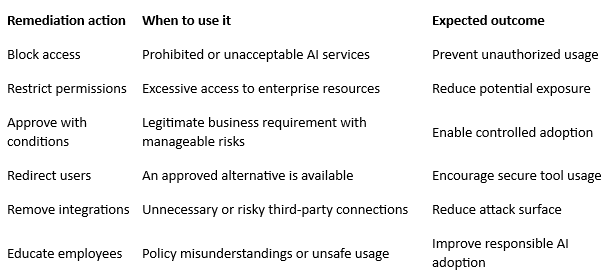
For example, if employees use an unapproved AI writing application, the organization could redirect them to an approved enterprise alternative rather than blocking every AI service.
However, if an application exposes confidential information or introduces unacceptable risk, access restrictions or immediate containment may be necessary.
Step 5: Implement AI Governance and Security Controls
Remediation becomes sustainable when organizations establish clear policies and technical controls.
An effective AI governance approach should define which applications employees can use, what information they can share, and how AI systems should be reviewed before deployment.
Important controls include:
- Approved AI application lists: Maintain a documented list of permitted and prohibited AI services.
- Data protection policies: Define restrictions for confidential information, personal data, source code, and intellectual property.
- Identity and access management: Enforce least-privilege permissions for users, applications, and AI agents.
- Third-party risk reviews: Evaluate AI providers, integrations, and data processing practices.
- AI usage monitoring: Track relevant application activity, access changes, and policy violations.
- Employee awareness: Provide practical guidance on safe AI usage and approved alternatives.
- Incident response procedures: Define how security teams should investigate and contain AI-related incidents.
Policies should be communicated clearly to employees. Security controls are more effective when users understand why certain restrictions exist and which alternatives are available.
Step 6: Continuously Monitor and Reassess AI Risks
Shadow AI remediation should not be treated as a one-time exercise.
Employees may introduce new AI applications, developers may connect additional APIs, and existing applications may introduce new AI capabilities. Permissions and data access can also change over time.
Security teams should establish recurring reviews and monitor important changes across the enterprise AI environment.
Useful monitoring activities include:
- Detecting newly introduced AI applications and services.
- Reviewing changes to AI identities and permissions.
- Monitoring access to sensitive enterprise data.
- Identifying newly connected APIs and integrations.
- Tracking repeated policy violations.
- Reassessing third-party AI provider risks.
- Validating whether remediation actions remain effective.
Organizations should also maintain records of discovered assets, risk decisions, approvals, exceptions, and completed remediation activities.
This creates an ongoing feedback loop between AI discovery, security assessment, governance, and remediation.
Shadow AI Remediation: From Discovery to Resolution
A structured workflow helps security teams move from identifying unauthorized AI usage to implementing measurable security improvements.
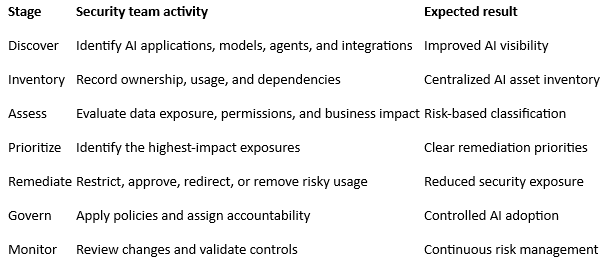
The workflow should connect with existing security operations rather than create another isolated process.
For example, application security teams can review AI-related code and integrations, identity teams can investigate permissions, and governance teams can evaluate policy exceptions.
This cross-functional approach makes remediation more consistent across enterprise environments.
How AI Security Posture Management Supports Shadow AI Remediation
Traditional security tools provide important visibility into applications, identities, infrastructure, and data. However, managing enterprise AI requires additional context about models, agents, AI integrations, and their associated permissions.
This is where AI Security Posture Management (AiSPM) becomes relevant.
AiSPM helps organizations discover AI assets, assess security configurations, understand data and identity relationships, prioritize risks, and continuously monitor their AI environments.
It can support Shadow AI remediation through several capabilities:
AI asset discovery: Identify AI applications, models, agents, APIs, and services operating across the organization.
AI security risk assessment: Evaluate exposure associated with sensitive data, excessive permissions, insecure configurations, and third-party dependencies.
AI agent security assessment: Understand agent identities, connected tools, permissions, and potential actions.
Risk prioritization: Connect technical findings with business context to determine which exposures require immediate attention.
Continuous monitoring: Identify changes in AI assets, integrations, configurations, and access permissions.
AiSPM complements broader application security posture management (ASPM), cloud security, identity security, and data protection programs. These disciplines can work together to provide a more complete view of enterprise technology risk.
For organizations evaluating AI security posture management consulting or AI risk management services, the objective should be to establish measurable visibility and remediation processes rather than simply add another security dashboard.
Key Metrics to Measure Shadow AI Remediation Effectiveness
Security teams need measurable indicators to understand whether their remediation program is reducing exposure.
The following metrics can help CISOs and security leaders evaluate progress.
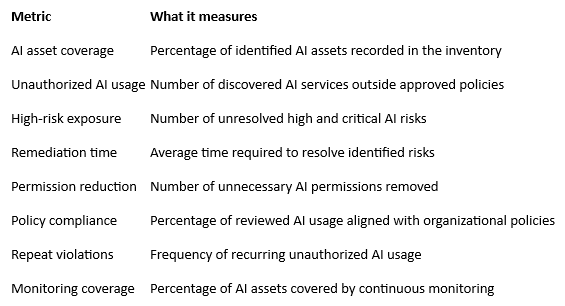
These metrics should be reviewed regularly and compared over time.
A reduction in unresolved high-risk exposures, faster remediation, and improved inventory coverage can indicate that the organization is strengthening its AI security posture.
Questions Security Leaders Should Ask Before Scaling AI
Before expanding enterprise AI adoption, CISOs and security teams should evaluate whether their current security processes can manage the associated risks.
Consider these questions:
- Can we identify all AI applications, models, and agents operating across the enterprise?
- Do we know which AI services can access confidential business information?
- Are AI agents operating with only the permissions they require?
- Do we have a documented process for approving new AI applications?
- Can we detect unauthorized AI integrations and changes in usage?
- Can we prioritize and remediate AI security risks based on business impact?
- Are AI-related security policies communicated and monitored consistently?
If these questions cannot be answered confidently, the organization may need a more structured AI security posture assessment.
Building a Sustainable Shadow AI Security Program
Restricting every unapproved AI application is not a long-term solution to enterprise AI risk. Employees need practical tools to perform their work, and organizations need a way to support innovation without losing control over sensitive information.
A sustainable Shadow AI remediation program combines continuous discovery, risk-based assessment, identity and data protection, governance, and ongoing monitoring.
Security teams should focus on understanding what AI assets exist, what they can access, and which risks require action. This makes it easier to distinguish acceptable AI usage from exposures that need immediate remediation.
As enterprise AI adoption expands, organizations need security processes that evolve alongside their technology. A well-implemented AiSPM strategy can help connect AI discovery, security assessment, governance, and remediation into a continuous enterprise security program.
About the Author
Brahma Guptha Illindra
Brahma Gupta is a technology entrepreneur, enterprise technology leader, and Founder & CEO of Indrasol, helping organizations adopt AI, cloud, data, and cybersecurity technologies securely, compliantly, and at scale. Over the years, he has worked across enterprise architecture, data engineering, analytics, cloud technologies, Oracle EPM, and business transformation. Today, his focus is increasingly on one of the biggest challenges facing enterprises: how to adopt AI at scale without losing visibility, security, governance, or control. At Indrasol, he and his team help organizations bridge the gap between technology innovation and business risk across: • AI Security & AI-SPM (AI Security Posture Management) • AI Governance & Responsible AI • Cloud Security & CSPM (Cloud Security Posture Management) • Cybersecurity & Risk Management • SOC 2, ISO 27001, ISO 42001 & CMMC compliance • Cloud modernization & DevOps • Data, analytics & AI transformation • Enterprise technology & automation Brahma is particularly
View Brahma Guptha Illindra's profile