
 Bizradar
 Tanva
Prioritizing Critical Risks in Cloud Security
Summary
Cloud security teams often face thousands of CSPM findings across cloud environments, making it difficult to identify which issues require immediate attention. This article explains how organizations can distinguish critical cloud risks from low-priority alerts by evaluating business impact, exploitability, identity exposure, sensitive data access and attack paths.
Why Cloud Security Teams Struggle With Too Many Findings
Cloud environments change continuously as organizations deploy applications, provision infrastructure and modify access permissions. Every change can introduce a configuration weakness, an unexpected exposure or a violation of an established security policy.
Cloud Security Posture Management (CSPM) helps organizations identify these issues through continuous monitoring and automated security assessments. However, identifying security findings is only one part of an effective cloud security strategy.
A typical CSPM dashboard may contain findings such as:
- Publicly accessible cloud storage resources.
- Excessive permissions assigned to user accounts and service identities.
- Unrestricted network access to cloud workloads.
- Missing encryption configurations.
- Vulnerabilities in production workloads.
- Non-compliant cloud resources.
- Security groups with unnecessary inbound access.
- Configuration differences across cloud environments.
Not every finding represents an immediate security threat. A missing configuration requirement on an isolated development resource may have limited impact, while an exposed production workload with privileged access could provide an attacker with a route to sensitive business information.
The challenge is understanding which findings create meaningful exposure and which can be addressed through planned security improvements.
Effective cloud security posture management should therefore focus on risk context rather than the total number of alerts generated by security tools.
Why Severity Scores Do Not Always Reflect Actual Cloud Risk
Most CSPM solutions assign severity levels to security findings based on predefined rules, configuration policies and technical risk indicators.
These classifications help security teams organize findings, but they do not always reflect the complete business impact.
For example, consider two cloud security findings:
- Finding A: A development storage resource has a missing encryption configuration but contains no sensitive information and is accessible only through restricted internal permissions.
- Finding B: A production application is publicly accessible, runs with excessive permissions and can connect to a database containing customer information.
Finding A may receive a high technical severity rating because it violates a security recommendation. Finding B may represent a substantially greater business risk because multiple weaknesses create a potential route to sensitive data.
This difference highlights an important limitation of severity-based prioritization.
Security teams should evaluate findings using additional factors, including:
- Exposure: Can an external attacker reach the affected resource?
- Exploitability: Is there a realistic way to exploit the weakness?
- Identity permissions: Can the resource access other systems or sensitive information?
- Asset importance: Does the affected resource support a critical business application?
- Data sensitivity: Does the resource contain customer, financial or regulated information?
- Attack path connectivity: Can multiple weaknesses be combined into a larger security threat?
Combining these factors creates a more meaningful risk assessment than relying on individual severity scores.
Five Factors for Identifying Critical Cloud Risks
A practical cloud security posture assessment should evaluate how individual weaknesses interact with the wider environment.
1. Internet Exposure and External Accessibility
Internet exposure is an important factor when evaluating cloud security risks.
A resource that is accessible from the public internet has a different risk profile from an internally restricted resource. However, public accessibility alone does not automatically indicate a critical vulnerability.
Security teams should investigate:
- Whether cloud workloads expose unnecessary public endpoints.
- Whether storage resources allow unintended public access.
- Whether administrative interfaces are accessible externally.
- Whether network security rules permit unrestricted inbound traffic.
- Whether exposed services contain known vulnerabilities.
- Whether additional authentication and access controls are enforced.
For example, a publicly accessible application gateway may be an approved business requirement. However, if the underlying workload also contains an exploitable vulnerability and has access to internal resources, the exposure becomes more significant.
A cloud misconfiguration assessment should therefore distinguish between intentional public services and unnecessary exposure that creates an attack opportunity.
2. Identity Permissions and Privilege Escalation
Cloud identity permissions are another important source of security risk.
Organizations frequently create service accounts, application identities and administrative roles to support automated workflows. Over time, these permissions may become broader than necessary.
An attacker who compromises an identity with excessive permissions may gain access to additional cloud resources, modify configurations or retrieve sensitive information.
Security teams should examine:
- IAM roles with excessive permissions.
- Unused administrative accounts.
- Long-lived access credentials.
- Unrestricted service account permissions.
- Cross-account access relationships.
- Privileged identities without appropriate monitoring.
For AWS security posture management, this includes reviewing IAM roles, attached policies and cross-account trust relationships.
Azure security posture management should examine Microsoft Entra ID permissions, managed identities and role assignments.
GCP security posture management should evaluate IAM bindings, service account permissions and project-level access.
The objective is to understand what an identity can actually access, not simply how many permissions have been assigned.
3. Sensitive Data Exposure and Business Importance
The sensitivity of information stored in a cloud resource directly influences the potential impact of a security incident.
A configuration issue involving a temporary test file does not necessarily carry the same consequences as an exposure involving customer records, financial information or intellectual property.
During a cloud security risk review, teams should identify:
- Resources containing confidential business information.
- Storage systems holding customer data.
- Databases containing financial or personal information.
- Backups containing sensitive application records.
- Data repositories accessible through external identities.
- Resources without appropriate encryption or access restrictions.
Data classification should be connected with cloud asset discovery.
For example, an application server may appear to have a moderate configuration issue. However, if that server can access a database containing regulated information, its business risk may be considerably higher.
This is why CSPM findings should be evaluated alongside data access relationships and application dependencies.
4. Vulnerability Exploitability and Attack Potential
A vulnerability should not be prioritized only because a scanner identifies it.
Security teams must determine whether the affected workload is reachable, whether the vulnerability can realistically be exploited and whether successful exploitation could provide access to other resources.
Important assessment factors include:
- Whether the vulnerability has a known public exploit.
- Whether active exploitation has been reported.
- Whether the affected workload is internet-facing.
- Whether security controls reduce exploitability.
- Whether the workload has privileged access.
- Whether exploitation could enable lateral movement.
For example, a vulnerable application running in an isolated development environment may have limited exposure.
The same vulnerability in a public-facing production workload with access to internal databases requires greater attention.
This approach helps teams move from vulnerability identification to practical risk evaluation.
5. Business Impact and Critical Asset Identification
Technical security findings should always be considered alongside business importance.
A cloud resource supporting customer transactions, payment processing or critical business operations deserves greater attention than an isolated resource with no significant dependencies.
Organizations should maintain an inventory that identifies:
- Production and non-production environments.
- Critical applications and supporting infrastructure.
- Business owners and technical owners.
- Data classification levels.
- Recovery requirements.
- Regulatory and contractual obligations.
When asset ownership and business context are available, security teams can make better decisions about remediation priorities.
This also improves communication between cloud engineering, security operations and business stakeholders.
How to Prioritize CSPM Findings Using a Risk-Based Model
A structured prioritization model helps organizations separate critical exposures from routine configuration findings.
Instead of ranking issues exclusively by scanner severity, security teams can evaluate multiple risk dimensions together.
The following framework provides a practical starting point.
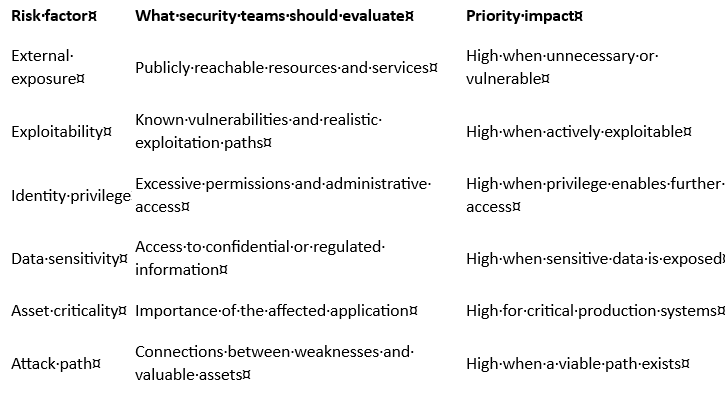
Critical – Immediate Investigation
Findings should receive immediate attention when they involve combinations such as:
- Publicly accessible production workloads with exploitable vulnerabilities.
- Sensitive data exposed through unintended permissions.
- Privileged identities that can access critical infrastructure.
- Confirmed attack paths leading to business-critical resources.
High – Urgent Remediation
Examples include:
- Excessive permissions on production service accounts.
- Vulnerable workloads with significant internal access.
- Misconfigured network boundaries.
- Security weaknesses affecting important business applications.
Medium – Planned Remediation
Examples include:
- Configuration weaknesses on restricted internal resources.
- Missing security controls with compensating protections.
- Non-critical application configuration deviations.
- Permissions that require reduction but have limited exposure.
Low – Monitor and Improve
Examples include:
- Informational security recommendations.
- Minor benchmark deviations.
- Isolated development environment issues.
- Findings without meaningful exposure or business impact.
These categories should be adjusted according to organizational risk appetite, regulatory requirements and available security resources.
Why Cloud Attack Path Analysis Matters
One of the biggest limitations of reviewing CSPM findings individually is that security weaknesses rarely exist in isolation.
Attackers often exploit relationships between exposed resources, vulnerable workloads, identity permissions and sensitive data.
Cloud attack path analysis helps security teams understand how these weaknesses could connect.
Consider the following example:
- An internet-facing application contains an exploitable vulnerability.
- The compromised workload has access to an overprivileged service identity.
- That identity can access an internal cloud storage resource.
- The storage resource contains sensitive business information.
Each finding may appear as a separate issue in a CSPM dashboard. However, together they represent a potential route to sensitive data.
Attack path analysis helps identify these connected risks and determine which security controls should be addressed first.
It can also help teams identify:
- Unnecessary trust relationships.
- Network paths to critical workloads.
- Privileged access between cloud resources.
- Exposed storage connected to production applications.
- Opportunities for lateral movement.
- Security weaknesses that create privilege escalation opportunities.
Rather than fixing isolated findings without understanding their relationships, organizations can prioritize remediation that interrupts the most dangerous paths.
Managing CSPM Risks Across AWS, Azure and GCP
Multi-cloud environments introduce additional challenges because each cloud provider uses different services, identity models and security controls.
Organizations operating across multiple platforms need consistent assessment criteria while accounting for provider-specific configurations.
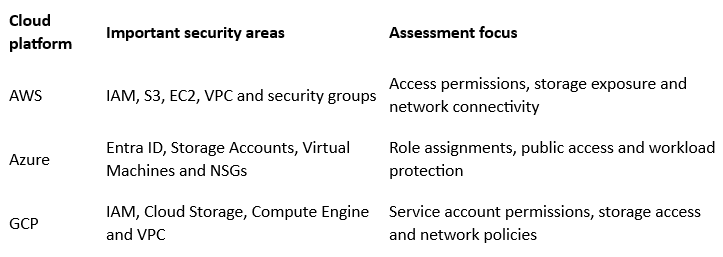
AWS security posture management
AWS environments should be evaluated for excessive IAM permissions, publicly accessible S3 buckets, unrestricted security groups and unnecessary access between accounts.
Security teams should also investigate whether compromised workloads could assume additional roles or access sensitive resources.
Azure security posture management
Azure assessments should examine role-based access control, storage configurations, network security groups and privileged identity assignments.
Organizations should also evaluate how permissions and network connectivity affect access to critical applications.
GCP security posture management
GCP environments require attention to project-level permissions, service account access, Cloud Storage exposure and network configurations.
Teams should identify overly permissive IAM bindings and understand how service identities interact with other cloud resources.
A multi-cloud security assessment should bring these findings into a common risk framework.
This allows organizations to compare exposure consistently without assuming that identical configuration rules apply across every provider.
Reducing False Positives Without Ignoring Real Threats
CSPM alerts can become difficult to manage when security teams repeatedly investigate findings that do not represent meaningful exposure.
However, reducing alert volume should never become the primary objective.
A finding should not be dismissed simply because it appears frequently or has remained open for a long time.
Security teams can improve finding quality through the following practices:
- Validate asset ownership: Identify who manages the affected cloud resource.
- Confirm environment type: Determine whether the resource belongs to production, testing or development.
- Check existing controls: Review network restrictions, authentication and compensating security measures.
- Correlate related findings: Determine whether multiple weaknesses create a larger exposure.
- Review exceptions: Ensure accepted risks have documented business justification and expiration dates.
- Remove duplicate findings: Consolidate repeated alerts that refer to the same underlying issue.
A useful process also includes regular validation of CSPM detection rules.
Security teams should review whether policies generate actionable findings and whether important cloud resources are covered by continuous monitoring.
This helps reduce unnecessary investigation while maintaining visibility into meaningful security weaknesses.
Connecting CSPM With SOC 2 and ISO 27001 Requirements
Cloud security posture management also supports organizations working toward SOC 2 and ISO 27001 compliance.
However, identifying a configuration issue is not the same as demonstrating that an organization operates an effective security control.
For example, an organization may have a policy requiring restricted access to production cloud resources. A CSPM platform can identify resources that violate this policy.
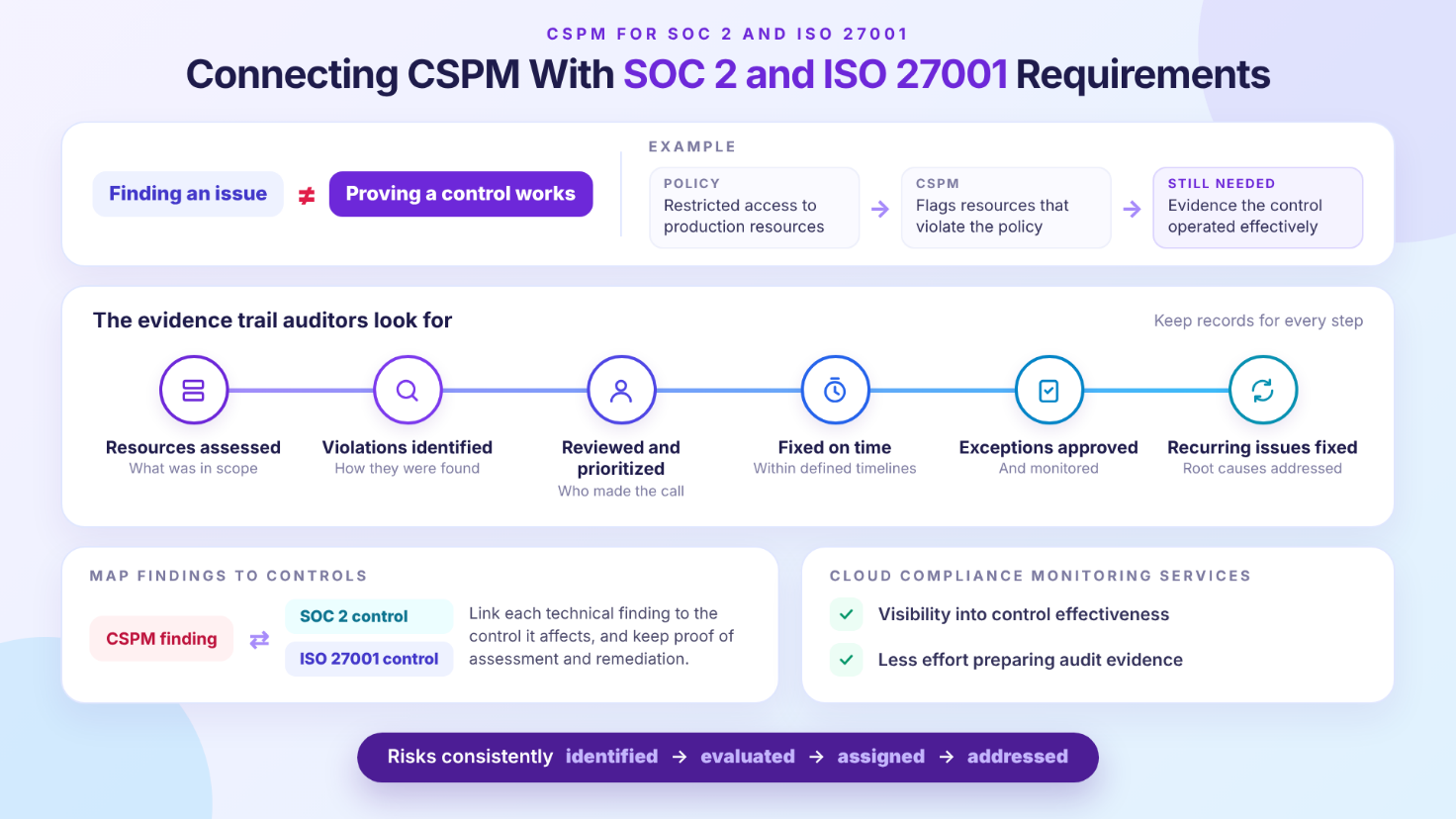
To demonstrate effective control operation, the organization should also maintain evidence showing:
- Which cloud resources were assessed.
- How configuration violations were identified.
- Who reviewed and prioritized the findings.
- Whether remediation was completed within defined timelines.
- How exceptions were approved and monitored.
- Whether recurring issues were addressed.
For CSPM for SOC 2 and ISO 27001, organizations should connect technical findings with relevant control requirements and retain evidence of assessment and remediation activities.
Cloud compliance monitoring services can help maintain visibility into control effectiveness and reduce the effort involved in preparing audit evidence.
The focus should be on demonstrating that security risks are consistently identified, evaluated, assigned and addressed.
Building an Effective Cloud Risk Remediation Process
Identifying critical cloud risks is useful only when the organization has a clear process for resolving them.
A structured remediation workflow should connect security findings with the teams responsible for cloud infrastructure and applications.
A practical process includes five stages.
Stage 1: Discover and Inventory
Identify cloud accounts, subscriptions, projects, workloads, identities and storage resources.
Maintain accurate ownership information and classify critical business assets.
Stage 2: Assess and Correlate
Perform a cloud misconfiguration assessment to identify configuration weaknesses.
Correlate findings with identity permissions, network exposure, vulnerabilities and sensitive data access.
Stage 3: Prioritize and Assign
Classify findings according to their potential business impact.
Assign critical and high-risk findings to responsible teams with clear remediation deadlines.
Stage 4: Remediate and Validate
Apply appropriate configuration changes, reduce excessive permissions and strengthen network restrictions.
Validate that remediation has actually eliminated the exposure rather than simply closing the original security alert.
Stage 5: Monitor and Prevent Recurrence
Continuously monitor configuration changes and review recurring weaknesses.
Introduce policy-based controls and deployment checks to prevent similar issues from appearing in future cloud deployments.
Managed CSPM services can support this process through ongoing monitoring, finding validation, remediation coordination and reporting.
CSPM consulting can also help organizations establish risk prioritization models, configure assessment policies and align cloud security operations with business requirements.
Measuring the Effectiveness of CSPM Risk Prioritization
The success of a CSPM program should not be measured only by the number of findings closed or improvements in a security score.
Organizations need metrics that demonstrate whether their most significant exposures are being reduced.
Useful performance indicators include:
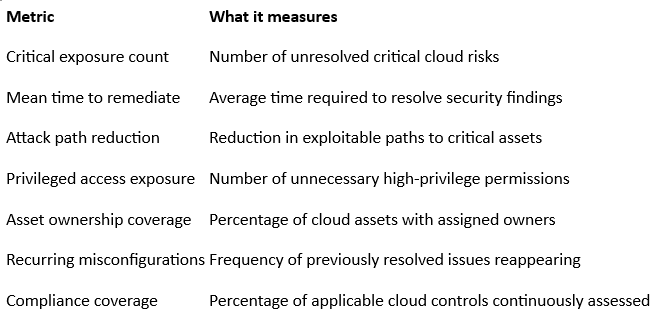
These metrics provide a clearer understanding of security improvements.
For example, reducing the number of critical attack paths may represent a more meaningful improvement than closing hundreds of low-impact configuration findings.
Security leaders can use these measurements during monthly cloud security reviews to evaluate remediation performance and identify areas requiring additional attention.
How Indrasol CSPM Services Help Organizations Prioritize Cloud Risks
Organizations need more than automated configuration scanning to maintain an effective cloud security posture.
They need a structured approach that connects cloud asset visibility, risk assessment, attack path analysis and remediation.
Indrasol CSPM services help organizations evaluate security weaknesses across AWS, Azure and GCP environments while focusing on the exposures that matter most to business operations.
The approach includes:
- Cloud security posture assessment: Evaluate cloud configurations, identities, network exposure and security policies.
- Multi-cloud security assessment: Establish consistent visibility across AWS, Azure and GCP environments.
- Cloud attack path analysis: Identify relationships between exposed workloads, excessive permissions and sensitive resources.
- Cloud security remediation services: Prioritize and address configuration weaknesses based on their potential impact.
- Managed CSPM services: Support continuous monitoring, finding validation and remediation tracking.
- Cloud compliance monitoring services: Connect cloud security assessments with relevant compliance requirements.
CSPM services can also help organizations establish repeatable security processes, improve asset ownership and reduce the operational burden of managing large finding volumes.
For organizations seeking to improve cloud risk visibility, CSPM consulting provides an opportunity to assess existing security practices and develop a remediation roadmap aligned with business priorities.
Explore Indrasol Cloud Security Posture Management Services to understand how structured cloud risk assessment and remediation can strengthen security across multi-cloud environments.
Moving From Alert Management to Risk Reduction
An effective cloud security strategy is not defined by how many CSPM findings an organization can identify or close.
It is defined by how effectively the organization understands its cloud exposure, identifies connected weaknesses and reduces the risks that could affect critical business operations.
By combining asset context, identity analysis, vulnerability assessment, attack path analysis and continuous monitoring, security teams can make more informed remediation decisions.
The objective is to ensure that critical cloud risks receive attention first, routine configuration issues follow a planned remediation process and security improvements remain measurable over time.
About the Author
Brahma Guptha Illindra
Brahma Gupta is a technology entrepreneur, enterprise technology leader, and Founder & CEO of Indrasol, helping organizations adopt AI, cloud, data, and cybersecurity technologies securely, compliantly, and at scale. Over the years, he has worked across enterprise architecture, data engineering, analytics, cloud technologies, Oracle EPM, and business transformation. Today, his focus is increasingly on one of the biggest challenges facing enterprises: how to adopt AI at scale without losing visibility, security, governance, or control. At Indrasol, he and his team help organizations bridge the gap between technology innovation and business risk across: • AI Security & AI-SPM (AI Security Posture Management) • AI Governance & Responsible AI • Cloud Security & CSPM (Cloud Security Posture Management) • Cybersecurity & Risk Management • SOC 2, ISO 27001, ISO 42001 & CMMC compliance • Cloud modernization & DevOps • Data, analytics & AI transformation • Enterprise technology & automation Brahma is particularly
View Brahma Guptha Illindra's profile