
 Bizradar
 Tanva
How to Prepare for SOC 2 Type II After Type I
Summary
Completing a SOC 2 Type I examination is an important milestone, but it does not prove that security controls operate consistently over time. Moving to Type II requires organizations to address earlier findings, maintain reliable evidence, monitor control activities, and demonstrate that security processes work throughout the examination period.
Type I Is Complete. What Does the Organization Need to Prove Next?
A SOC 2 Type I report demonstrates that an organization's controls are suitably designed and implemented at a specific point in time. A Type II report goes further by evaluating whether those controls operated effectively throughout a defined examination period.
This changes the organization's compliance responsibilities. Having an approved access management policy, for example, is not enough. The organization must demonstrate that access requests were approved, permissions were reviewed, and unnecessary access was removed consistently during the period.
For SaaS companies, startups, and technology providers, this transition is particularly important. Customers increasingly want evidence that security practices are part of everyday operations rather than activities performed only before an audit.
The main objective after Type I is to move from having documented controls to demonstrating that those controls operate reliably.
Start With the Findings, Not Another Compliance Checklist
The Type I report provides a useful starting point for planning the next examination. Review the auditor's observations, exceptions, and recommendations before introducing new compliance activities.
Some organizations may have completed Type I without major exceptions. Even then, they should examine whether their controls generate sufficient evidence and whether the processes are consistently followed.
Pay particular attention to:
- Control weaknesses: Activities that were missing, incomplete, or not implemented as expected.
- Documentation gaps: Policies that do not reflect actual business practices.
- Ownership issues: Controls without clearly assigned responsibilities.
- Evidence limitations: Activities that happen but are not recorded appropriately.
- Operational inconsistencies: Processes that depend on individual reminders rather than established procedures.
A remediation tracker can connect every finding to an owner, corrective action, target date, and supporting evidence.
A finding should not be marked as resolved simply because a policy was updated. The organization must verify that the revised control is operating and producing the expected evidence.
The Observation Period Changes the Way Teams Work
One of the most important differences between Type I and Type II is the examination period. Instead of demonstrating control implementation on a particular date, the organization must show that controls operated throughout a defined period.
The observation period should be agreed with the audit partner. It should reflect the organization's readiness, the scope of the examination, and its ability to maintain reliable evidence.
Before the period begins, confirm that:
- The systems and services included in the examination are clearly identified.
- Relevant controls are implemented and operating.
- Control owners understand their responsibilities.
- Evidence collection processes are established.
- Open findings and exceptions have been reviewed.
- Significant business and infrastructure changes have been evaluated.
For example, a SaaS company may introduce a new cloud environment or launch an additional product after Type I. These changes could affect the system description, access management, vendor relationships, or risk assessment.
The organization should review such changes with its auditor rather than assuming that the original Type I scope automatically covers them.
A practical consideration: Evidence from an earlier period generally cannot be recreated after the fact. Organizations should establish their evidence collection processes before the relevant activities begin.
From Written Policies to Controls That Actually Operate
A policy describes what an organization intends to do. Type II evidence demonstrates whether employees and systems actually follow that requirement.
Consider an access management policy that requires periodic user access reviews. During Type I, the organization may demonstrate that the policy exists and the process has been established. During Type II, it needs records showing that the reviews occurred as required, were completed by authorized personnel, and resulted in corrective action where necessary.
The same principle applies across the security program.
Access management
- Record employee onboarding and offboarding activities.
- Require approval before granting access to sensitive systems.
- Review user permissions at the defined frequency.
- Remove unnecessary access promptly.
- Retain records of access changes and approvals.
Change management
- Document production changes and approvals.
- Maintain records of testing before deployment.
- Track emergency changes and subsequent reviews.
- Retain deployment histories and relevant tickets.
Security monitoring
- Review relevant infrastructure and application activity.
- Investigate security alerts.
- Document incidents and corrective actions.
- Maintain logs according to established requirements.
Employee security
- Conduct security awareness training.
- Track employee completion records.
- Maintain policy acknowledgments.
- Document processes for reporting security concerns.
The important change is operational consistency. Controls should function as part of normal business activities, not as temporary audit preparation tasks.
Evidence Should Be Generated by the Process Itself
Evidence collection often becomes one of the most demanding parts of a SOC 2 Type II examination. Auditors may select samples from different points in the examination period to verify that controls operated as expected.
If an organization starts collecting evidence only when audit fieldwork approaches, it may discover missing approvals, incomplete logs, or undocumented activities.
A better approach is to make evidence generation part of the control process.
A centralized evidence repository can make these records easier to organize and retrieve. Each item should be associated with the relevant control, activity date, responsible owner, and approval or review record.
Where possible, connect evidence collection to existing business systems, including:
- HR and employee management platforms
- Identity and access management systems
- Cloud infrastructure and monitoring tools
- Engineering ticketing and change management platforms
- Vulnerability management solutions
- Vendor management systems
This approach reduces manual effort and makes SOC 2 evidence collection support more sustainable.
Who Owns Compliance When Every Team Contributes?
SOC 2 compliance is not exclusively a security team's responsibility. Evidence and control activities often come from engineering, HR, IT, procurement, legal, and management.
When responsibilities are unclear, reviews may be missed and evidence may not be available when needed.
A practical ownership model looks like this:
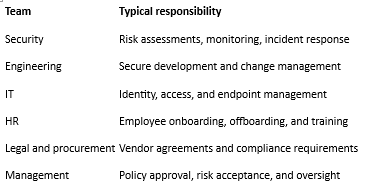
Each control should have an accountable owner who understands the required activity, its frequency, and the evidence that must be retained.
Regular coordination between these teams helps identify delayed reviews, incomplete records, and changes that could affect the examination scope.
When Controls Do Not Work as Expected
Even well-managed organizations experience control exceptions. An access review may be delayed, a vulnerability may remain unresolved, or a change may be deployed without the expected approval.
These events should be documented and evaluated rather than ignored.
A control exception register should capture:
- The affected control and date of the exception.
- The reason the activity did not operate as expected.
- The potential impact on the organization.
- The corrective action taken.
- The person responsible for remediation.
- The evidence confirming resolution.
For example, if an employee's access was not removed promptly after termination, the organization should document the event, investigate the cause, evaluate the exposure, and record the corrective action.
Repeated exceptions may indicate a broader process weakness. Management should examine whether the issue is caused by unclear ownership, manual processes, insufficient monitoring, or ineffective procedures.
Organizations should discuss significant exceptions with their audit partner and maintain accurate records. Missing evidence should never be hidden or recreated as if the original activity had occurred.
Internal Testing: Find the Gaps Before the Auditor Does
An organization should not wait until the observation period ends to determine whether its controls are working.
Periodic internal reviews can identify weaknesses while there is still time to investigate and improve the process.
For example, an internal review might select access requests from different months and verify that approvals were completed before access was granted. A change management review could examine whether production changes had the required testing and approval records.
Other useful checks include:
- Confirming that security alerts were investigated.
- Verifying that vendor reviews occurred as scheduled.
- Reviewing vulnerability remediation timelines.
- Checking whether employee training records are complete.
- Confirming that access reviews covered the relevant systems and users.
The organization should also ensure that it can produce complete records for controls that require sampling. A few manually selected screenshots may not be enough to demonstrate that the full population of activities is accurate.
A SOC 2 readiness assessment before formal fieldwork can help identify weaknesses in control operation, evidence quality, and documentation.
Planning the Transition Around Real Business Activities
The transition from Type I to Type II should be managed as an ongoing compliance program rather than a last-minute audit project.
The following planning view can help teams organize responsibilities around the examination timeline.
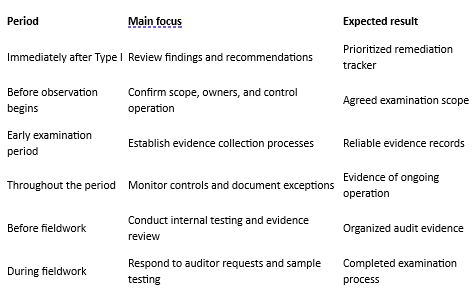
The exact timeline depends on the organization's control maturity, complexity, and examination period. It should be coordinated with the auditor rather than treated as a universal schedule.
How Indrasol Helps Organizations Move Beyond Type I
Moving from Type I to Type II requires organizations to maintain controls, collect evidence, manage exceptions, and demonstrate that security processes operate consistently.
Indrasol's SOC 2 Compliance Services support organizations with readiness assessments, gap analysis, security control implementation, evidence collection, and audit preparation.
For organizations preparing for Type II, relevant support areas include:
SOC 2 gap assessment: Identify unresolved findings and weaknesses in existing controls before the examination period.
SOC 2 policies and controls implementation: Strengthen access management, security monitoring, incident response, vendor management, and governance processes.
SOC 2 evidence collection support: Organize documentation and establish repeatable evidence collection practices.
SOC 2 audit preparation services: Review evidence, conduct internal readiness checks, and coordinate with the audit partner.
SOC 2 continuous compliance services: Maintain control activities and address compliance gaps as business operations evolve.
Indrasol SOC 2 compliance services are relevant to SaaS companies, startups, and technology organizations that need structured compliance support while maintaining their day-to-day operations.
Organizations looking for SOC 2 consulting or a SOC 2 compliance consultant for technology companies can use this approach to strengthen control consistency and prepare for the next examination.
Building a Compliance Program That Lasts Beyond the Audit
A successful SOC 2 Type II examination depends on more than the controls documented during Type I. Organizations must demonstrate that those controls continue to operate effectively as employees, applications, infrastructure, and business processes change.
The transition becomes more manageable when teams establish clear ownership, maintain evidence continuously, review exceptions, and test controls throughout the examination period.
For organizations pursuing SOC 2 compliance for SaaS companies or SOC 2 compliance for startups, these activities should become part of everyday operations rather than separate audit-related tasks.
With appropriate SOC 2 implementation services, continuous monitoring, and audit preparation, organizations can move from point-in-time control validation to a more mature and consistently managed security program.
About the Author
Brahma Guptha Illindra
Brahma Gupta is a technology entrepreneur, enterprise technology leader, and Founder & CEO of Indrasol, helping organizations adopt AI, cloud, data, and cybersecurity technologies securely, compliantly, and at scale. Over the years, he has worked across enterprise architecture, data engineering, analytics, cloud technologies, Oracle EPM, and business transformation. Today, his focus is increasingly on one of the biggest challenges facing enterprises: how to adopt AI at scale without losing visibility, security, governance, or control. At Indrasol, he and his team help organizations bridge the gap between technology innovation and business risk across: • AI Security & AI-SPM (AI Security Posture Management) • AI Governance & Responsible AI • Cloud Security & CSPM (Cloud Security Posture Management) • Cybersecurity & Risk Management • SOC 2, ISO 27001, ISO 42001 & CMMC compliance • Cloud modernization & DevOps • Data, analytics & AI transformation • Enterprise technology & automation Brahma is particularly
View Brahma Guptha Illindra's profile