
Can You Trace AI Agent Actions to Human Identity?
Summary
AI agents can access enterprise applications, retrieve sensitive data, and execute tasks on behalf of people or organizations. Learn how to connect AI agent activity to its initiating identity, track delegated permissions, and build reliable audit trails for enterprise security and accountability.
Why AI Agent Identity Matters for Enterprise Security
When an employee performs an action in an enterprise application, security teams can often trace it to a user account. AI agents make this process more complicated because they may operate through service accounts, API credentials, connected tools, or other agents.
If an AI agent updates a customer record or retrieves confidential information, security teams need to understand more than which application performed the action. They need to know who initiated the task, what authority the agent received, and which systems it accessed.
Without this visibility, organizations may struggle to investigate suspicious activity, identify excessive permissions, or establish accountability for sensitive operations.
The key challenge is establishing a reliable connection between the initiating identity, the AI agent, its delegated authority, and every consequential action it performs.
What Makes AI Agent Activity Difficult to Trace?
Traditional user activity monitoring is not always sufficient for autonomous AI workflows. One task may involve several agents, tools, APIs, and enterprise systems, each producing separate records.
Common challenges include:
- Shared service accounts: Multiple agents or workflows may use the same technical identity, making individual actions difficult to distinguish.
- Delegated access: An agent may inherit or receive permissions to act on behalf of a user or another service.
- Multi-step execution: A single request may trigger several tool calls across different systems.
- Incomplete audit logs: Applications may record the final change without capturing the agent, initiating request, or authorization context.
- Sub-agent activity: An agent may delegate work to another agent, creating additional identity and permission relationships.
- Long-running workflows: Credentials, permissions, or task ownership may change while an operation is in progress.
These gaps can affect incident response, access reviews, compliance evidence, and investigations into unauthorized activity.
How to Trace an AI Agent Action to Its Origin
Reliable AI agent attribution requires more than recording a username or an API request. Organizations should maintain a traceable chain of identity and authorization across the complete workflow.
1. Record the Initiating Human or System Identity
Every workflow should capture the identity that initiated it, where that identity is available and appropriate to record.
Depending on the use case, this may be an authenticated employee, an approved application, or an authorized automated process.
Record relevant context such as:
- Initiating user or workload identity
- Request or workflow ID
- Agent identity and task identifier
- Start time and execution environment
- The purpose or approved scope of the request
For automated workflows that do not originate from a human, record the responsible system or workload identity rather than incorrectly attributing the action to a person.
2. Give Each Agent a Distinguishable Identity
Avoid relying entirely on a shared service account to represent every AI agent. Where possible, assign agents distinct workload identities or otherwise ensure their activities can be differentiated in the logs.
A useful identity record should connect the agent to its owner, operating purpose, permitted resources, and lifecycle status.
This makes it easier to answer questions such as: Which agent accessed this resource? Who manages that agent? Was the access expected for its assigned task?
3. Track Delegated Permissions
An agent may act on behalf of a user, but that does not mean it should inherit all the user's privileges.
Use scoped delegation to limit the agent to the resources and operations required for its task. When work passes to a sub-agent or downstream tool, the delegated authority should remain bounded by the original authorization.
For example, an agent authorized to read a set of customer records should not automatically gain permission to modify every customer account.
4. Correlate Events Across Tools and Systems
A workflow may generate events in an AI platform, identity provider, API gateway, database, and business application. Each system may use a different event format or identifier.
Use a shared correlation ID, trace ID, or equivalent mechanism to connect these events. Where possible, preserve the initiating identity and agent identity throughout the workflow.
This helps investigators reconstruct the sequence of events instead of examining isolated log entries.
5. Preserve Independent Audit Evidence
Audit records should be protected from unauthorized changes, including changes by the agent being monitored.
Capture relevant information about the requested action, permission checks, tool calls, approvals, execution results, and errors. Apply suitable access restrictions, retention policies, and tamper-evident storage.
The objective is to create evidence that can be independently reviewed even if an agent behaves unexpectedly or becomes compromised.
What Should an AI Agent Audit Trail Capture?
The information required depends on the sensitivity of the workflow, but the following fields provide a practical starting point.
Avoid collecting unnecessary sensitive data in logs. Record enough information to support investigations and accountability while protecting credentials, personal information, and confidential business content.
Example: Tracing an AI Agent Across Enterprise Systems
Consider an employee asking an AI agent to prepare a customer account update. The agent retrieves information from a CRM, checks an internal policy source, and submits an update through an API.
A traceable workflow could look like this:
1. Employee identity
The authenticated employee initiates the request. A workflow ID is created.
2. AI agent identity
The agent receives a defined task scope and uses its assigned identity.
3. Tool and API activity
CRM reads, policy lookups, authorization checks, and update requests are linked to the workflow.
4. Audit evidence
Logs preserve the initiating identity, agent, action sequence, authorization outcome, and final result.
If the agent attempts an unauthorized update, security teams can investigate the original request, the agent's assigned permissions, the API call, and the authorization decision.
This process supports accountability, but it does not automatically prove that the human intended every action the agent took. That distinction is important: initiating a workflow is not the same as explicitly authorizing every possible downstream operation.
Common AI Agent Identity and Logging Mistakes
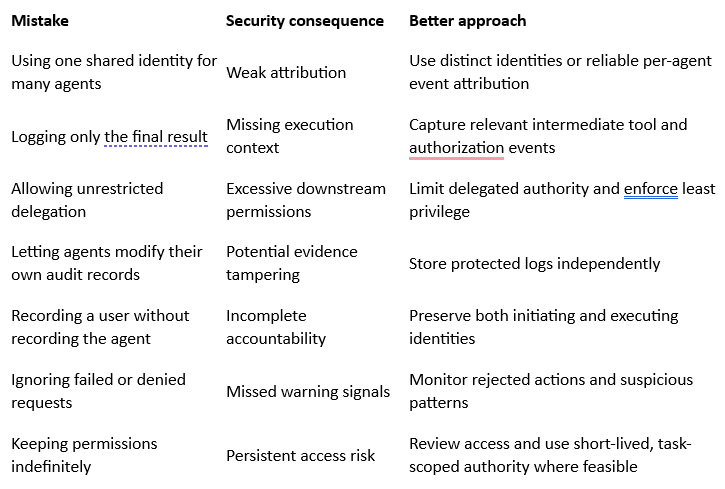
Identity attribution is most effective when it is combined with access enforcement, monitoring, and incident response—not treated as a logging-only project.
How AI Security Posture Management Supports Identity Traceability
Identity traceability is one part of a broader enterprise AI security program. Organizations also need visibility into which AI agents exist, what data they access, which tools they use, and how their permissions change over time.
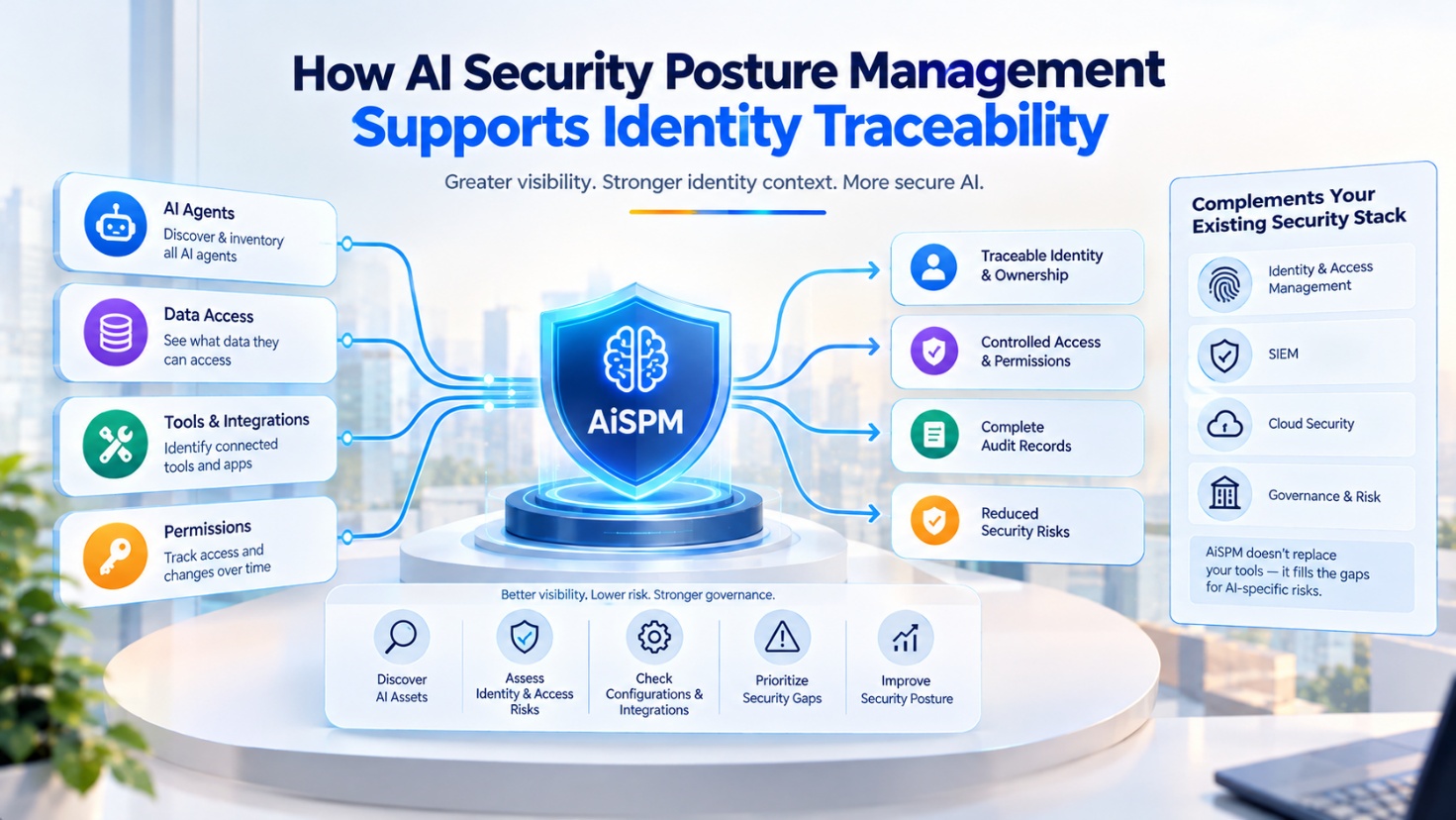
AI Security Posture Management (AiSPM) helps organizations discover AI assets, understand identity and access risks, assess configurations and integrations, and prioritize security gaps across their AI environments.
An AI security posture assessment can help teams identify:
- Unknown or unmanaged AI agents and integrations
- Service accounts with excessive permissions
- Unclear agent ownership or delegated access
- Sensitive data paths across AI applications and tools
- Gaps in audit coverage and activity monitoring
- Changes in agent configuration or access that increase risk
AiSPM complements identity management, SIEM, cloud security, and governance tools. It does not replace their enforcement and logging capabilities; instead, it helps teams understand AI-specific risks and determine where additional controls are needed.
Explore Indrasol's AI Security Posture Management services to learn more about AI asset discovery, identity and access risk, governance, and security posture improvement.
A Practical Checklist for AI Agent Accountability
Before deploying an AI agent into a sensitive enterprise workflow, verify that your organization can:
- Identify the human or system that initiated each workflow.
- Distinguish the executing agent from the initiating identity.
- Document agent ownership and approved responsibilities.
- Restrict permissions to the minimum required for each task.
- Track delegated authority across sub-agents and connected tools.
- Correlate events across identity providers, APIs, and business applications.
- Record authorization decisions and relevant execution outcomes.
- Protect audit records against unauthorized modification.
- Alert on unusual access, privilege changes, or unexpected actions.
- Review attribution gaps and test incident reconstruction regularly.
Not every workflow requires identical logging. Prioritize stronger attribution and evidence for agents that access sensitive data, exercise privileged permissions, or affect critical business operations.
Frequently Asked Questions
Can AI agent actions be traced back to a human?
Often, yes, when the workflow records the initiating identity and preserves that context throughout execution. However, an action may originate from an automated system rather than a human, and incomplete logs can prevent reliable attribution.
What is AI agent identity management?
AI agent identity management covers how agents are identified, authenticated, authorized, and governed. It helps organizations distinguish agents from human users and control what resources and actions each agent can access.
Why are shared service accounts a problem for AI agents?
When several agents use the same account, logs may show which account performed an operation without identifying the specific agent or workflow. Distinct identities or reliable event-level attribution can improve accountability.
What should AI agent audit logs include?
Useful logs capture initiating and executing identities, timestamps, workflow identifiers, tool calls, target resources, authorization decisions, and execution outcomes. Logs should be protected and designed to minimize unnecessary sensitive data.
How does AiSPM help identify AI agent risks?
AiSPM helps discover AI assets and assess associated identity, access, configuration, data, and integration risks. This broader visibility can help organizations identify agents with unclear ownership or excessive permissions.
Build Traceability Into Enterprise AI Workflows
As AI agents become more connected to enterprise applications and business processes, organizations need a reliable way to understand who initiated a task, which agent performed it, and what authority supported each action.
Start with distinct identities, bounded delegation, correlated audit events, and independently protected evidence. Then assess whether your current security tools provide enough visibility to reconstruct important agent workflows and investigate unexpected behavior.
Indrasol** helps organizations assess and improve their AI security posture** through AI asset discovery, risk assessment, governance, and practical security recommendations. Learn more about Indrasol's AiSPM services.
About the Author
Brahma Guptha Illindra
Brahma Gupta is a technology entrepreneur, enterprise technology leader, and Founder & CEO of Indrasol, helping organizations adopt AI, cloud, data, and cybersecurity technologies securely, compliantly, and at scale. Over the years, he has worked across enterprise architecture, data engineering, analytics, cloud technologies, Oracle EPM, and business transformation. Today, his focus is increasingly on one of the biggest challenges facing enterprises: how to adopt AI at scale without losing visibility, security, governance, or control. At Indrasol, he and his team help organizations bridge the gap between technology innovation and business risk across: • AI Security & AI-SPM (AI Security Posture Management) • AI Governance & Responsible AI • Cloud Security & CSPM (Cloud Security Posture Management) • Cybersecurity & Risk Management • SOC 2, ISO 27001, ISO 42001 & CMMC compliance • Cloud modernization & DevOps • Data, analytics & AI transformation • Enterprise technology & automation Brahma is particularly
View Brahma Guptha Illindra's profile