
 Bizradar
 Tanva
When Should CISOs Block or Govern Shadow AI?
Summary
Not every unauthorized AI application needs to be blocked, but unmanaged AI usage can expose enterprise data, identities, and critical systems to security risks. This guide explains how CISOs can decide when to block Shadow AI, when to govern its usage, and how AI security posture management helps enterprises balance security with innovation.
Why Shadow AI Creates a Difficult Decision for CISOs
Employees are increasingly using AI applications to generate content, analyze documents, write code, automate workflows, and improve everyday business operations. However, many of these applications are introduced without formal IT approval or security assessment.
This creates Shadow AI: the use of AI applications, models, agents, and services outside an organization's approved security and governance processes.
For CISOs, the challenge is not simply identifying unauthorized AI usage. It is deciding whether an application should be blocked entirely or allowed under appropriate security controls.
Blocking every unauthorized AI tool can interrupt legitimate business activities and encourage employees to find alternative applications without involving IT teams. Allowing unrestricted access, however, can expose confidential information, introduce third-party dependencies, and create security gaps across enterprise systems.
A better approach is to evaluate each application based on its business purpose, data access, permissions, provider security, and potential impact.
This allows security leaders to distinguish unacceptable AI usage from applications that can be safely governed.
When Should CISOs Block Shadow AI?
Blocking is appropriate when an AI application creates security, privacy, or compliance risks that cannot be reduced to an acceptable level.
CISOs should consider restricting access immediately when the application introduces significant data exposure, unauthorized system access, or unacceptable third-party risks.
1. When AI Applications Expose Confidential Data
Employees may share customer records, financial information, internal reports, source code, and intellectual property with external AI applications.
The risk increases when the organization cannot determine how the provider processes, stores, or retains submitted information.
Security teams should consider blocking an application when:
- The provider cannot demonstrate acceptable data protection practices.
- Sensitive information is processed without appropriate safeguards.
- Data retention and deletion policies are unclear.
- Enterprise data is used in ways that violate organizational requirements.
- The application does not provide sufficient administrative or security controls.
For example, an employee using a personal AI account to analyze confidential customer information could create an exposure that cannot be addressed through simple awareness training.
In such cases, restricting access and providing an approved enterprise alternative may be necessary.
2. When AI Agents Have Excessive Permissions
AI agents introduce additional security concerns because they can interact with enterprise applications, access information, and execute actions through connected tools and APIs.
An agent with excessive permissions could retrieve sensitive records, modify business information, or trigger workflows beyond its intended purpose.
CISOs should consider blocking an agent when:
- It has unrestricted access to critical enterprise systems.
- Its actions cannot be monitored or audited.
- It can perform sensitive operations without appropriate approval.
- Its credentials or API tokens have been exposed.
- Its permissions cannot be reduced to an acceptable level.
An AI agent that provides recommendations has a different risk profile from one that can independently modify production data.
The greater the agent's autonomy and access, the stronger its security requirements should be.
3. When Third-Party AI Providers Present Unacceptable Risks
AI applications often depend on external models, APIs, plugins, infrastructure providers, and data processing services.
These dependencies can introduce security exposure beyond the application itself.
Organizations should consider blocking an application when:
- The provider lacks adequate security documentation.
- Data processing locations or subprocessors cannot be established.
- Required contractual protections are unavailable.
- Security incidents cannot be investigated appropriately.
- The provider fails organizational vendor risk requirements.
An enterprise AI security risk assessment should consider the complete service relationship rather than evaluating only the application's interface.
4. When AI Usage Violates Compliance Requirements
Some AI applications may be unsuitable for specific business activities because of the information they process or the decisions they support.
For example, an organization may prohibit unapproved AI platforms from processing regulated customer information or making sensitive business decisions without human oversight.
CISOs should coordinate with legal, privacy, and compliance teams before making these decisions.
Where the exposure cannot be resolved through additional safeguards, blocking the application may be the most appropriate option.
When Should CISOs Govern Shadow AI Instead?
Not every unauthorized AI application presents an unacceptable security risk. Some tools provide legitimate business value and can be brought into an approved environment through appropriate safeguards.
Governance is often preferable when an application has a valid business purpose and its risks can be controlled through configuration, access restrictions, monitoring, or contractual requirements.
1. When Employees Have a Legitimate Business Requirement
Employees may independently adopt AI applications because existing enterprise tools do not provide the functionality they need.
For example, marketing teams may use AI writing applications for non-confidential content, while developers may use coding assistants to improve development efficiency.
Instead of automatically blocking these applications, security teams should evaluate:
- Whether the business requirement is legitimate.
- Whether an approved alternative is available.
- What information the application processes.
- Whether enterprise security configurations are supported.
- Whether the application meets organizational policies.
If the risks are manageable, CISOs can work with IT and business owners to establish an approval process.
2. When Data Usage Can Be Restricted
An AI application may be suitable for certain business activities but inappropriate for processing confidential information.
Organizations can establish data usage restrictions instead of blocking the entire application.
For example:
- Allow processing of publicly available information.
- Restrict customer and employee personal data.
- Prohibit confidential source code uploads.
- Require enterprise accounts for business usage.
- Apply approved data retention and processing conditions.
This approach helps employees use AI productively without allowing unrestricted information sharing.
3. When AI Permissions Can Be Controlled
Some AI applications can be governed through identity and access management controls.
Security teams can reduce exposure by:
- Assigning individual identities to AI applications.
- Applying least-privilege access.
- Restricting API permissions.
- Limiting access to approved data sources.
- Requiring strong authentication.
- Logging important application activities.
For AI agents, additional safeguards should include approved tool access, restricted actions, human approval for sensitive operations, and the ability to revoke credentials quickly.
4. When Continuous Monitoring Is Available
Governance becomes more practical when security teams can observe how AI applications behave after approval.
Organizations should monitor changes in permissions, data access, integrations, and application usage.
If an approved application introduces new capabilities or begins accessing sensitive resources, its risk classification should be reviewed.
This makes AI governance an ongoing security responsibility rather than a one-time approval exercise.
Block vs. Govern: A CISO Decision Matrix
CISOs need a consistent way to determine whether an AI application should be blocked, restricted, or approved.
The following decision matrix connects common enterprise scenarios with appropriate security actions.
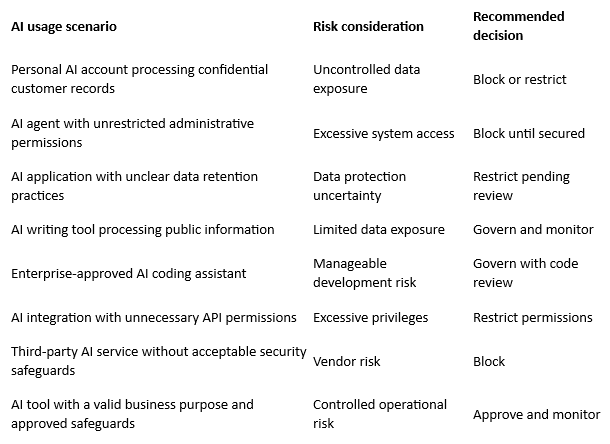
The decision should not depend only on whether an application appears on an approved software list.
Security teams should evaluate actual data access, permissions, integrations, business impact, and available controls.
An unauthorized application may be suitable for governance if its risks are manageable. Similarly, an already approved application may require restrictions if its configuration or usage changes.
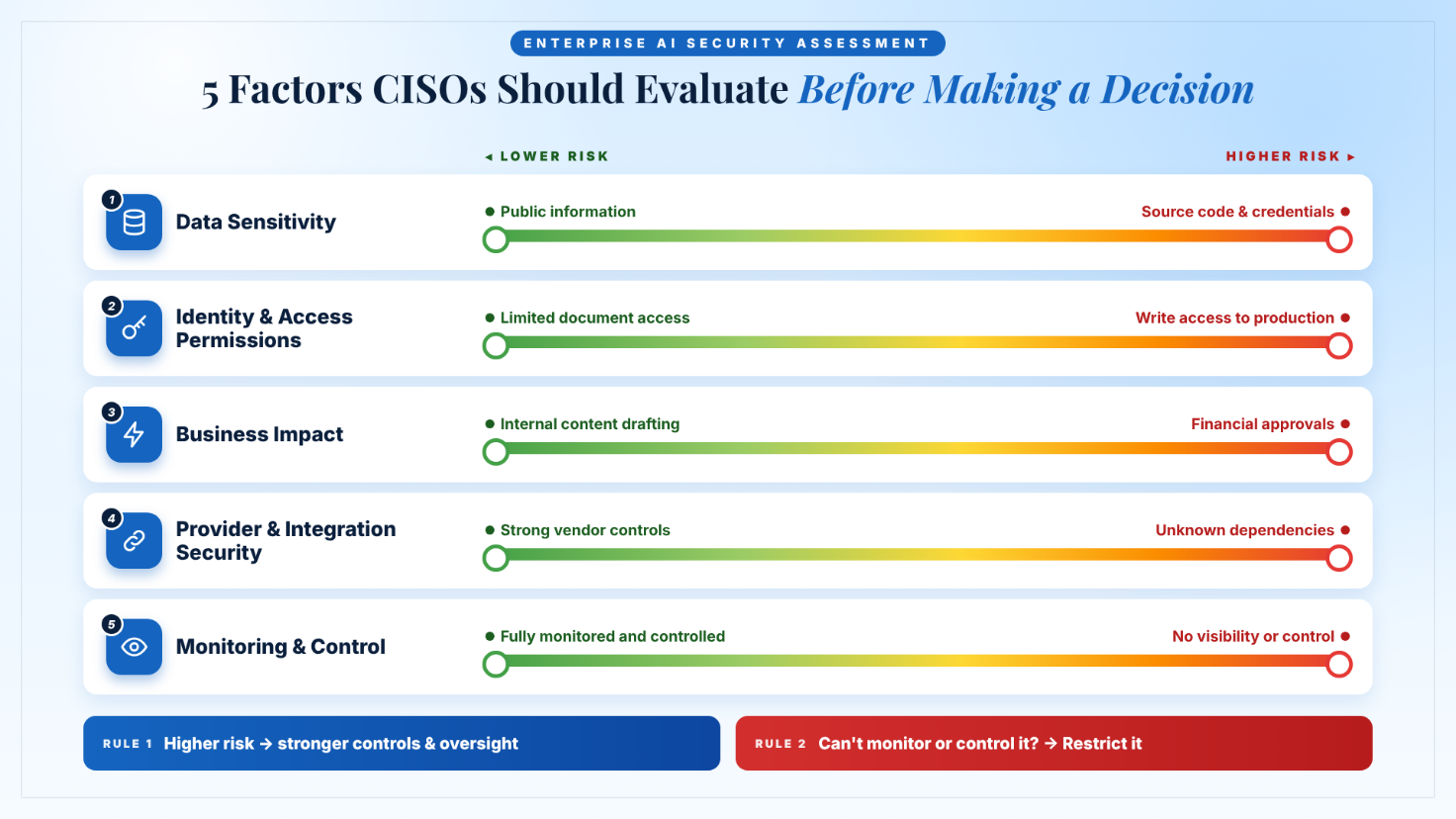
Five Factors CISOs Should Evaluate Before Making a Decision
An effective enterprise AI security assessment should consider more than the application's reputation or popularity.
The following five factors help security leaders make informed decisions.
1. Data Sensitivity
Determine what information the AI application receives, processes, stores, or shares with external providers.
Consider whether the information includes:
- Public business information.
- Internal operational documents.
- Confidential intellectual property.
- Customer or employee personal information.
- Financial or regulated information.
- Source code and security credentials.
Higher data sensitivity generally requires stronger controls and closer oversight.
2. Identity and Access Permissions
Evaluate which users, applications, and service accounts can interact with the AI system.
For connected AI agents, examine permissions through APIs, OAuth integrations, and enterprise applications.
An AI tool with access to a limited document collection presents a different risk from an agent with write access to production systems.
3. Business Impact
Assess the potential consequences if the AI application is misused, compromised, or unavailable.
Consider financial loss, operational disruption, customer impact, regulatory exposure, and reputational damage.
A tool used for internal content drafting may require a different level of oversight from one supporting financial approvals or critical business operations.
4. Provider and Integration Security
Evaluate the AI provider and its connected services.
Security teams should review authentication, encryption, data handling, vendor controls, third-party dependencies, API security, and incident response capabilities.
This is particularly important when an AI application connects to multiple enterprise platforms.
5. Monitoring and Control Capabilities
Determine whether the organization can enforce security requirements after approving the application.
If usage cannot be monitored, permissions cannot be restricted, and suspicious activities cannot be investigated, governance may not be sufficient.
In those situations, restricting or blocking the application until adequate controls are available is a reasonable decision.
How Indrasol Helps Enterprises Evaluate Shadow AI Risks
Making the right decision about Shadow AI requires visibility into the organization's AI environment, its associated security risks, and the controls available to manage them.
Indrasol's AI Security Posture Management (AiSPM) services focus on helping enterprises discover AI systems, understand their security exposure, assess governance and compliance gaps, and prioritize risks based on business impact.
This provides security leaders with a more structured foundation for deciding which AI applications require restrictions and which can operate under approved governance controls.
Key areas of support include:
AI Application and Asset Discovery: Identify AI applications, models, agents, APIs, data sources, and integrations operating across enterprise environments.
AI Security Risk Assessment: Evaluate security exposure associated with sensitive data, insecure configurations, excessive permissions, and third-party dependencies.
AI Agent Security Assessment: Review agent identities, delegated permissions, connected tools, execution capabilities, and potential misuse.
AI Governance and Compliance: Evaluate governance requirements, security controls, accountability, and compliance exposure across the AI lifecycle.
AI Risk Prioritization: Translate technical findings into practical priorities based on exposure, business impact, and remediation urgency.
Continuous AI Posture Improvement: Establish processes to monitor changes in AI assets, configurations, permissions, and integrations.
Through its AI Security Posture Management services, Indrasol helps organizations develop a measurable approach to enterprise AI security.
Its approach connects AI discovery, assessment, risk prioritization, protection, and continuous monitoring rather than treating AI security as a one-time checklist.
For organizations evaluating AI security posture management consulting, the objective should be to establish practical visibility and governance processes that support secure AI adoption.
How AiSPM Supports Better CISO Decisions
As enterprise AI adoption expands, security teams need more than traditional application and infrastructure visibility.
AI systems introduce additional components, including models, agents, APIs, identities, data flows, and third-party dependencies. These relationships can make it difficult to understand the complete security exposure through isolated security tools.
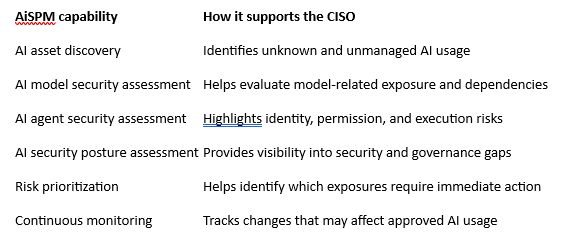
AI Security Posture Management (AiSPM) helps address this challenge by connecting AI assets with their associated security context.
For CISOs, this can support several important decisions:
Indrasol also provides broader cybersecurity capabilities covering AI and LLM security, application security, cloud security, and compliance readiness.
For example, its cybersecurity services include AI and LLM security reviews, threat modeling, cloud and application assessments, remediation support, and continuous monitoring.
These capabilities can complement an enterprise's existing security program when AI applications connect to business-critical applications, cloud environments, and sensitive data.
How AI Governance Connects with Application Security
AI applications do not operate independently of the broader enterprise technology environment.
They often connect to software applications, APIs, cloud infrastructure, development repositories, and third-party components.
This means Shadow AI governance should also consider the security of the applications and integrations supporting AI workflows.
Application Security Posture Management (ASPM) helps security teams understand application-related risks by bringing together findings, application ownership, vulnerabilities, dependencies, and remediation priorities.
While AiSPM focuses on AI-specific security posture, ASPM focuses on application security posture. Both can contribute to a broader enterprise security strategy.
For example:
- Application security findings can reveal vulnerabilities in AI-enabled applications.
- Software supply chain assessments can identify risks in third-party components.
- API security reviews can uncover weaknesses in AI integrations.
- Application vulnerability correlation can help prioritize related security findings.
- DevSecOps security assessments can strengthen controls throughout the software development lifecycle.
Indrasol's Application Security Posture Management services help organizations connect application security findings, correlate risks, prioritize remediation, and improve application security visibility.
For CISOs, coordinating AiSPM and ASPM activities can provide a broader understanding of risks across AI systems and the applications they depend on.
Building a Risk-Based Shadow AI Governance Policy
A clear AI governance policy helps employees understand which applications they can use and what security requirements apply to different AI activities.
CISOs should work with IT, legal, privacy, compliance, and business teams to establish practical rules.
A useful policy should cover the following areas:
Approved AI applications: Maintain a list of AI services that have passed organizational security and privacy reviews.
Data usage requirements: Define which information employees can share with different categories of AI applications.
AI agent permissions: Establish access restrictions, approved actions, and human oversight requirements for autonomous systems.
Third-party reviews: Require security assessments before connecting external AI providers or integrations to enterprise environments.
Exception management: Provide a documented process for employees who need AI applications that are not currently approved.
Continuous reassessment: Review approved applications when their functionality, permissions, providers, or data processing practices change.
The policy should also identify application owners and assign responsibility for reviewing exceptions.
Without clear ownership, AI governance can become an informal approval process with limited accountability.
Measuring Whether Your AI Governance Strategy Is Working
A successful governance program should demonstrate that the organization is reducing unacceptable AI exposure without unnecessarily restricting legitimate business activities.
CISOs can track the following metrics:
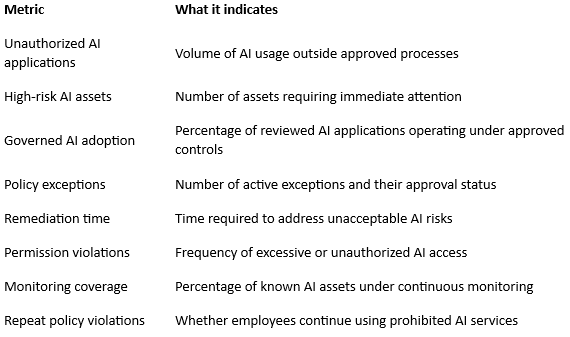
These metrics should be reviewed regularly with business and security stakeholders.
A reduction in high-risk exposure combined with an increase in governed AI adoption is a more meaningful indicator of progress than simply measuring how many applications have been blocked.
A Practical Decision Framework for CISOs
Before making a final decision about any Shadow AI application, security leaders can follow this sequence:
- Understand the business purpose: Identify why employees are using the application and what problem it solves.
- Evaluate the exposure: Assess the data, identities, permissions, integrations, and provider risks.
- Check available controls: Determine whether the identified risks can be reduced through technical and contractual safeguards.
- Select an action: Block unacceptable usage, restrict risky capabilities, or approve the application under defined governance requirements.
- Assign ownership: Identify the business owner and security team responsible for ongoing oversight.
- Reassess regularly: Review changes in usage, functionality, access, and risk.
This approach helps organizations make consistent decisions instead of relying on blanket AI restrictions.
Building a Secure and Governed Enterprise AI Environment
Shadow AI is not automatically a security incident, and every unauthorized application does not need to be permanently blocked.
The real challenge for CISOs is distinguishing manageable business usage from AI activity that creates unacceptable exposure. Blocking should be reserved for situations where risks cannot be adequately controlled, while governance should be used when applications provide legitimate value and can operate within defined security boundaries.
A mature AI security governance program combines visibility, risk-based decisions, appropriate access controls, employee awareness, and continuous monitoring.
With support from AI Security Posture Management, organizations can make these decisions using better information about their AI assets and associated risks.
Indrasol's AI, application, cloud, and cybersecurity capabilities can help enterprises strengthen their security posture while building a more structured approach to AI adoption.
Explore Indrasol's AI Security Posture Management services to understand how your organization can assess AI security risks and establish a more controlled enterprise AI environment.
About the Author
Brahma Guptha Illindra
Brahma Gupta is a technology entrepreneur, enterprise technology leader, and Founder & CEO of Indrasol, helping organizations adopt AI, cloud, data, and cybersecurity technologies securely, compliantly, and at scale. Over the years, he has worked across enterprise architecture, data engineering, analytics, cloud technologies, Oracle EPM, and business transformation. Today, his focus is increasingly on one of the biggest challenges facing enterprises: how to adopt AI at scale without losing visibility, security, governance, or control. At Indrasol, he and his team help organizations bridge the gap between technology innovation and business risk across: • AI Security & AI-SPM (AI Security Posture Management) • AI Governance & Responsible AI • Cloud Security & CSPM (Cloud Security Posture Management) • Cybersecurity & Risk Management • SOC 2, ISO 27001, ISO 42001 & CMMC compliance • Cloud modernization & DevOps • Data, analytics & AI transformation • Enterprise technology & automation Brahma is particularly
View Brahma Guptha Illindra's profile