
Real-Time Intelligence: Monitoring, Securing, and Scaling ML in Production with Databricks
ABSTRACT
Managing and protecting models in production is becoming a more complicated and extensive task as businesses extend their AI initiatives. This blog describes how scalable governance, real-time intelligence, and dependable model lifecycle management are made possible by a unified MLOps platform that is supported by the Databricks Lakehouse.
Organizations can combine continuous monitoring, model deployment, and data engineering in a single collaborative environment with Databricks. Wiz Cloud's Security Graph, which offers continuous visibility and automatic compliance for AI operations, is integrated by Indrasol to expand enterprise security and fortify this base.
Indrasol enables businesses to develop responsibly and achieve a faster time-to-value while upholding compliance and trust throughout their AI ecosystem by fusing data-driven performance with proactive threat detection.
INTRODUCTION
The competitiveness of modern businesses now depends on AI and ML, yet operating these systems at production scale adds a great deal of complexity. The majority of businesses lack comprehensive tools for effectively retraining, governing, and safeguarding models on a continuous basis [4]. By integrating testing and deployment together, the MLOps platform fills this gap and guarantees operational stability and reproducibility. This integration is best demonstrated by the Databricks Lakehouse Platform, which combines analytics, machine learning, and structured data into a single ecosystem [8].
PRODUCTION CHALLENGES IN ML OPERATIONS
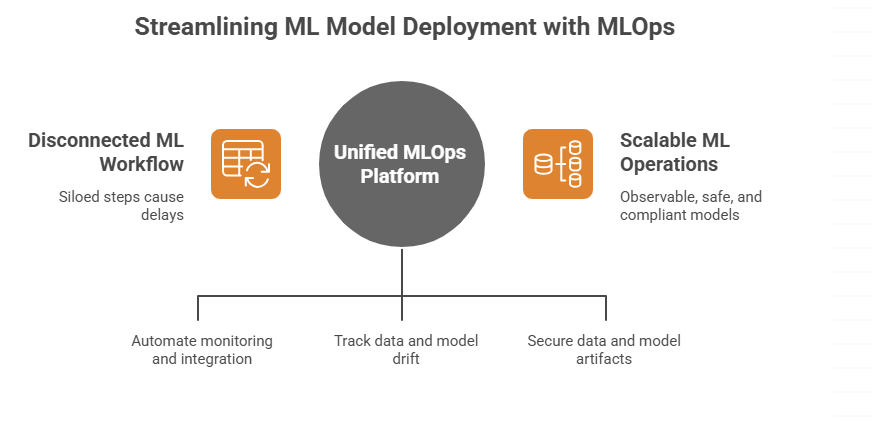
The most challenging aspect of the process is frequently transferring machine-learning models from a research notebook into an operational system. Production settings reveal issues in data pipelines, monitoring, and governance, as many teams find out. Each step of the workflow data ingestion, training, deployment, and retraining functions independently in the absence of a centralized MLOps platform. Delays in releases, irregular model behavior, and a lack of performance visibility are the outcomes.
Model drift is one enduring issue. An accurate model can gradually fail and produce incorrect predictions as incoming data changes. Continuous observability across characteristics and data is necessary to identify and fix the drift. This visibility is frequently made impossible by separate technologies, forcing data scientists and engineers to rely on ad hoc scripts or manual verification [1].
Problems with data quality make things more difficult. Models may be biased or inference delay may rise due to missing or corrupted records. Those variations often give rise to compliance issues in regulated businesses. Standards like as GDPR or SOC 2 require teams to maintain audit logs and demonstrate data lineage, but point solutions rarely offer full traceability. Another level of complication is added by security. Sensitive data, model artifacts, and credentials need to be handled uniformly across settings. Unauthorized access and configuration mistakes are more likely to occur in disconnected systems.
These issues are resolved by standardizing pipelines, automating monitoring, and integrating security and governance straight into workflows with a unified MLOps platform [4]. Knowing that every model in production is observable, safe, and compliant as data and business requirements change gives organizations the confidence to scale.
DATABRICKS LAKEHOUSE OVERVIEW
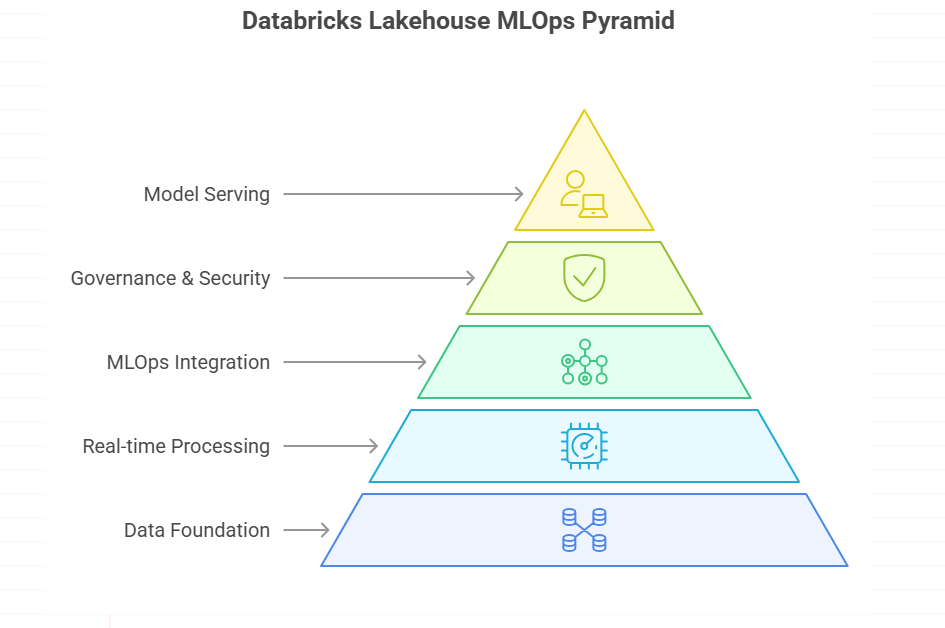
The ability to integrate data, models, and infrastructure determines whether a modern MLOps platform is successful or not. By fusing the flexibility of data lakes with the dependability of data warehousing, the Databricks Lakehouse Platform [8] offers that unification. Without transferring resources between disparate tools, teams may prepare data, train models, and serve predictions in real time inside a single environment.
Delta Lake, the open-source storage layer at the core of this ecosystem, guarantees consistent version control and ACID transactions for big datasets. By removing data-quality gaps that frequently disrupt production pipelines, Delta Lake provides a reliable basis for all models. Real-time machine learning at the corporate level is made possible by Apache Spark Structured Streaming [9], which powers continuous data intake and feature computation on top of this storage layer.
The Databricks Lakehouse is not just for computing and storage. For any comprehensive MLOps platform, integrated components like MLflow offer experiment tracking, model registration, and deployment automation. Teams may use MLflow [3] to log metrics, parameters, and artifacts for each experiment. Then, they can use controlled versioning to promote models from development to production with ease. When data or business rules change, this traceability speeds up retraining and makes audits easier.
Another essential component of the Lakehouse is Unity Catalog [3], which ensures uniform data governance and security guidelines for all workloads. It documents full lineage for compliance audits and specifies who has access to datasets, notebooks, or registered models. This integrated governance lowers risk and does away with needless manual reviews for businesses that must comply with GDPR, HIPAA, or SOC 2 regulations.
Model Serving uses autoscaling endpoints to provide quick, low-latency inference in the production layer. Models can be implemented as REST APIs with integrated latency and performance monitoring. This enables online feature retrieval for streaming use cases like fraud detection or recommendation systems when paired with a feature store.
The Databricks Lakehouse is the foundation of an enterprise-grade MLOps platform [4] because of these combined features. It unifies machine learning and data engineering into a single, visible, cost-effective architecture. As a result, there is a steady flow from unprocessed data to useful intelligence that is prepared for production workloads in real time and secure against future data expansion.
MONITORING AND OBSERVABILITY IN PRODUCTION
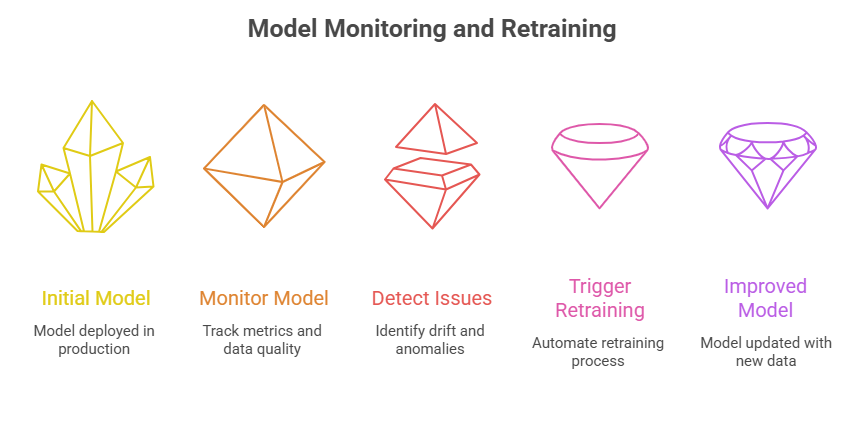
Model success in production is dependent on visibility. Even robust models become irrelevant when data and behavior shift in the absence of feedback loops. Observability is considered a fundamental MLOps capability by Databricks.
Model Monitoring: MLflow Tracking provides a clear picture of the health of the model by capturing metrics like accuracy, precision, recall, and loss across revisions. Teams can identify drift, compare real-time forecasts to ground truth, and initiate retraining automatically when combined with real-time machine learning serving [7].
Data Quality: Delta Live Tables check data as it is being ingested, identifying outliers, missing values, and schema problems before they have an impact on models. This assures that changes in data may be linked to changes in performance.
Drift and Anomaly Detection: By continuously monitoring feature distributions and outputs, small data shifts are detected early on, resulting in proactive alarms that include deployment lineage and feature-level context [1].
Compliance and Transparency: Complete auditability and reproducibility are ensured by the model registration and Unity Catalog, which log each prediction, dataset, and configuration change.
Databricks creates a self-correcting machine learning environment by integrating monitoring, alerting, and traceability into workflows. This ecosystem allows for early detection of performance problems, automatic retraining [4], and quantifiable trust as data changes.
SECURING ML PIPELINES AND GOVERNANCE
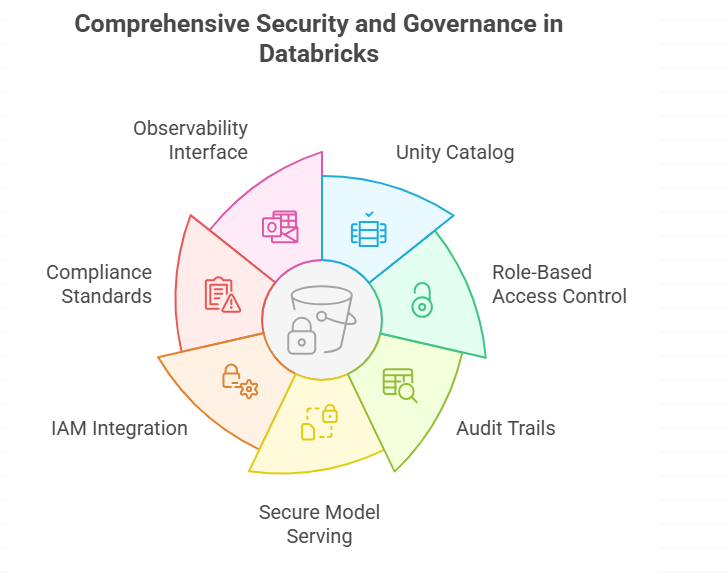
Security and governance are crucial in production because machine learning models handle sensitive data and have a significant impact on important choices. Databricks uses Unity Catalog to consolidate governance across data, notebooks, and models, and integrates these controls into its MLOps workflow [4]. To ensure compliance, it imposes role-based access control (RBAC), customized permissions, and keeps an exhaustive audit trail of all operations. Input validation, encryption, and authentication are guaranteed via secure model serving, and access is limited to authorized users and services only through connection with IAM systems.
By using lineage tracing, encryption, and policy enforcement, compliance with standards like GDPR, HIPAA, and SOC 2 is accomplished. The platform uses the same observability interface that is used for performance monitoring to deliver alarms when it detects unusual behavior or unauthorized access. Organizations can confidently install and expand models while preserving data integrity and regulatory compliance because to Databricks integration of security, governance, and operational visibility [2].
SCALING ML WORKLOADS EFFICIENTLY
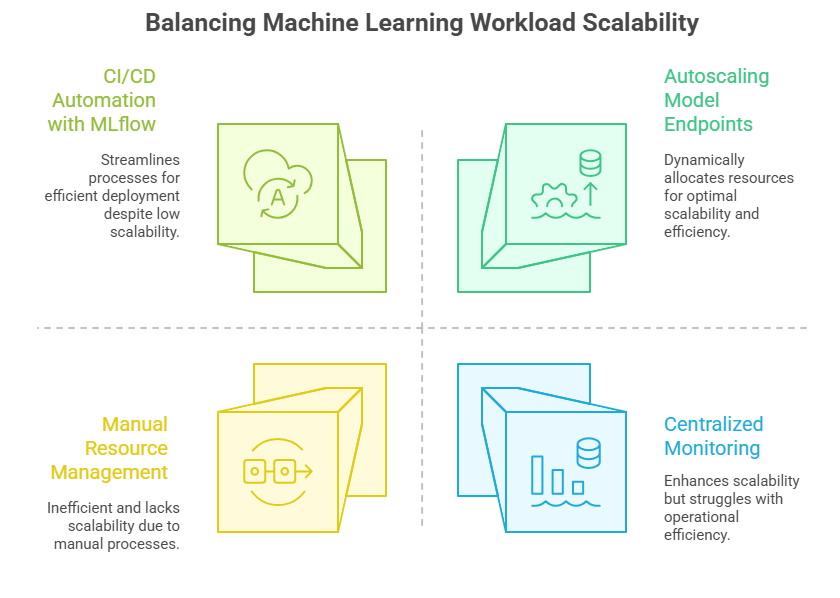
In order to scale machine learning workloads, reliability, cost, and performance must be balanced as data and traffic increase. This is addressed by Databricks' autoscaling model endpoints, which offer both batch and real-time inference with predictable latency by dynamically allocating computation based on demand. Continuous testing, deployment, and version control are made possible by CI/CD automation with MLflow [9], while responsiveness and cost effectiveness are maximized by cluster policies and elastic resource management. Consistent, scalable pipelines are ensured by features like automated rollbacks, canary deployments, and connection with Spark Structured Streaming and Delta Live Tables [7].
In addition to computation, Databricks maximizes scalability by providing low-latency access for both online and offline use cases, including fraud detection or recommendations, using effective feature stores. Through centralized monitoring, teams can see how resources are being used and adjust expenses and performance. Databricks helps businesses to scale machine learning workloads with ease by combining autoscaling, CI/CD orchestration, and intelligent resource monitoring. This allows them to maintain high availability, low latency, and operational efficiency in dynamic production environments.
INTEGRATING WIZ CLOUD’S SECURITY GRAPH & INDRASOL’S AI SECURITY EXPERTISE
Wiz Cloud's Security Graph [10] gives companies the ability to proactively reduce risks by providing a contextualized, visible map of cloud assets, identities, and vulnerabilities.
Indrasol uses AI-driven analytics [6] along with this graph to strengthen ML pipelines and automate compliance processes. Their method unifies DevOps, MLOps, and SecOps under a single governance layer, turning security from a reactive process into a predictive system.
Indrasol [5] makes sure that AI ecosystems are robust, compliant, and prepared for the future by combining Databricks Lakehouse intelligence with Wiz Cloud visibility.
CONCLUSION
The exponential growth of machine learning (ML) and artificial intelligence (AI) across industries highlights the increasing demand for scalable, secure, and reliable MLOps systems. Ensuring operational dependability and governance becomes equally as important as model performance as businesses grow their AI workloads.
Businesses can combine pipelines for data ingestion, model creation, and deployment into a single, high-performance environment by utilizing the Databricks Lakehouse Platform. Real-time information, ongoing monitoring, and smooth cooperation between data science and engineering teams are made possible by this integration.
However, the increasing complexity of cyberthreats requires that security solutions keep up with innovation. Here, Databricks-driven MLOps are transformed into a secure AI operations ecosystem by combining Indrasol's AI security [6] expertise with Wiz Cloud's Security Graph [10]. Continuous protection is offered by Indrasol's automated compliance workflows and Wiz Cloud's contextual visibility across cloud assets without compromising speed or agility.
By working together, Databricks and Indrasol enable businesses to confidently develop, track, and grow machine learning (ML) systems, transforming data-driven insights into useful business outcomes while upholding the highest security, regulatory, and trust standards. Through this collaboration, Indrasol establishes itself as a reliable authority on safe AI operations, assisting businesses in making ethical innovations in a world that is becoming more data-driven.
REFERENCES
[1] Booz Allen Hamilton. (n.d.). Securing Artificial Intelligence. https://www.boozallen.com/insights/ai-research/securing-artificial-intelligence.html
[2] Lakehouse storage. Databricks. (n.d.). https://www.databricks.com/product/lakehouse-storage
[3] MLflow for ML Model Lifecycle. Databricks on AWS. (2025, June 10). https://docs.databricks.com/aws/en/mlflow/
[4] MLOps workflows on Databricks. Databricks on AWS. (2024, December 18). https://docs.databricks.com/aws/en/machine-learning/mlops/mlops-workflow
[5] Website. Indrasol. (n.d.). https://indrasol.com/services
[6] Website. Indrasol. (n.d.). https://indrasol.com/services/aisolutions
[7] Dagogo, G. M. (2024, May 30). Databricks: A modern data lakehouse platform(dim). Medium. https://medium.com/@georgemichaeldagogomaynard/databricks-a-modern-data-lakehouse-platform-dim-a1f896bf3c03
[8] Mssaperla. (n.d.). What is a Data Lakehouse? - azure databricks. Azure Databricks | Microsoft Learn. https://learn.microsoft.com/en-us/azure/databricks/lakehouse/
[9] Mssaperla. (n.d.). The scope of the Lakehouse Platform - Azure Databricks. Azure Databricks | Microsoft Learn. https://learn.microsoft.com/en-us/azure/databricks/lakehouse-architecture/scope
[10] Wiz security graph: How it works, benefits, use cases: WIZ. wiz.io. (n.d.). https://www.wiz.io/lp/wiz-security-graph
About the Author
Jyothirmayee Kunapareddy
Jyothirmayee Kunapareddy is a Data Analyst Trainee with a passion for transforming raw data into meaningful insights that drive business decisions. Skilled in data visualization, SQL, and analytics tools, she focus on extracting value from complex datasets to support informed strategy and growth. She holds the "Databricks Certified Data Analyst Associate" credential, which demonstrates her proficiency in building data-driven solutions using the Databricks Lakehouse Platform. She is enthusiastic about leveraging analytics, modern data platforms to enable smarter, faster decision-making.
View Jyothirmayee Kunapareddy's profile