
Building a Production-Grade ETL Pipeline on Databricks: A Complete 2025 Guide
ABSTRACT
To transform raw data into clean, dependable, and useful information, a robust ETL pipeline is necessary. As data grows in volume and complexity, organizations need systems that are scalable, automated, and easy to maintain. Databricks delivers a modern platform that enables ETL creation through an integrated environment, declarative pipelines, and built-in automation. This blog walks you through how to design and create a production-grade ETL pipeline on Databricks in 2025 using clear, practical steps without complexities.
Introduction
Today, data arrives from a variety of sources and forms, making it challenging for teams to use it directly for reporting or analysis. By extracting raw data from various systems, cleaning it, and loading it into a usable format, ETL (Extract, Transform, Load) assists in resolving this issue. This process guarantees that companies may make decisions based on reliable and consistent data. Because Databricks integrates data engineering, automation, and scalability into a single platform, it offers a solid basis for ETL. The goal is to help you learn how to construct something secure, simple to maintain, and ready for real-world corporate application.
What Is ETL — and Why It Matters
The process of moving data from several sources into a single, well-organized area usually a data warehouse or data lake is known as ETL, or extract, transform, load. To put it simply, ETL takes raw data from various systems, cleans it, transforms it into a format that can be used, and then stores it, so that business teams, data engineers, and analysts can readily access it. Data is extracted from sources such as files, databases, and APIs during the "Extract" step. "Transform" enhances the data by applying business rules, standardizing formats, and removing errors. Finally, "Load" transfers the processed data to a location that can facilitate machine learning, analytics, and reporting.
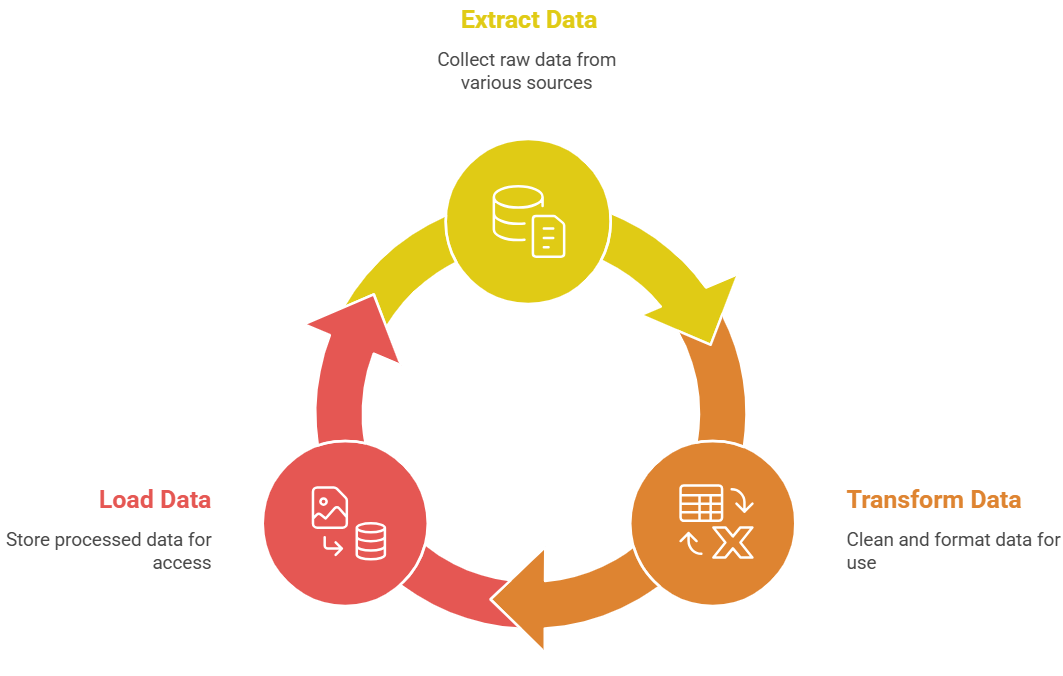
Figure 1: Extract, Transform, Load (ETL)
ETL is crucial because it enables businesses to transform disorganized data into reliable information. Most of the teams frequently suffer with inaccurate data, manual tasks, and poor decision-making in the absence of ETL. An effective ETL procedure guarantees data accuracy, accelerates reporting, and establishes a single source of truth for the whole company. Additionally, it offers significant use cases including automation, predictive models, and real-time dashboards. To put it briefly, ETL provides companies with the framework they need to make data-driven, quicker, and more intelligent decisions.
Why Use Databricks for ETL?
Databricks is an effective option for ETL because it combines analytics, data science, and data engineering on a single platform. Teams can use the same environment for data extraction, cleaning, and loading rather than handling numerous tools. Large amounts of data may be easily handled by Databricks quick, scalable engine, which is driven by Apache Spark. Additionally, you may process both historical data and real-time events without switching systems because it supports both batch and streaming ETL. This makes ETL easier, quicker, and more dependable particularly for businesses dealing with large or dynamic information.
Databricks ability to streamline automation and collaboration is another advantage. Teams can collaborate in one location, monitor changes, guarantee data accuracy, and effortlessly manage production pipelines with to features like notebooks, Delta Lake, and integrated workflows. By providing versioned data, ACID transactions, and schema enforcement, Delta Lake increases reliability by lowering mistakes and maintaining pipeline consistency. Databricks, when combined with cost-effective compute and the flexibility to interact with cloud storage and popular tools, provides a simple and modern approach to create production-grade ETL pipelines that expand as your business develops.
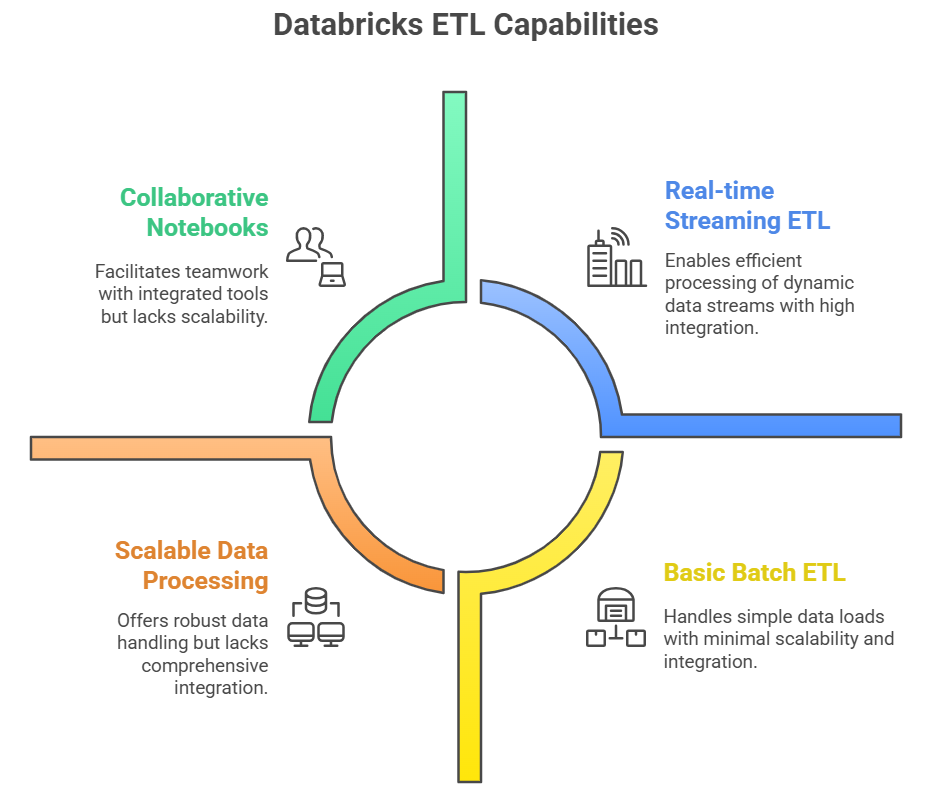
Figure 2: Databricks ETL Capabilities
A Reliable ETL Pipeline Design on Databricks — Step by Step
Using Databricks, we can create a scalable and auditable ETL pipeline by importing raw data, storing it in Delta Lake zones (raw/bronze → silver → gold), applying tested transformations, and automating and monitoring the entire process.
Plan your objectives and data flow:
List consumers (reports, ML models), sources (databases, APIs, files, streaming), SLAs (latency, freshness), and data quality guidelines first. A well-defined plan eliminates rework and specifies which components must be batch vs real-time.
Ingestion of raw data (Bronze Layer):
Import data using a simple schema-on-write or schema-as-captured method and store it exactly as it was received with some changes or else you can directly upload the data files also. Keeping the original files makes debugging easier and guarantees provenance. Use Databricks CDC or streaming ingestion methods for situations that call for high throughput or change data gathering.
Store with Delta Lake for dependability:
To obtain time travel, scalable metadata, and ACID properties ensures that keep ingested data in Delta Lake tables. Delta’s schema enforcement and transaction log minimize inconsistent writes and facilitate recovery from pipeline failures.
Refine to silver tables that have been cleaned (Silver Layer):
Use deterministic transformations, such as type normalization, deduplication, addressing missing values, and enforcing business rules. Maintain modular transformation steps (small notebooks or jobs) so you may test and re-run only the important changes.
Create serving tables and gold layer (curated) datasets:
Create tables (aggregates, feature sets, BI views) that are ready for analysis and consumption. These needs to be tuned for access control and query efficiency (Z-order, partitioning). To keep costs and stability under control, separate compute for exploratory work from production query workloads.
Organize and schedule tasks with consistency:
To create a repeatable pipeline, link ingestion → transform → tests → publish phases using Databricks jobs or Lakeflow (or your orchestration provider). To enable pipelines to run for several dates or partitions, add backfills, parameterization, and retries.
CI/CD and automated testing:
Test transformations using integration tests (end-to-end on staging), unit tests (small sample data), and data quality checks (row counts, null thresholds, schema checks). Automate release workflows and version notebooks in source control to ensure reliable rollouts.
Observability, lineage, and monitoring:
Monitor data quality metrics, table row counts, and pipeline health (latency, error rates). To help analysts track an unexpected value back to the original raw file, record lineage and metadata (who/when/why). Transaction logs and delta time travel are useful for root cause analysis.
Governance, security, and cost management:
Use Unity Catalog or your cloud’s IAM for table-level controls, enforce least privilege, encrypt data while it’s in transit or at rest, and implement retention/cleanup procedures to control storage expenses. To balance cost and performance, select the right compute configurations (jobs vs. interactive clusters, auto-scaling).
Repeat and document the results:
To add additional sources or modify transformations with little impact, keep the pipeline modular. When something goes wrong, it saves hours to document data contracts, expected SLAs, and failure scenarios.
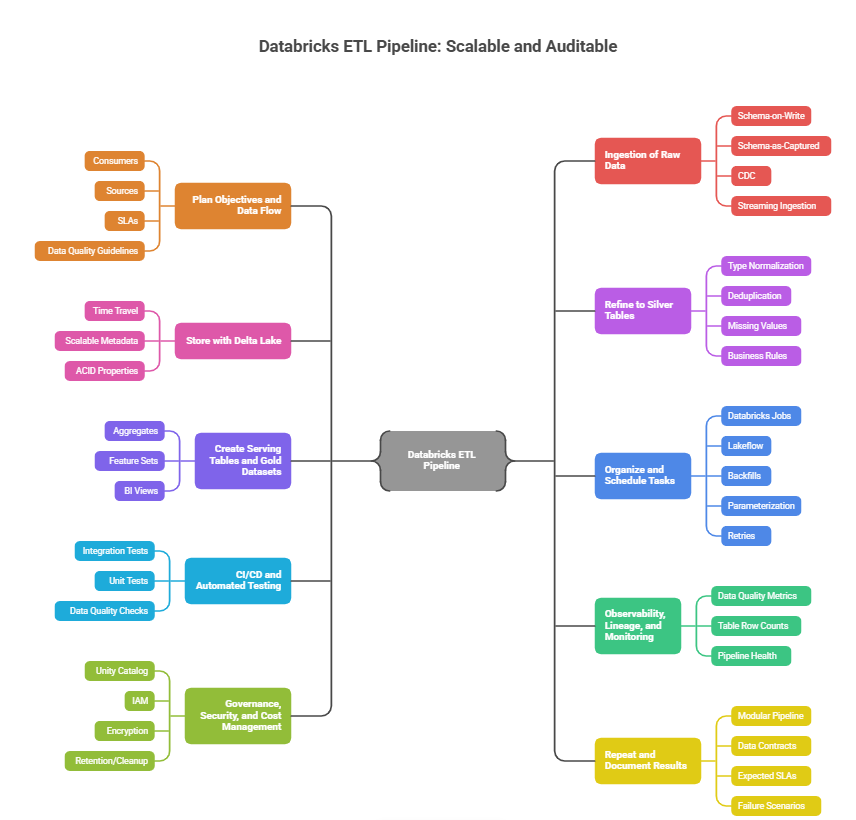
Figure 3: Databricks ETL Pipeline Steps
Common Patterns & Use Cases
Depending on how quickly the data changes and how quickly they require insights, Databricks allows teams to select the best ETL strategy. Batch ETL is still the simplest and most dependable choice for many businesses. For planned tasks like weekly performance dashboards, daily sales summaries, or recurring data refreshes, it performs effectively. Teams can handle data in predictable cycles using these workloads, which typically run at set intervals.
Incremental and CDC (Change Data Capture) pipelines are more helpful when companies deal with operational systems like e-commerce platforms, CRM applications, or inventory systems. These pipelines only concentrate on new or updated records rather than reprocessing everything. This lowers computation costs, maintains data freshness, and facilitates near-real-time decision-making without taxing the platform.
Databricks provides streaming ETL for applications that need quick insights, such as fraud detection, consumer activity tracking, IoT device monitoring, or real-time user interactions. Teams can respond rapidly and create responsive data products which continually process events as they come in.
Data usually enters curated layers after being ingested and processed. People here create feature-ready datasets for machine learning, dimensional models, or clean tables that feed analytics programs like Tableau, Looker, and Power BI. Databricks easily supports everything from straightforward reporting workflows to complex, enterprise-scale pipelines because it integrates storage, computation, and governance into a single platform.
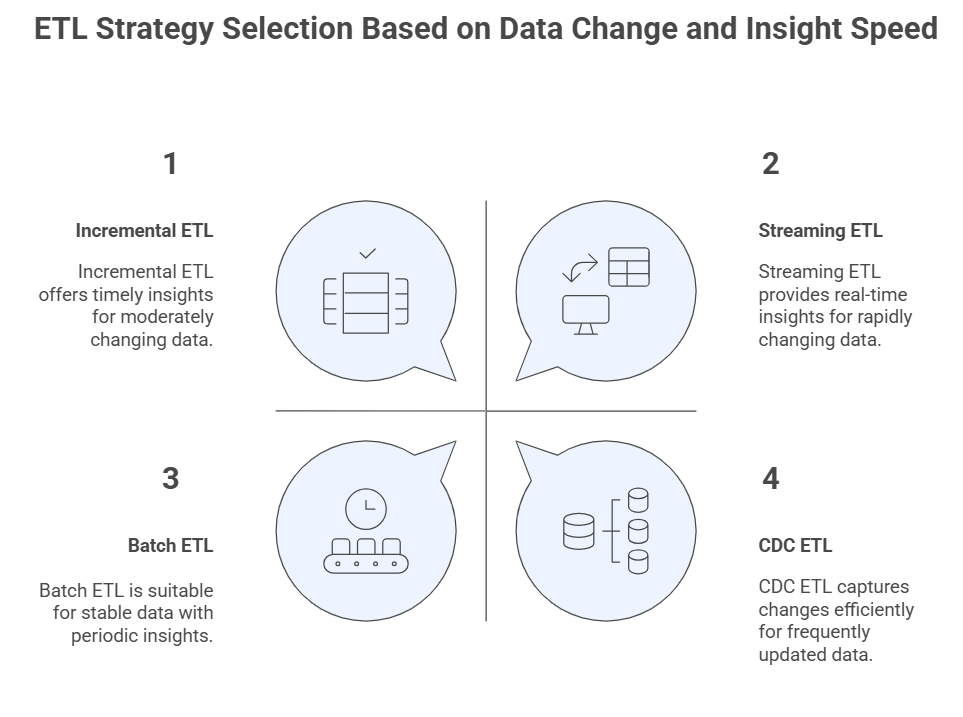
Figure 4: ETL Strategy Selection Based on Data Change and Insight Speed
Key Best Practices
The first step in developing a reliable ETL pipeline is to arrange your data carefully and properly. Separating each pipeline stage into layers one for raw data, another for cleaned and validated data, and a third layer for processed, business-ready outputs is the most popular method. This keeps confusing logic from combining with original data and simplifies the flow.
Your code can be made simpler and easier for teams to comprehend by keeping your pipelines declarative, which means you concentrate on what needs to happen rather than creating lengthy step-by-step instructions. It also helps in maintaining uniformity throughout projects.
Another important aspect is data quality checks. Running validation early in the pipeline guarantees that errors, duplication, or broken records are discovered before they reach dashboards or machine learning models. This avoids confusion later and saves time.
Set up automated monitoring and notifications to keep everything functioning properly. Someone on the team should be informed right away if a job fails or processes unexpected volumes of data. Also, groups may monitor changes, evaluate updates, and roll back to a prior version if something goes wrong by utilizing version control (such as Git).
Conclusion
A robust production-grade ETL pipeline supports in the transformation of raw, dispersed data into dependable information that teams can rely on for reporting, analytics, and decision-making. Databricks facilitates this process by providing scalable computation, automated workflows, and integrated tools that greatly simplify the management of validation, monitoring, and error handling.
Organizations may create pipelines that remain stable even as data increases by using a structured architecture, implementing regular quality checks, and automating as many processes as they can. This lowers errors, cuts down on manual work, and frees up teams to concentrate more on providing insights and business value than on resolving technical problems.
References
[1] Extract transform load (ETL). Databricks. (n.d.). https://www.databricks.com/discover/etl
[2] What is Delta Lake in Databricks?. Databricks on AWS. (n.d.). https://docs.databricks.com/aws/en/delta
[3] Lakeflow jobs. Databricks on AWS. (2025, September 9). https://docs.databricks.com/aws/en/jobs
[4] What is a medallion architecture?. Databricks. (n.d.). https://www.databricks.com/glossary/medallion-architecture
[5] Structured Streaming Concepts. Databricks on AWS. (2024, October 2). https://docs.databricks.com/aws/en/structured-streaming/concepts
[6] Build lakehouses with Delta lake. Delta Lake. (n.d.). https://delta.io/
[7] Manage data quality with pipeline expectations. Databricks on AWS. (2025, November 10). https://docs.databricks.com/aws/en/ldp/expectations
[8] Data Engineering with databricks. Databricks on AWS. (2025, November 13). https://docs.databricks.com/aws/en/data-engineering
About the Author
Jyothirmayee Kunapareddy
Jyothirmayee Kunapareddy is a Data Analyst Trainee with a passion for transforming raw data into meaningful insights that drive business decisions. Skilled in data visualization, SQL, and analytics tools, she focus on extracting value from complex datasets to support informed strategy and growth. She holds the "Databricks Certified Data Analyst Associate" credential, which demonstrates her proficiency in building data-driven solutions using the Databricks Lakehouse Platform. She is enthusiastic about leveraging analytics, modern data platforms to enable smarter, faster decision-making.
View Jyothirmayee Kunapareddy's profile