
How to Scale MLOps on Databricks: From Prototype to Production with Best Practices
ABSTRACT
Only a small percentage of machine learning initiatives make it to production in a dependable and scalable manner, despite the fact that many begin strong with promising results in notebooks. As teams progress beyond experimentation, they frequently encounter real-world problems, including uneven settings, laborious deployment procedures, a lack of clear ownership after models are live, and restricted visibility into model performance. These difficulties impede team productivity and raise operational risk, particularly as machine learning moves from discrete trials to integrated business systems.
This blog examines how MLOps may be scaled from early prototypes to machine learning systems that are ready for production using Databricks. It focuses on useful best practices, including maintaining model versions, recording experiments, automating training and deployment, and keeping an eye on models once they are released. Teams may decrease complexity, increase dependability, and iterate more quickly by utilizing a single platform that unifies data, machine learning, and operations. The objective is to disseminate an understandable, experienced-based perspective on what it takes to create machine learning systems that genuinely function in production and continue to provide value over time.
INTRODUCTION
It is now easier than ever to begin machine learning. A single laptop may quickly create a model that appears realistic and promising strong platforms and contemporary frameworks. The issue of putting that same idea into production is somewhat different. When the model needs to be retrained, deployed, monitored, and maintained over time, many teams find that what worked well during testing breaks down. Because of this, companies frequently have brittle pipelines, manual procedures, and models that gradually become outdated without anybody realizing.
MLOps can help in this situation. Like DevOps did for software development, MLOps focuses on introducing structure, automation, and engineering rigor to the machine learning lifecycle. Reproducibility, version control, deployment consistency, and operational monitoring are among the practical issues it tackles. By providing a single platform where data engineering, machine learning, and analytics may collaborate, Databricks plays a significant role in this field. Teams may create, implement, and run machine learning systems on a single platform rather than piecing together several disparate technologies. In the sections that follow, we examine how Databricks facilitates this shift from prototype to production and provides best practices for organizations looking to grow machine learning sustainably.
MLOps CHALLENGES IN MOVING FROM PROTOTYPE TO PRODUCTION
A lot of machine learning work starts in a notebook where structure is less important than speed. When someone subsequently has to replicate results, retrain the model, or explain why a forecast was altered, it becomes problematic. However, it is acceptable for experimentation. Because models rely on data that is constantly changing, pipelines become tightly coupled, and minor changes can have a cascading effect on the entire system. Research has shown that ML systems accumulate "hidden technical debt" in ways that regular software does not [1].
Production machine learning requires much more than a trained model, which presents another significant obstacle. Repeatable training, data quality checks, early failure detection tests, and transparent versioning are all necessary to ensure you are constantly aware of what is operating in production. Google's "ML Test Score" project demonstrates how much real-world testing and monitoring are required before a system can be deemed production-ready (not merely "the model has good accuracy") [2].
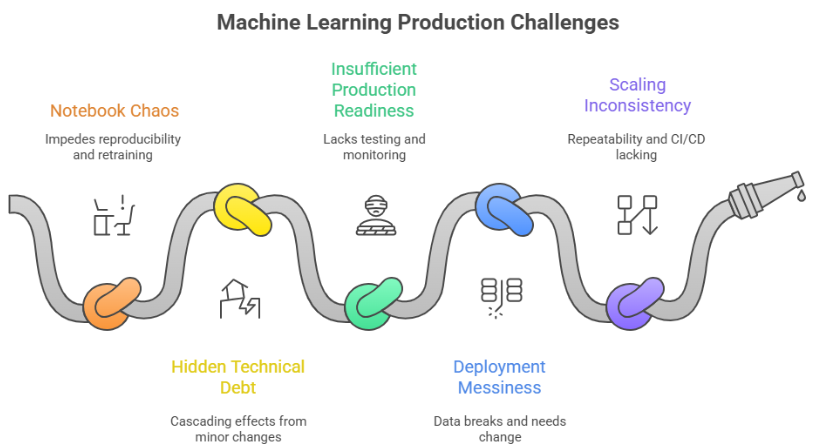
When it comes to long-term operations and deployment, many teams face the greatest challenges. A review of actual deployment case studies reveals that since production settings are messy, data breaks, needs change, stakeholders want explanations, and models require continuous care, challenges arise at every stage—data collection, training, release, monitoring, and maintenance [3].
Lastly, scaling MLOps is a procedural and consistency challenge in addition to a technological one. Building a repeatable development-to-production process is emphasized in Databricks own MLOps workflow guidelines, and their MLOps Gym series defines maturity as progressing from basic repeatability to CI/CD and ultimately to better rigor and quality. To put it another way, scaling MLOps is about transforming one-time success into a dependable system that your team can operate on a daily basis without heroics [4].
DATABRICKS AS A UNIFIED PLATFORM FOR SCALABLE MLOps
Scalable MLOps are made possible by Databricks, which unifies the machine learning lifecycle onto a single platform. Teams may operate in a single environment from beginning to end rather than depending on disparate technologies for data preparation, testing, deployment, and monitoring. Databricks helps teams standardize procedures and cut down on ad hoc practices by offering a baseline MLOps workflow that precisely outlines how models progress from exploration to production. This cohesive approach is particularly crucial when machine learning systems become more complicated and require ongoing maintenance rather than being handled as one-time jobs.
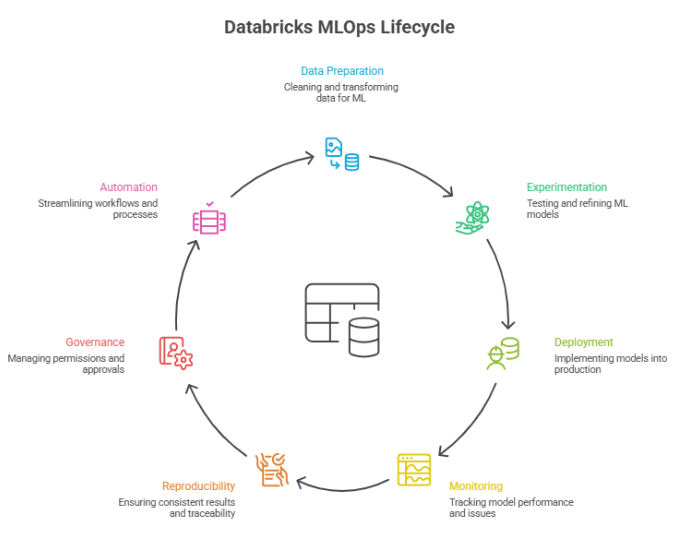
Databricks significant emphasis on reproducibility, traceability, and governance is one of its main advantages. Databricks enables teams to log parameters and metrics, maintain model versions consistently, and follow experiments by tightly integrating MLflow into the platform. Every production model may be linked to the precise configuration, data, and code that produced it. Centralized cataloging and access control, which assist businesses in managing permissions, approvals, and audit needs as additional teams and models are used, further enhance governance.
Automation and operational dependability, which Databricks offers native support for, are also necessary for scalability. Teams can automate end-to-end machine learning pipelines, including data validation, training, assessment, and deployment, without the need for human involvement owing to workflow orchestration. Teams may maintain consistency between training and serving by reusing and standardizing features across models with the use of feature management tools. When combined, these features enable Databricks to transform experimental machine learning to work into reliable, repeatable production systems that can grow to meet corporate demands.
BEST PRACTICES FOR SCALING MLOps ON DATABRICKS
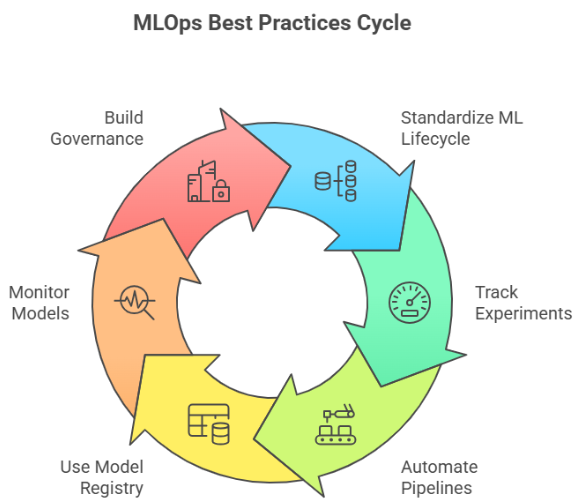
Scaling MLOps requires more than improving model accuracy; it demands reliable processes and strong engineering discipline. Based on industry research and Databricks recommended workflows, the following best practices highlight what teams need to build reproducible, automated, and production-ready ML systems at scale.
Standardize the End-to-End ML Lifecycle Early
Avoiding considering production and experimental as two different universes is one of the most crucial lessons in scaling MLOps. Teams using Databricks are urged to adhere to a standard lifecycle from the initial notebook trial to the production model. This entails using uniform deployment techniques, tracking systems, and data sources across settings. Standardization eliminates uncertainty, fosters better teamwork, and keeps teams from creating new procedures for each new model.
Make Experiment Tracking and Reproducibility Non-Negotiable
Reliability in reproducing findings is essential for scaling MLOps. Logging experiments methodically, including parameters, metrics, artifacts, code versions, and data references for each run, is a best practice for Databricks. This allows one to track production models back to their roots, compare versions objectively, and comprehend how a model was constructed. When models must be retrained, audited, or debugged months after their original release, reproducibility becomes crucial.
Automate Training, Validation, and Deployment Pipelines
Manual workflows do not scale. Training and deployment must be automated as ML systems expand in order to lower mistakes and accelerate iteration. Databricks facilitate automation by coordinating data preparation, training, assessment, and model registration using scheduled processes and CI/CD connectors. Adding automatic checks, such as performance limits and data quality validation, to ensure that only models that satisfy predetermined criteria are advanced is one of the best practices. Instead of being a delicate handoff, automation transforms ML delivery into a repeatable engineering process.
Use a Model Registry to Control Promotion and Ownership
Managing models at scale requires a centralized model registry. The model registry serves as a Databricks system of record for model versions, stages, and information. Assigning responsibility, recording approval requirements, and clearly outlining promotion phases (such as development, staging, and production) are examples of best practices. Because of this framework, teams will always be aware of which model is in production, who approved it, and how to securely roll back if problems occur.
Monitor Models Continuously After Deployment
A model's deployment marks the start of operations rather than the conclusion of its lifespan. It is necessary to keep an eye out for unexpected behavior, data drift, and performance deterioration in production models. Monitoring prediction distributions, input feature data, and business metrics over time are examples of best practices. Teams can rapidly identify issues and determine when retraining is necessary by connecting monitoring insights to training data and experiments on Databricks. Even well-made models silently lose value in the absence of monitoring.
Build Governance, Security, and Lineage into the Platform
Governance becomes crucial when new teams and models are brought on board. Centralized access control, audit logs, and lineage across data, features, and models are key components of Databricks best practices. This lowers security threats, helps businesses comply with regulations, and preserves confidence in ML systems. Integrating governance into the platform guarantees scalability without compromising control or transparency, therefore it shouldn't be added as an afterthought.
MONITORING GOVERNANCE AND CONTINUOUS IMPROVEMENT
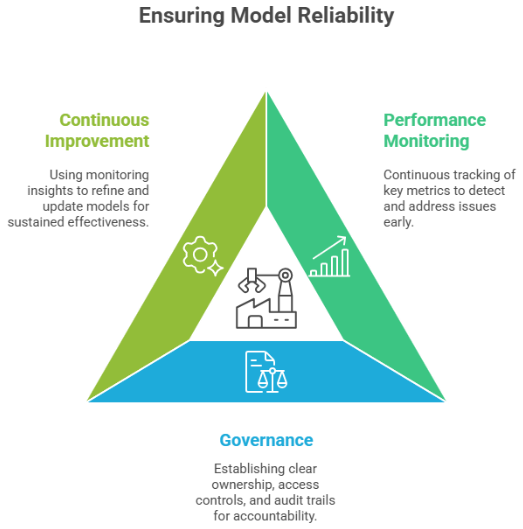
The actual job starts as soon as a model is put into production. Assumptions developed during training may gradually fall apart when data and user behavior change over time. These problems frequently go undiscovered until they begin to have an impact on company outcomes if they are not monitored. Production models thus require constant monitoring of their performance. Teams may identify issues early and determine whether a model requires attention by keeping an eye on important business indicators, input data trends, and forecast quality. Long after deployment, models are kept dependable and helpful because of this continuous input.
Monitoring is closely linked to governance and ongoing development. To preserve trust and accountability when additional models are implemented, teams require audit trails, access limits, and unambiguous ownership. Simple but important questions like who authorized a model, what data it was trained on, and when it was last updated are all answered by governance. By employing monitoring findings to initiate retraining, refinement, or even model replacement in a controlled manner, continuous improvement expands upon this basis. Monitoring and governance work together to transform machine learning from a one-time offering into a long-term, sustainable system.
CONCLUSION
It is not only a technological but also an operational problem to scale machine learning from prototypes to production. Issues like repeatability, automation, governance, and long-term durability become crucial as models approach actual business effect. Even the most accurate models find it difficult to endure production settings without an organized MLOps strategy.
By combining data, machine learning, and operations into a single platform, Databricks offers a useful basis for tackling these issues. Teams can go beyond one-time triumphs and create machine learning systems that scale with confidence by standardizing procedures, automating pipelines, tracking trials, and integrating governance and monitoring into the lifecycle. Creating systems that can be trusted, maintained, and enhanced over time is ultimately the goal of effective MLOps, and Databricks provides the resources and framework required to make that shift long-lasting.
REFERENCES
[1] D. Sculley, G. Holt, D. Golovin, E. Davydov, T. Phillips, D. Ebner, V. Chaudhary, M. Young, J.-F. Crespo, and D. Dennison, “Hidden technical debt in machine learning systems,” in Advances in Neural Information Processing Systems (NeurIPS), Montreal, QC, Canada, 2015, pp. 2503–2511. Available: https://proceedings.neurips.cc/paper_files/paper/2015/file/86df7dcfd896fcaf2674f757a2463eba-Paper.pdf
[2] E. Breck, S. Cai, E. Nielsen, M. Salib, and D. Sculley, “The ML test score: A rubric for ML production readiness and technical debt reduction,” in Proc. IEEE International Conference on Big Data (Big Data), Boston, MA, USA, 2017, pp. 1123–1132, doi: 10.1109/BigData.2017.8258038. Available: https://static.googleusercontent.com/media/research.google.com/en//pubs/archive/aad9f93b86b7addfea4c419b9100c6cdd26cacea.pdf
[3] A. Paleyes, R.-G. Urma, and N. D. Lawrence, “Challenges in deploying machine learning: A survey of case studies,” ACM Computing Surveys, vol. 55, no. 6, pp. 1–38, Jan. 2023, doi: 10.1145/3533378. Available: https://dl.acm.org/doi/10.1145/3533378
[4] Databricks, “MLOps workflows on Databricks,” Databricks Documentation, 2023. [Online]. Available: https://docs.databricks.com/en/machine-learning/mlops/mlops-workflow.html
About the Author
Dheekshitha Kamisetty
Dheekshitha Kamisetty is a Software/Data Engineer with experience building scalable data pipelines, cloud analytics solutions, and AI-driven systems. I specialize in Python, SQL, and Databricks to design end-to-end ETL workflows, analytics dashboards, and optimized data pipelines, and I have built backend services using FastAPI and GraphQL. My work includes integrating LLM-based applications, automation agents, and machine learning workflows, supported by cloud deployments and CI/CD pipelines, to deliver reliable, production-ready data solutions.
View Dheekshitha Kamisetty's profile