
 Bizradar
 Tanva
How CISOs Should Prioritize AI Security Findings
Summary
Most enterprises now have more AI security findings than they can fix, and severity scores alone cannot say which ones matter. This guide gives CISOs a context-based method to prioritize AI and application security findings by real business risk.
Why AI Security Findings Pile Up So Fast
AI adoption has outpaced most security programs. Teams deploy models, copilots and AI agents faster than security can review them. Every new tool, scan and integration adds findings to the backlog.
The result is a familiar problem. A security team opens its AI risk register and sees hundreds of open items. Each one looks urgent, yet the team has capacity to fix only a fraction of them this quarter.
Findings now arrive from many directions at once:
The challenge is not finding problems. It is deciding which few problems deserve attention first.
Why Severity Scores Alone Mislead Security Teams
Most tools rank findings by a severity label such as Critical, High or Medium. These labels describe how bad a flaw could be in theory. They say nothing about how bad it is in your environment.
Consider two findings that both carry a "Critical" label:
- Finding A: a prompt injection flaw in an internal test chatbot with no data access and no internet exposure
- Finding B: an over-permissioned AI agent that can read customer records and is reachable through a public API
On paper, they look equal. In practice, Finding B could lead to a reportable data breach, while Finding A poses little real risk.
What Severity Labels Miss
Severity scores were built for traditional software. AI systems add context that these scores cannot see:
- Autonomy: AI agents can act on their own, so a small flaw can trigger large actions
- Data reach: models and retrieval pipelines often connect to sensitive data stores
- Non-human identities: service accounts and API keys used by AI often hold broad, long-lived access
- Business purpose: the same flaw matters more in a revenue system than in a sandbox
This is why application security findings prioritization and AI risk prioritization must start with context, not with the score.
The Four Factors That Decide Real AI Risk
A finding becomes dangerous when four conditions line up. We call this the Asset × Identity × Data × Exposure model. If any one factor is low, the overall risk drops sharply.
Asset Criticality
Start by tagging every AI system with a business owner and a criticality level. A model that supports loan decisions or patient care is not the same as an internal summarization tool. Without this tag, every finding looks equally important.
Identity and Access
AI agents act through identities: service accounts, OAuth tokens and API keys. A finding on an agent with admin rights is far more serious than one on a read-only agent. Our earlier guide on AI agent access reviews covers how to audit these permissions in detail.
Data Sensitivity
Map which data stores each AI system can read or write. Include vector databases, retrieval pipelines and training data. A flaw that touches regulated data carries legal and compliance impact, not just technical risk.
External Exposure
Finally, ask whether an attacker can actually reach the flaw. Internet-facing endpoints, partner integrations and public APIs move a finding up the list. Internal-only systems behind strong network controls move it down.
A Five-Step Process to Prioritize AI Security Findings
The four factors tell you what to measure. The process below tells you how to apply them across a large backlog, week after week.
Step 1: Build a Complete AI Inventory
You cannot rank risk on systems you do not know about. Start with an enterprise AI security assessment that lists every model, agent, copilot and AI-enabled application. Include shadow AI discovery to catch tools that teams adopted without approval.
For each item, record:
- Business owner and purpose
- Models and third-party AI services used
- Identities and permissions attached
- Data sources it can access
- How it is exposed (internal, partner, public)
Step 2: Correlate and Deduplicate Findings
The same root cause often appears in several tools. One vulnerable library might show up in ASPM, container scanning and cloud scans as three separate findings. Application security vulnerability correlation groups these into a single issue with one owner.
Correlation alone often shrinks a backlog significantly. It also stops teams from fixing the same problem three times.
Step 3: Score Each Finding With Context
Apply the four factors to every correlated finding. Use simple 1–3 scores rather than complex formulas, so teams can score quickly and consistently. The next section shows a ready-to-use scoring model.
Step 4: Translate Risk Into Business Impact
Boards and business leaders do not act on CVE numbers. They act on impact. For each high-priority finding, describe what could happen in business terms:
- Customer data exposure and breach notification
- Regulatory penalties under frameworks such as GDPR, HIPAA or the EU AI Act
- Service downtime for a revenue-critical AI product
- Loss of intellectual property, such as model weights or source code
Step 5: Assign Owners and Deadlines
Every priority finding needs a named owner and a due date. Link deadlines to priority tiers, not to individual opinions. Review the list weekly and re-score when systems, permissions or exposure change.
A Practical Scoring Model You Can Use Today
Score each factor from 1 (low) to 3 (high). Multiply the four scores to get a risk score between 1 and 81. Multiplication matters here: a single low factor pulls the total down, just as it does in real attacks.
Priority Tiers and Response Times
One override applies to every tier. If a finding is being actively exploited in the wild, for example listed in CISA's Known Exploited Vulnerabilities catalog, treat it as Critical regardless of score.
A Worked Example
Here is how the model ranks four real-world style findings:
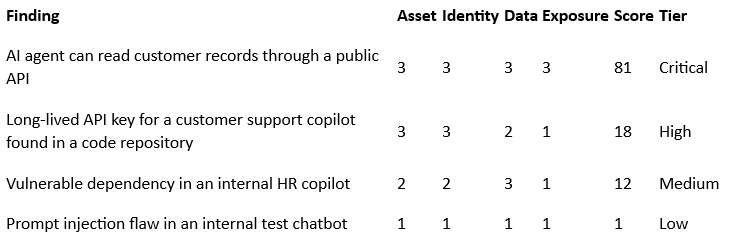
The first and last findings might share the same severity label in a scanner. Context separates them by a factor of 81. That gap is exactly what a CISO needs to see when deciding where to spend limited team capacity.
Which Findings Should Stop a Production Release?
Prioritization is not only about fixing old findings. It also decides what new code and AI features can ship. Clear release gates prevent arguments between security and engineering at the last minute.
We recommend blocking a production deployment when a release introduces any of the following:
- A Critical-tier finding with no approved mitigation
- Hard-coded secrets, API keys or model credentials
- An AI agent with write or admin access to production data, without human approval steps
- A new public endpoint for a model or agent that has not passed an AI model security assessment
- A third-party model or package from an unverified source, which is a software supply chain risk
- Missing logging for AI actions that touch regulated data
Everything else should ship with a tracked ticket and an owner. This keeps delivery moving while making sure the riskiest issues never reach production. Build these gates into your DevSecOps pipeline so they run automatically on every release.
Metrics That Prove Progress to the Board
Counting open findings is a weak metric. A falling count can hide a rising risk, and a rising count may simply mean better visibility. Track metrics that reflect real exposure instead.
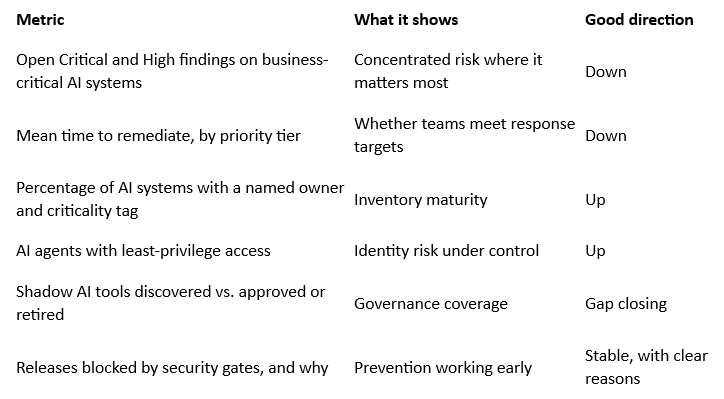
Report these monthly in business language. A single page that links top risks to business impact builds more trust than a long technical report.
Common Prioritization Mistakes to Avoid
Even mature teams fall into a few predictable traps:
- Chasing the scanner's severity label. Labels ignore your business context.
- Treating every tool's output separately. Without correlation, teams fix duplicates and miss root causes.
- Ignoring non-human identities. AI agents and service accounts are often the real path to sensitive data.
- Relying on point-in-time assessments. AI systems change weekly, so risk scores go stale fast.
- Leaving business owners out. Security cannot judge business impact alone.
- Never accepting risk formally. Low-tier findings need a documented decision, not an endless backlog.
How Indrasol Helps Enterprises Prioritize AI Risk
Indrasol combines AI security consulting with hands-on remediation support. Our teams help security leaders move from a noisy backlog to a ranked, owned and measurable risk list.
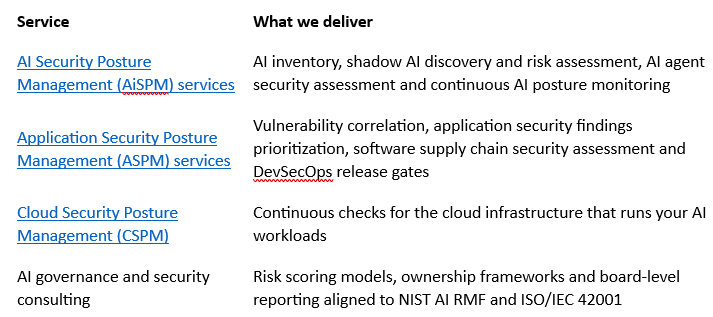
Every engagement ends with a prioritized application security remediation roadmap. Your team knows exactly what to fix first, who owns it and when it is due.
Start with an AI security posture assessment. Contact Indrasol to see which of your AI security findings matter most.
From Backlog to Remediation Roadmap
The number of AI security findings will keep growing as AI adoption grows. Trying to fix everything is not a strategy. Fixing the right things first is.
By scoring every finding on asset, identity, data and exposure, CISOs can turn hundreds of alerts into a short, defensible priority list. Pair that list with clear release gates and business-focused metrics. The result is an AI risk management program that leadership understands and engineering can actually deliver.
Frequently Asked Questions
What is AI security posture management?
AI security posture management (AI-SPM) is the continuous discovery, assessment and monitoring of AI systems. It covers models, agents, data pipelines and AI-enabled applications. Its goal is to find and reduce AI-specific risks such as over-permissioned agents, data leakage and insecure model endpoints.
How is ASPM different from AI-SPM?
Application security posture management (ASPM) focuses on application code, dependencies and APIs across the software lifecycle. AI-SPM focuses on AI models, agents and their data access. Most enterprises need both, because AI features run inside applications.
How should CISOs prioritize AI security findings?
Score each finding on four factors: asset criticality, identity permissions, data sensitivity and external exposure. Multiply the scores to rank findings, then assign response times by tier. Always treat actively exploited vulnerabilities as Critical.
How often should AI risk scores be updated?
Re-score findings whenever a system's permissions, data access or exposure changes. At a minimum, review the full priority list weekly. Continuous AI posture monitoring is better than point-in-time assessments because AI systems change quickly.
What should be included in an enterprise AI security assessment?
A strong assessment covers an AI inventory, shadow AI discovery, AI agent access reviews, model security testing and data flow mapping. It should end with a prioritized remediation roadmap with owners and deadlines.
About the Author
Brahma Guptha Illindra
Brahma Gupta is a technology entrepreneur, enterprise technology leader, and Founder & CEO of Indrasol, helping organizations adopt AI, cloud, data, and cybersecurity technologies securely, compliantly, and at scale. Over the years, he has worked across enterprise architecture, data engineering, analytics, cloud technologies, Oracle EPM, and business transformation. Today, his focus is increasingly on one of the biggest challenges facing enterprises: how to adopt AI at scale without losing visibility, security, governance, or control. At Indrasol, he and his team help organizations bridge the gap between technology innovation and business risk across: • AI Security & AI-SPM (AI Security Posture Management) • AI Governance & Responsible AI • Cloud Security & CSPM (Cloud Security Posture Management) • Cybersecurity & Risk Management • SOC 2, ISO 27001, ISO 42001 & CMMC compliance • Cloud modernization & DevOps • Data, analytics & AI transformation • Enterprise technology & automation Brahma is particularly
View Brahma Guptha Illindra's profile