
 Bizradar
 Tanva
5 Best Ways to Find Shadow AI Before It Becomes a Security Incident
Shadow AI is no longer limited to employees opening ChatGPT in a browser.
AI is now embedded in coding assistants, SaaS platforms, browser extensions, customer-support tools, meeting applications, productivity software, APIs, autonomous agents, and MCP-enabled workflows. An employee may introduce an AI capability into the environment without the security team ever receiving a procurement request.
That creates a visibility problem.
You cannot govern an AI asset you do not know exists.
NIST’s AI Risk Management Framework emphasizes maintaining an inventory of AI systems and taking a lifecycle approach to AI risk. Its 2026 work on post-deployment AI monitoring also highlights the need to understand how AI systems behave after deployment, not just before they go live. (NIST SI Resource Center)
For security leaders, the practical question is:
How do you find shadow AI before an unknown tool, model, agent, or integration becomes a data-leakage or security incident?
Here are five approaches that work.
What Is Shadow AI?
Shadow AI is the use of AI applications, models, agents, APIs, or AI-enabled features without formal approval, visibility, or security governance from the organization.
It is essentially the AI version of shadow IT.
Examples include:
- Employees using personal ChatGPT or Claude accounts for company work
- Developers connecting an unapproved LLM API to an internal application
- Teams uploading confidential documents to AI productivity tools
- Employees installing AI browser extensions
- Developers deploying AI coding assistants without security review
- Business teams adopting AI SaaS applications without IT involvement
- Employees creating autonomous AI agents with access to business systems
- AI applications connecting to internal data through OAuth
- MCP servers giving AI agents access to enterprise tools
- AI features hidden inside existing SaaS applications
The important distinction is that shadow AI isn't defined only by whether a tool is approved. It's also about whether security knows how the AI is being used, what it can access, and what it can do.
1. Monitor Network Traffic for Unknown AI Applications
The first place to look is the network.
Employees may use dozens of AI services without installing anything on corporate infrastructure. Traditional endpoint inventories can therefore miss a significant part of shadow AI activity.
Monitor outbound traffic for connections to:
- Generative AI platforms
- LLM providers
- AI APIs
- AI SaaS applications
- AI coding platforms
- AI image and video services
- AI transcription platforms
- AI meeting assistants
- AI browser applications
- SaaS MCP servers
- Model-hosting platforms
Microsoft's current Shadow AI Discovery capability, for example, uses network traffic analysis to identify AI applications and tools, including services such as ChatGPT, Claude, AI model-provider frameworks and SaaS MCP servers. It can also associate usage with users and analyze data-transfer patterns. (Microsoft Learn)
What security teams should look for
Don't stop at:
"Employee X accessed ChatGPT."
That tells you very little.
The better questions are:
- Which AI service did they access?
- How frequently?
- From which device?
- Using which identity?
- Was a corporate or personal account used?
- How much data was transferred?
- Which department is using it?
- Is the service approved?
- What type of information is being sent?
- Does the application support API access?
- Does it connect to other enterprise systems?
This turns **AI usage visibility **into AI risk visibility.
SEO keywords naturally covered
- shadow AI detection
- shadow AI discovery
- shadow AI security
- how to detect shadow AI
- enterprise AI security
- AI security monitoring
- unauthorized AI tools
- AI application discovery
2. Search Identity, OAuth and SaaS Activity
Network monitoring won't catch everything.
Modern AI applications increasingly operate through SaaS integrations, OAuth permissions and APIs.
An employee might authorize an AI application to access:
- Google Drive
- Microsoft 365
- GitHub
- Slack
- Salesforce
- Jira
- Notion
- SharePoint
- Internal databases
- Cloud storage
The dangerous part isn't necessarily the AI chatbot itself.
**It's the permissions behind it. **
An apparently harmless AI productivity application may have access to thousands of documents through an OAuth connection.
Build an AI identity and integration inventory
Security teams should periodically review:
**Users → Applications → OAuth grants → Permissions → Data sources → AI services **
Look for:
- New OAuth applications
- AI-related service principals
- Unusual API tokens
- Personal accounts accessing corporate data
- Third-party integrations
- AI applications with broad permissions
- Dormant integrations that remain active
- Applications with access to sensitive repositories
Then classify each AI integration according to the data and privileges it can reach.
For example:
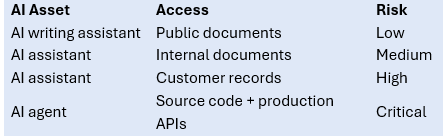
This is where **shadow AI discovery becomes AI security posture management. **
You're no longer asking only:
"Are employees using AI?"
You're asking:
"What can this AI access?"
3. Hunt for AI Inside Development Environments
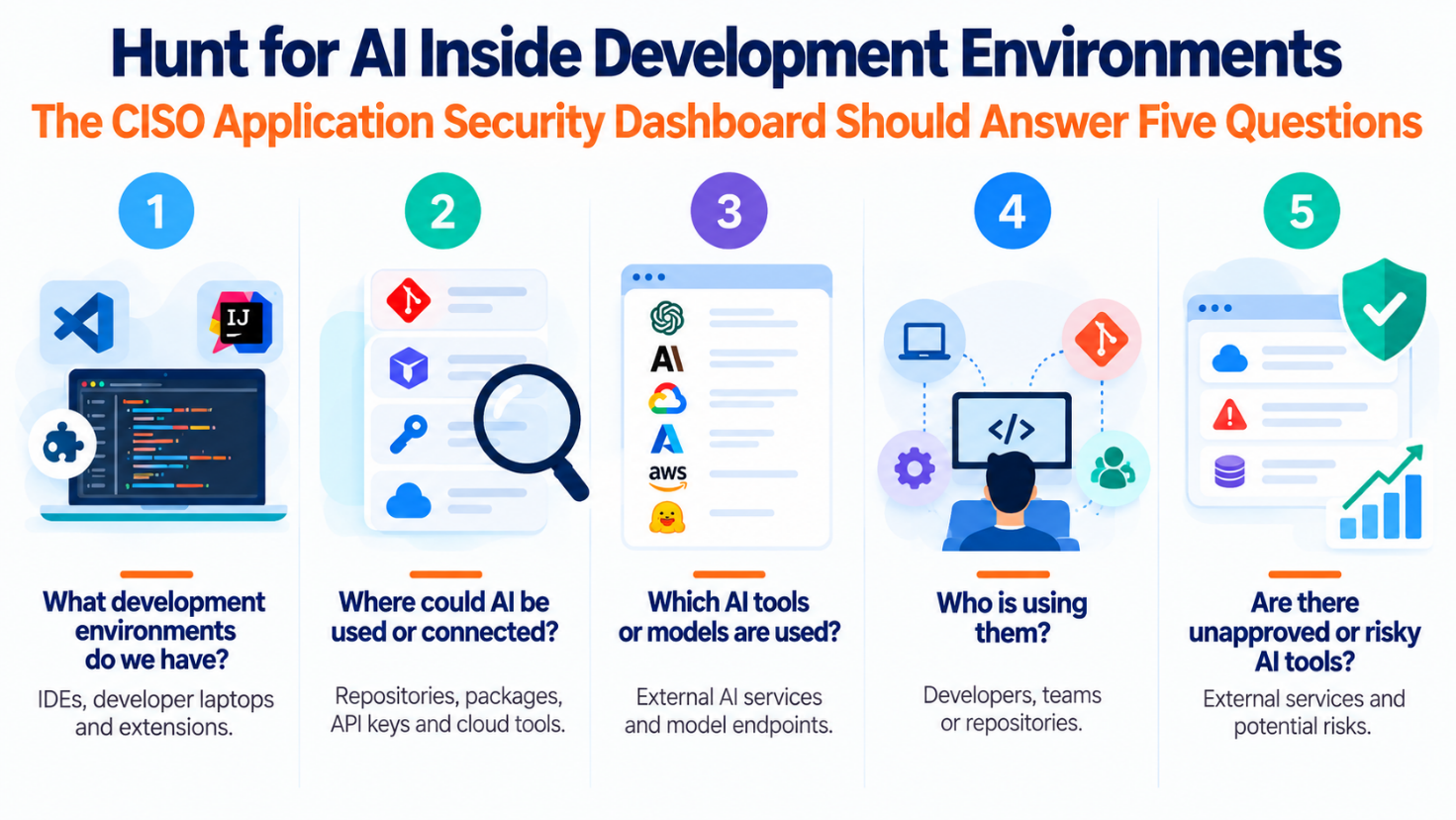
Developers are often early adopters of AI.
That makes software-development environments one of the most important places to search for shadow AI.
An organization may have approved one AI coding assistant while developers independently use several others.
Look across:
- IDE extensions
- Git repositories
- Package managers
- API keys
- Environment variables
- CI/CD pipelines
- Infrastructure-as-code
- Container images
- Developer laptops
- AI SDKs
- LLM libraries
- Model endpoints
- Open-source AI frameworks
Search your codebase for AI connections
Security teams can scan repositories and configuration files for references to:
- OpenAI APIs
- Anthropic APIs
- Google AI APIs
- Azure OpenAI
- Amazon Bedrock
- Hugging Face
- Vertex AI
- Ollama
- AI SDKs
- Model endpoints
- AI-related packages
- MCP configurations
The objective isn't to block developers from using AI.
It is to identify AI that entered production without going through the organization's security controls.
NIST's secure software development guidance specifically addresses AI model and AI-system development across the software lifecycle. (NIST)
A useful question for CISOs
Ask your application-security team:
**"Can we produce a list of every application in production that calls an external AI model?" **
If the answer is no, you probably have an AI asset-inventory gap.
4. Discover AI Agents, MCP Connections and Hidden Automation
This is where shadow AI gets substantially more complicated.
A chatbot that answers questions is one thing.
An **AI agent that can take actions **is another.
An agent may be able to:
- Read email
- Create tickets
- Query databases
- Modify files
- Execute code
- Access cloud resources
- Call APIs
- Send messages
- Create customer records
- Trigger workflows
- Interact with other agents
MCP adds another discovery challenge because AI applications can connect models to external tools and data sources through MCP servers.
That means an AI asset inventory should increasingly include:
**Models + applications + agents + tools + MCP servers + identities + data + permissions **
Questions to ask about every AI agent
For every discovered agent, identify:
- **Who created it? **
- **Who owns it? **
- **Which model does it use? **
- **What identity does it operate under? **
- **Which tools can it invoke? **
- **What data can it read? **
- **What systems can it modify? **
- **Can it execute actions without human approval? **
- **What are its permission boundaries? **
- **Where are its activities logged? **
This is particularly important because traditional application inventories weren't designed to describe autonomous software behavior.
The risk equation is changing
For conventional software, security teams often focus on:
**Application → Vulnerability → Exploit **
For AI agents, you increasingly need:
**Agent → Identity → Data → Tools → Permissions → Actions → Business impact **
That is a very different attack surface.
NIST's current work on trustworthy AI in critical infrastructure specifically discusses managing risks associated with AI agents and tools across their lifecycle and supply chains. (NIST)
5. Build a Continuous AI Asset Inventory
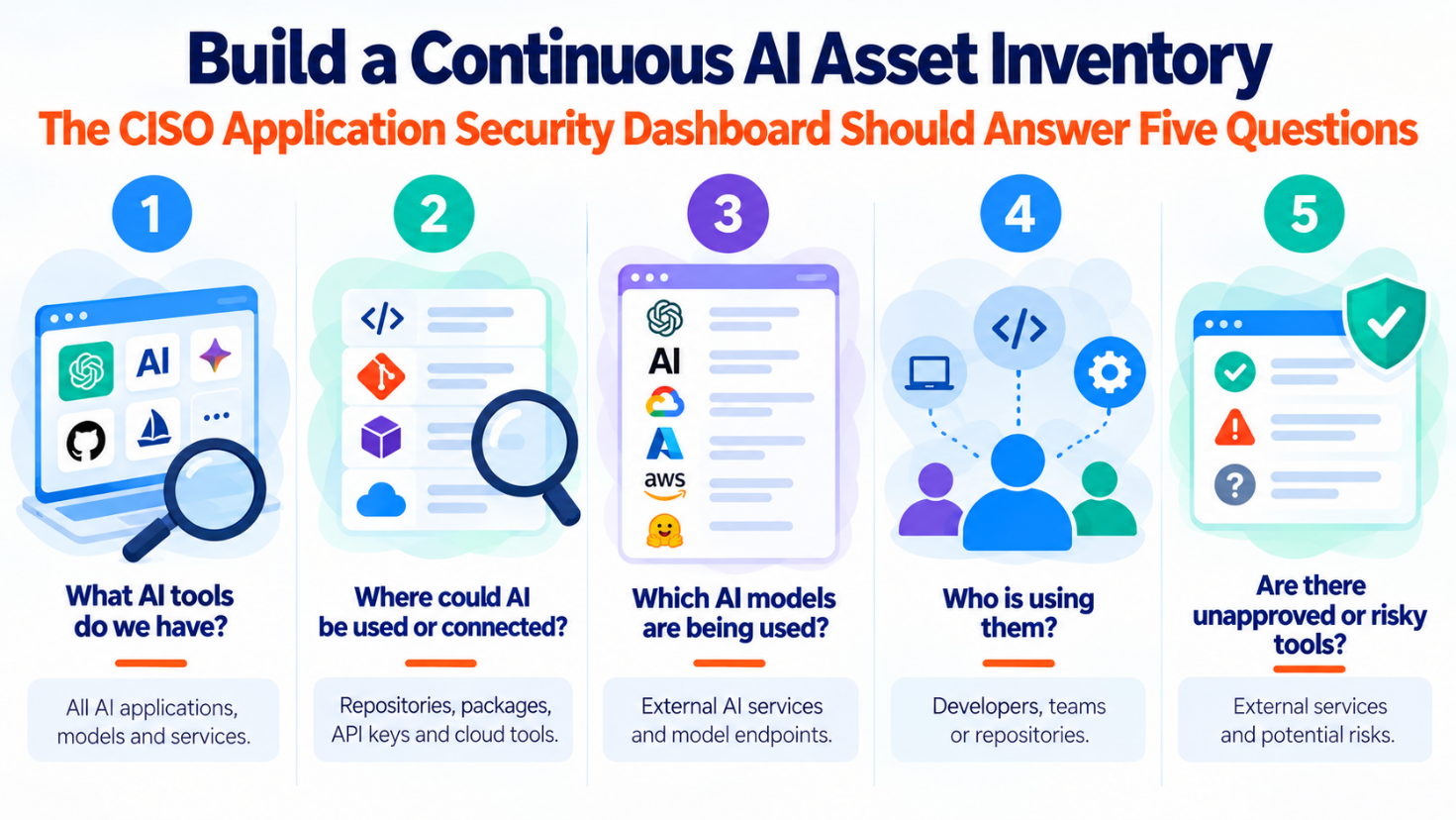
The biggest mistake organizations make with shadow AI is treating discovery as a one-time assessment.
It isn't.
AI usage changes too quickly.
A team can adopt a new AI application this week, connect it to corporate data next week, and automate an internal workflow the week after.
Your inventory needs to evolve with it.
NIST's AI RMF Playbook describes an AI system inventory as an organized collection of information about AI systems and notes that inventories provide organizations with a holistic view of AI assets. (NIST SI Resource Center)
Your AI inventory should capture more than the application name
At minimum, track:
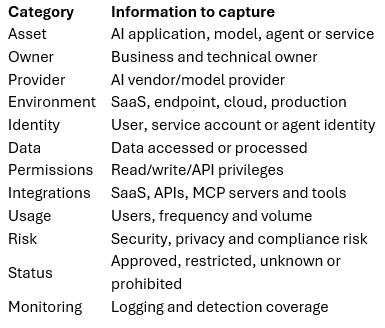
Then continuously compare newly discovered AI assets against the approved inventory.
The goal
Your security team should be able to answer:
**"Show me every AI system operating in our environment, who owns it, what data it can access, what actions it can take, and whether it has been approved." **
If you can't answer that quickly, your organization has an AI visibility problem.
Shadow AI Discovery Should Be a Security Control, Not an IT Spreadsheet
A spreadsheet of approved AI tools is not an AI security program.
It becomes useful only when discovery connects to enforcement and risk management.
A practical shadow AI security workflow looks like this:
Discover → Identify → Classify → Assess → Prioritize → Control → Monitor
Discover
Find AI applications, APIs, models, agents and integrations.
Identify
Determine owners, users, identities and providers.
Classify
Understand what data and systems each AI asset can access.
Assess
Evaluate permissions, vendor risk, data exposure and potential attack paths.
Prioritize
Focus first on AI assets with sensitive data, excessive privileges or autonomous capabilities.
Control
Apply policies, access controls, approval requirements and monitoring.
Monitor
Continuously detect new AI assets and changes to existing ones.
This aligns with the broader lifecycle approach advocated by NIST's AI RMF, which organizes AI risk management around Govern, Map, Measure and Manage. (NIST)
Why Traditional Shadow IT Discovery Is Not Enough
Traditional shadow IT tools were designed to answer:
"Which applications are employees using?"
Shadow AI requires additional questions:
"Which AI models are behind those applications?"
"What data are they receiving?"
"Which identities are they using?"
"What tools can they call?"
"Can they act autonomously?"
"Which AI agents exist?"
"Which MCP servers are connected?"
"What can those agents do?"
That is the difference between application discovery and AI security posture management.
A Practical Shadow AI Detection Checklist
CISOs can use this quick checklist to assess their current visibility:
- We maintain an inventory of approved AI applications.
- We monitor network traffic for AI services.
- We monitor AI API usage.
- We review OAuth applications and permissions.
- We scan source code for AI integrations.
- We monitor AI-related developer tools and extensions.
- We identify AI applications accessing corporate data.
- We inventory AI agents.
- We inventory MCP servers and connections.
- We map AI identities and service accounts.
- We understand what actions AI agents can perform.
- We classify AI assets by risk.
- We continuously detect newly introduced AI assets.
- We have a process for investigating unknown AI assets.
- We can revoke access when an AI asset becomes unacceptable.
If several of these boxes are unchecked, the problem may not be that your organization has too much AI.
It may be that security can't see enough of it.
The Bottom Line
Shadow AI is fundamentally a **visibility problem before it becomes a security problem. **
You don't need to eliminate every unsanctioned AI application. You need to know what exists, understand its access and behavior, and decide what deserves approval, restriction or removal.
The five strongest starting points are:
- **Monitor network traffic for AI applications and services. **
- **Audit identities, OAuth permissions and SaaS integrations. **
- **Search development environments and codebases for AI integrations. **
- **Discover AI agents, MCP connections and autonomous workflows. **
- **Maintain a continuously updated AI asset inventory. **
NIST's guidance increasingly treats AI risk as a lifecycle and monitoring problem rather than a one-time pre-deployment exercise. (NIST)
For security leaders, that leads to a simple operational test:
**Can you identify every AI asset in your environment before an attacker, employee or autonomous agent uses it in a way you didn't anticipate? **
If the answer is no, shadow AI should be treated as an active AI security posture gap, not merely an IT policy issue.
Frequently Asked Questions About Shadow AI
What is shadow AI?
Shadow AI refers to AI applications, models, APIs, agents or AI-enabled services used within an organization without appropriate IT, security, compliance or governance visibility.
Why is shadow AI a security risk?
Shadow AI can create data leakage, excessive permissions, unauthorized third-party access, compliance issues, unmanaged AI identities and unmonitored autonomous actions.
How do you detect shadow AI?
Organizations can detect shadow AI through network traffic analysis, SaaS and OAuth monitoring, endpoint telemetry, source-code scanning, API discovery, cloud logs, identity monitoring and AI asset inventories.
What is shadow AI discovery?
Shadow AI discovery is the process of identifying AI applications, models, agents, APIs and integrations operating within an organization that may not exist in the approved AI inventory.
How is shadow AI different from shadow IT?
Shadow IT covers unauthorized technology broadly. Shadow AI focuses specifically on AI applications, models, agents, APIs and AI-enabled features—and introduces additional concerns around model behavior, data exposure, AI identities and autonomous actions.
What should be included in an AI asset inventory?
An AI asset inventory should include the AI application or model, owner, provider, identity, data accessed, permissions, integrations, tools, usage, risk classification, approval status and monitoring coverage.
How can CISOs manage shadow AI?
CISOs should combine continuous AI discovery with identity governance, data controls, application security, AI risk assessment, agent governance and ongoing monitoring rather than relying only on an acceptable-use policy.
Suggested SEO metadata
**SEO Title: **
5 Best Ways to Find Shadow AI Before It Becomes a Security Incident
**Meta Description: **
Learn how to detect shadow AI before it creates a security incident. Discover five practical methods for AI asset discovery, AI monitoring, agent discovery, OAuth auditing and AI security posture management.
About the Author
Brahma Guptha Illindra
Brahma Gupta is a technology entrepreneur, enterprise technology leader, and Founder & CEO of Indrasol, helping organizations adopt AI, cloud, data, and cybersecurity technologies securely, compliantly, and at scale. Over the years, he has worked across enterprise architecture, data engineering, analytics, cloud technologies, Oracle EPM, and business transformation. Today, his focus is increasingly on one of the biggest challenges facing enterprises: how to adopt AI at scale without losing visibility, security, governance, or control. At Indrasol, he and his team help organizations bridge the gap between technology innovation and business risk across: • AI Security & AI-SPM (AI Security Posture Management) • AI Governance & Responsible AI • Cloud Security & CSPM (Cloud Security Posture Management) • Cybersecurity & Risk Management • SOC 2, ISO 27001, ISO 42001 & CMMC compliance • Cloud modernization & DevOps • Data, analytics & AI transformation • Enterprise technology & automation Brahma is particularly interested in the emerging security challenges created by Generative AI, AI agents, Shadow AI, AI identities, model risk, data exposure, AI governance, and autonomous AI systems. His perspective is simple: AI adoption should create business advantage—not introduce unmanaged risk. He also believes security and compliance should be more than check-the-box exercises. Done correctly, they can help organizations win enterprise customers, accelerate sales cycles, strengthen trust, reduce risk, and scale technology with confidence. Brahma regularly writes about AI security, AI-SPM, cloud security, cybersecurity, AI governance, SOC 2, ISO 27001, ISO 42001, CSPM, enterprise AI adoption, and technology strategy. He enjoys connecting with CISOs, CIOs, CTOs, founders, technology leaders, security professionals, and enterprise teams building the next generation of secure AI and cloud-powered businesses. If you’re working on AI security, cloud security, enterprise AI adoption, cybersecurity, compliance, or digital transformation, connect with Brahma.
View Brahma Guptha Illindra's profile