
The Security Mistakes Growing SaaS Companies Make
Why High-Growth Startups Lose Enterprise Deals Long Before a Cyberattack Happens
By Indrasol
Every SaaS founder worries about building the next feature.
Few worry about the security questionnaire sitting in an enterprise buyer's inbox.
Ironically, that questionnaire often determines whether the deal moves forward.
This is one of the biggest misconceptions among growing SaaS companies.
Many believe cybersecurity becomes important only after they become a larger business.
Enterprise buyers think differently.
To them, security is evidence of business maturity.
Whether you're selling AI software, HR platforms, fintech solutions, healthcare technology, or B2B SaaS products, your prospects want confidence that their data—and reputation—are protected.
This is why SOC 2 compliance, cloud security, vendor risk management, and cybersecurity compliance have become boardroom discussions rather than technical conversations.
Security has evolved from an operational requirement into a revenue strategy.
Why Security Has Become a Business Decision
Enterprise software spending continues to grow despite economic uncertainty.
At the same time, procurement teams have become significantly more rigorous.
Today, enterprise buyers commonly require vendors to demonstrate:
- SOC 2 Type II compliance
- Information Security Management
- Vendor Risk Assessments
- Data Privacy Controls
- Incident Response Plans
- Access Control Policies
- Business Continuity Plans
- Cloud Security Best Practices
According to IBM's Cost of a Data Breach Report, the global average cost of a data breach reached $4.88 million in 2024, the highest recorded to date. Organizations with mature security practices generally experienced significantly lower breach-related costs. Independent market research also shows that enterprise procurement increasingly includes formal security reviews before contracts are approved. These trends have made cybersecurity and compliance critical components of enterprise sales.
The result?
Security is no longer evaluated after the buying decision.
It influences the buying decision.
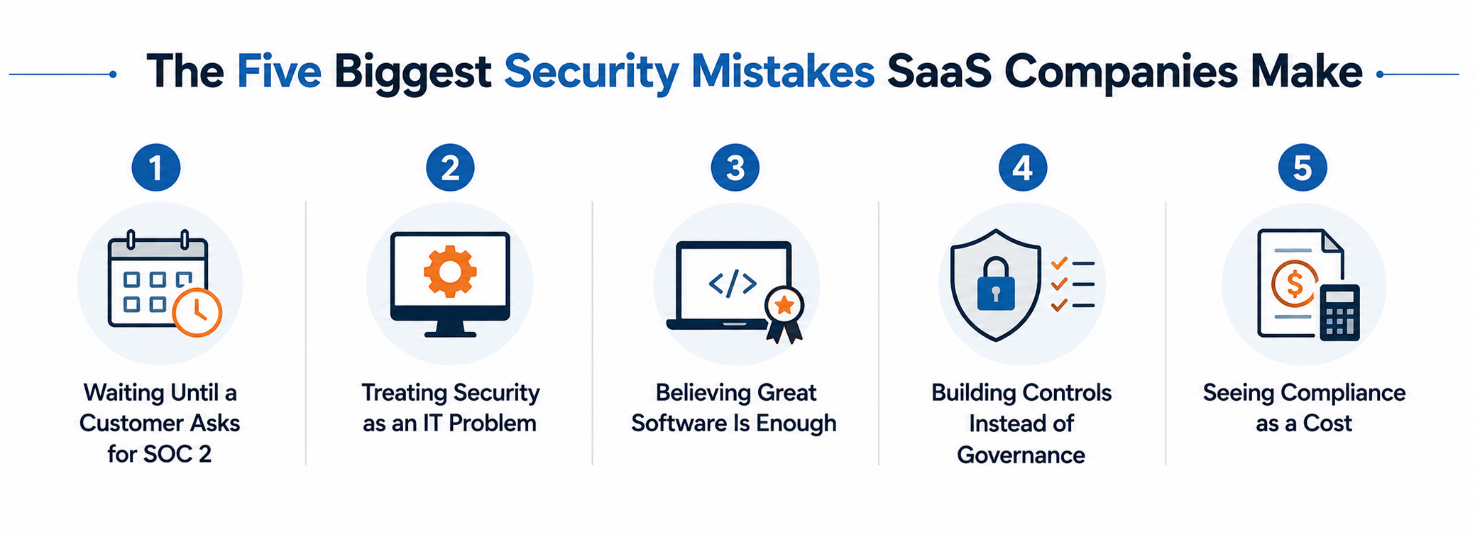
The Five Biggest Security Mistakes SaaS Companies Make
1. Waiting Until a Customer Asks for SOC 2
This is by far the most expensive mistake.
Many startups begin SOC 2 preparation only after receiving their first enterprise security questionnaire.
By then:
- Procurement stalls
- Sales cycles extend
- Revenue forecasts slip
- Competitors move ahead
SOC 2 readiness typically requires months—not weeks—because controls must operate consistently before they can be audited.
Transformation
Instead of reacting to customer requests, companies that prepare early enter enterprise conversations already qualified.
Trust becomes an accelerator rather than an obstacle.
2. Treating Security as an IT Problem
Security isn't owned solely by engineering.
It affects:
- Revenue
- Legal
- Operations
- Customer Success
- Executive Leadership
Every department influences customer trust.
The fastest-growing SaaS companies integrate security into company culture rather than isolating it inside technical teams.
3. Believing Great Software Is Enough
Founders often assume superior technology wins deals.
Enterprise buyers disagree
Risk outweighs innovation.
If two vendors offer similar capabilities, buyers almost always choose the one with stronger security maturity.
Customers don't simply purchase software.
They purchase confidence.
4. Building Controls Instead of Governance
Many startups invest heavily in security tools.
Firewalls.
Endpoint protection.
Identity management.
Cloud monitoring.
Yet they lack:
- Security policies
- Risk assessments
- Employee awareness training
- Incident response documentation
- Vendor management
- Access reviews
Technology without governance rarely satisfies enterprise security reviews.
SOC 2 evaluates how security is managed—not simply which tools are installed.
5. Seeing Compliance as a Cost
This mindset quietly limits growth.
Security investments reduce:
- Procurement delays
- Customer objections
- Vendor risk concerns
- Sales friction
- Contract negotiations
More importantly, they increase:
- Enterprise credibility
- Customer confidence
- Renewal opportunities
- Partner relationship
- Investor confidence
The return extends far beyond compliance.
What Changes After SOC 2?
The transformation isn't simply receiving an audit report.
The transformation is becoming an enterprise-ready organization.
Companies typically experience:
Faster Enterprise Procurement
Security questionnaires become easier to complete.
Legal reviews accelerate.
Procurement teams gain confidence earlier.
Shorter Sales Cycles
Instead of repeatedly proving trust, organizations demonstrate it immediately.
Larger Customer Opportunities
Many enterprise organizations won't onboard vendors lacking recognized security assurance.
SOC 2 expands the addressable market.
Improved Operational Discipline
Security processes become repeatable.
Teams understand responsibilities.
Risks become measurable.
Stronger Competitive Positioning
When competitors struggle through security reviews, compliant organizations move forward faster.
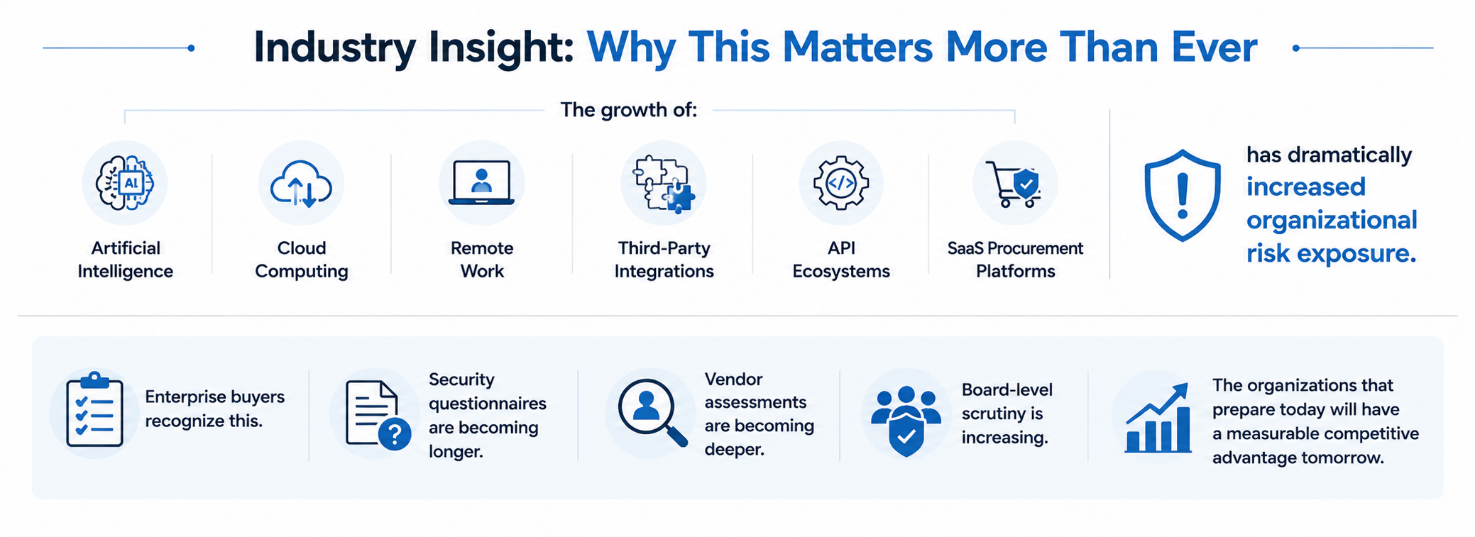
Industry Insight: Why This Matters More Than Ever
The growth of:
- Artificial Intelligence
- Cloud Computing
- Remote Work
- Third-Party Integrations
- API Ecosystems
- SaaS Procurement Platforms
has dramatically increased organizational risk exposure.
Enterprise buyers recognize this.
Security questionnaires are becoming longer.
Vendor assessments are becoming deeper.
Board-level scrutiny is increasing.
The organizations that prepare today will have a measurable competitive advantage tomorrow.
What CEOs Should Really Ask
Instead of asking:
*"Do we need SOC 2?" *
Ask:
- How many enterprise opportunities require it?
- How much revenue is delayed because procurement lacks confidence?
- How much executive time is spent answering security questionnaires?
- How many deals are lost before pricing discussions even begin?
These questions reveal the true cost of postponing security.
Security Is a Growth Strategy
The highest-performing SaaS companies no longer view cybersecurity as insurance.
They view it as infrastructure for growth.
Every mature security control reduces uncertainty.
Every compliance milestone increases trust.
Every trusted vendor closes enterprise deals faster.
In today's market, security isn't just about protecting your platform.
It's about making your company easier to buy.
How Indrasol Helps SaaS Companies Scale with Confidence
At Indrasol, we help SaaS startups move beyond checkbox compliance to build security programs that support long-term growth.
Our SOC 2 readiness and implementation services include:
- SOC 2 Readiness Assessments
- Gap Analysis & Remediation
- Security Policy Development
- Risk Assessments
- Cloud Security Best Practices
- Vendor Risk Management
- Evidence Collection
- Audit Preparation
- Ongoing Compliance Support
Our goal isn't simply to help you pass an audit.
It's to help you become the vendor enterprise customers trust.
Ready to Turn Security into a Competitive Advantage?
If your company is preparing for enterprise sales, investor due diligence, or scaling into regulated industries, now is the right time to build your security foundation.
**Book a complimentary SOC 2 Readiness Assessment with Indrasol. **
We'll identify your compliance gaps, prioritize the highest-impact actions, and provide a practical roadmap to achieve SOC 2 without slowing your growth.
The fastest-growing SaaS companies don't wait until security becomes a sales blocker. They build trust before the opportunity arrives.
About the Author
Satish Govindappa
Satish Govindappa is an Visionary technology leader with 15+ years of experience spearheading AI/ML transformations across complex enterprise environments. Proven ability to align AI initiatives with business goals, lead global cross-functional teams, and deliver scalable, cloud-native solutions using LLMs, predictive analytics, and anomaly detection. Skilled in building AI Centers of Excellence, developing architecture standards, and ensuring responsible AI adoption across the organization. Championed a multi-million dollar Generative AI program at Synopsys, leading the development and deployment of custom large language models (LLMs) to strengthen compliance, accelerate product innovation, and streamline critical operational workflows. Facilitated architectural design sessions with IT architects and engineering leaders to build scalable, cloud-native AI infrastructure, enabling smooth integration with Synopsys and ICE Mortgage Technology’s distributed enterprise systems. Orchestrated the creation of enterprise-wide AI architecture standards, standardizing the deployment of predictive analytics, real-time anomaly detection, and large language model (LLM) solutions across diverse business units. Directed cross-functional teams of global professionals, uniting IT, operations, and business units to drive successful adoption of Generative AI applications. Experienced Generative AI Security Architect with solid background in LLM security, AI threat modeling, and machine learning to protect AI systems from prompt injection, model poisoning, and data leakage. Proficient in Cloud AI security (AWS, Azure, GCP), MLOps security, and Zero-trust AI architectures. Securing AI applications for Fortune 500 enterprises, startups, and government agencies across the US, EU, and APAC. Committed to ensuring AI compliance (SOC 2, NIST AI RMF, GDPR, ISO 27001) and enterprise AI risk management Expert in securing Generative AI and Large Language Models (LLMs) against emerging threats such as prompt injection, model poisoning, and adversarial machine learning attacks. A J2EE Developer turned Application Security Professional with unique ability to understand both the worlds better (Development and Security). Working experience in top companies like Fidelity Investments, TD Ameritrade, DTCC, MindTree, Honeywell and AOL. Specialties: GenAI Security, LLM security, Threat Modeling, Secure Code Review, Web Penetration Testing, Server Audits, Security Training, Security Automation
View Satish Govindappa's profile