
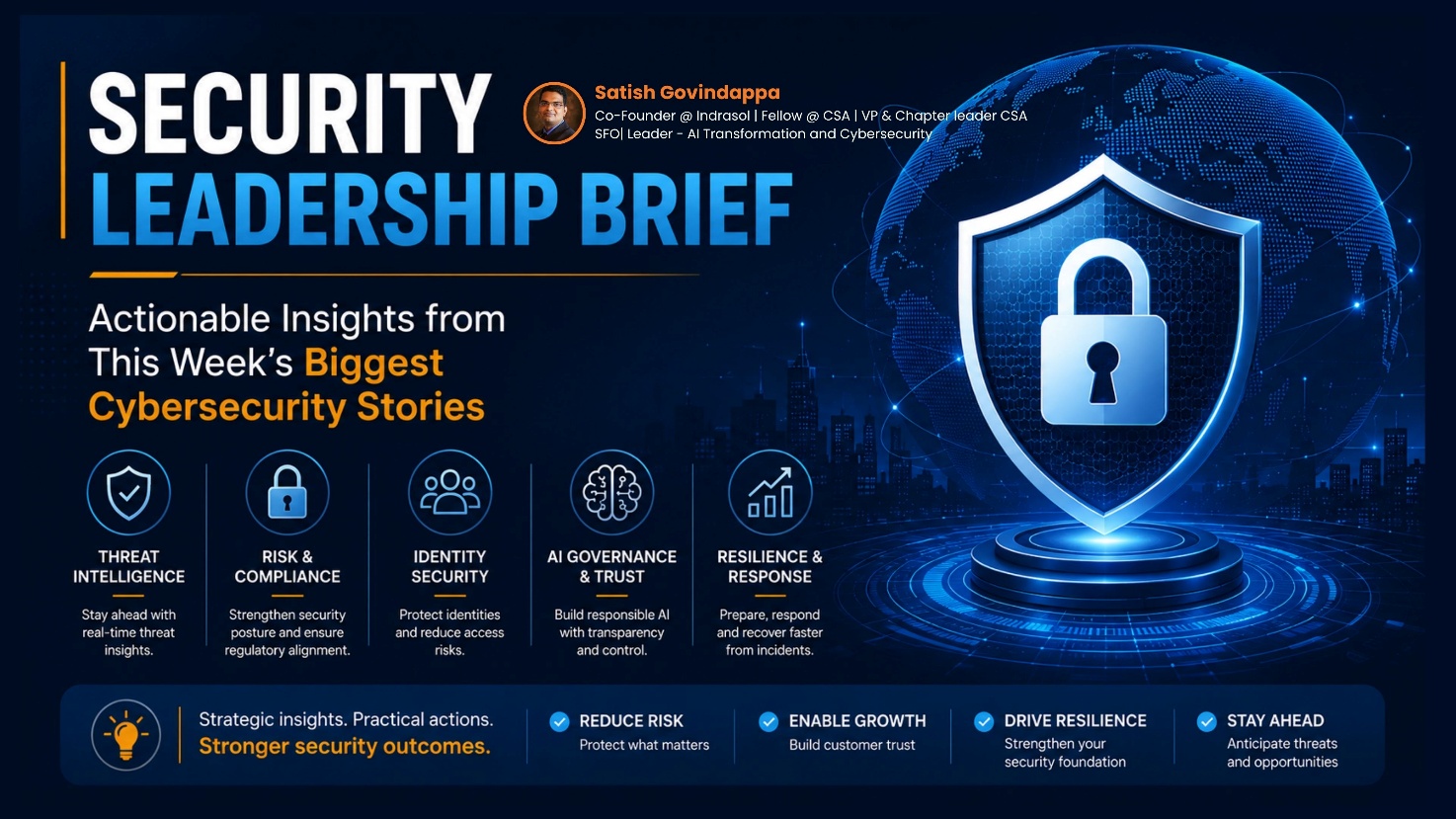
Security Leadership Brief: Actionable Insights from This Week's Biggest Cybersecurity Stories
Every week brings another wave of security incidents, regulatory developments, and emerging threats.
But still many organizations make the mistake of treating cybersecurity news as someone else's problem.
Cybersecurity landscape is changing rapidly.
The companies that learn from industry events before they become direct victims avoid costly breaches, compliance failures, and operational disruptions.
There is a clear pattern in this week's security headlines:
Swiftness has become attackers' weapon, new governance challenges pop up because of AI, and the standards are continuously raised by the regulators raising the bar for security accountability.
Security leaders should be paying close attention to the below key takeaways.
1. Third-Party Risk Remains One of the Largest Security Blind Spots
A significant number of security incidents continue to originate from vendors, suppliers, software providers, and external partners.
Organizations are spending millions to secure their own environments ignoring the risks introduced through third-party relationships.
What Security Leaders Should Do
- Review critical vendor inventories.
- Reassess third-party access privileges.
- Strengthen vendor security assessments.
- Implement continuous monitoring for critical suppliers.
- Require evidence of security compliance such as SOC 2, ISO 27001, or equivalent frameworks.
Executive Takeaway
Your security posture is only as strong as the weakest vendor connected to your environment.
2. AI Adoption Is Moving Faster Than AI Governance
Organizations are deploying AI-powered tools across customer support, software development, operations, and decision-making processes.
However, governance frameworks are struggling to keep pace.
Many organizations still lack:
AI risk assessments
- AI governance policies
- Model oversight processes
- Accountability structures
- AI inventory management
What Security Leaders Should Do
- Establish an AI governance committee.
- Conduct AI risk assessments.
- Create acceptable-use policies for AI systems.
- Define accountability for AI-related decisions.
- Evaluate readiness for ISO 42001 implementation.
Executive Takeaway
AI adoption without governance creates business, regulatory, and reputational risks.
Responsible AI governance is rapidly becoming a competitive advantage.
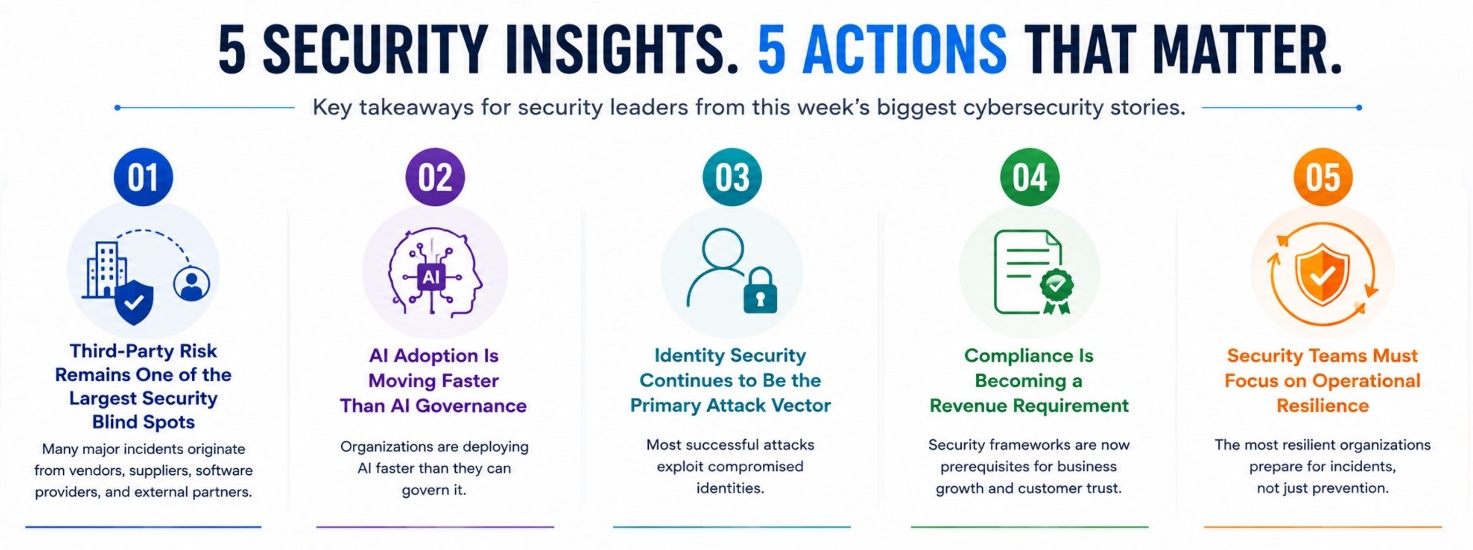
3. Identity Security Continues to Be the Primary Attack Vector
The majority of successful attacks still involve compromised identities.
Whether through phishing, credential theft, session hijacking, or privilege escalation, attackers continue targeting people rather than technology.
What Security Leaders Should Do
- Enforce phishing-resistant MFA.
- Review privileged accounts.
- Conduct quarterly access reviews.
- Monitor abnormal authentication activity.
- Implement least-privilege access controls.
Executive Takeaway
Organizations often focus heavily on perimeter security while attackers simply log in using stolen credentials.
Identity is the new security perimeter.
4. Compliance Is Becoming a Revenue Requirement
Security frameworks are no longer viewed solely as risk management tools.
Increasingly, they are becoming prerequisites for business growth.
Enterprise customers, government agencies, investors, and strategic partners now routinely request evidence of security and governance maturity.
Organizations without formal compliance programs often encounter:
- Delayed procurement cycles
- Lost contracts
- Increased due diligence requests
- Customer trust concerns
What Security Leaders Should Do
Evaluate whether your organization should pursue:
- SOC 2
- ISO 27001
- ISO 42001
- CMMC
- NIST 800-171
based on customer requirements and growth objectives.
Executive Takeaway
Compliance has shifted from a defensive function to a strategic growth enabler.
5. Security Teams Must Focus on Operational Resilience
Cybersecurity is no longer just about preventing attacks.
The most resilient organizations assume incidents will occur and prepare accordingly.
Questions every leadership team should be asking include:
- How quickly can we detect an incident?
- How quickly can we recover?
- What systems are mission critical?
- Have we tested our response plans recently?
- Do we know our recovery objectives?
What Security Leaders Should Do
- Review incident response plans.
- Conduct tabletop exercises.
- Test backup and recovery procedures.
- Identify single points of failure.
- Establish measurable resilience metrics.
Executive Takeaway
The organizations that recover fastest often outperform those that focus exclusively on prevention.
What This Means for Security Leaders
The lessons from this week's security developments are clear:
Security is no longer confined to the IT department.
It has become a board-level business issue that directly impacts revenue, reputation, customer trust, and operational resilience.
The organizations that will thrive over the next few years are not necessarily those with the largest security budgets.
They are the ones that:
- Understand their risks.
- Govern AI responsibly.
- Manage third-party exposure.
- Strengthen identity security.
- Treat compliance as a business strategy.
- Build resilience into everyday operations.
Cyber threats will continue evolving.
Regulations will continue expanding.
Customer expectations will continue rising.
The question is no longer whether organizations should prepare.
The question is whether they will prepare before or after a major incident forces the issue.
About Indrasol
Indrasol helps organizations strengthen cybersecurity, achieve compliance readiness, and build trust through frameworks including SOC 2, ISO 27001, ISO 42001, CMMC, NIST 800-171, and broader governance, risk, and compliance initiatives.
Follow our Security Leadership Brief for weekly insights on cybersecurity, compliance, AI governance, and risk management.
About the Author
Satish Govindappa
Satish Govindappa is an Visionary technology leader with 15+ years of experience spearheading AI/ML transformations across complex enterprise environments. Proven ability to align AI initiatives with business goals, lead global cross-functional teams, and deliver scalable, cloud-native solutions using LLMs, predictive analytics, and anomaly detection. Skilled in building AI Centers of Excellence, developing architecture standards, and ensuring responsible AI adoption across the organization. Championed a multi-million dollar Generative AI program at Synopsys, leading the development and deployment of custom large language models (LLMs) to strengthen compliance, accelerate product innovation, and streamline critical operational workflows. Facilitated architectural design sessions with IT architects and engineering leaders to build scalable, cloud-native AI infrastructure, enabling smooth integration with Synopsys and ICE Mortgage Technology’s distributed enterprise systems. Orchestrated the creation of enterprise-wide AI architecture standards, standardizing the deployment of predictive analytics, real-time anomaly detection, and large language model (LLM) solutions across diverse business units. Directed cross-functional teams of global professionals, uniting IT, operations, and business units to drive successful adoption of Generative AI applications. Experienced Generative AI Security Architect with solid background in LLM security, AI threat modeling, and machine learning to protect AI systems from prompt injection, model poisoning, and data leakage. Proficient in Cloud AI security (AWS, Azure, GCP), MLOps security, and Zero-trust AI architectures. Securing AI applications for Fortune 500 enterprises, startups, and government agencies across the US, EU, and APAC. Committed to ensuring AI compliance (SOC 2, NIST AI RMF, GDPR, ISO 27001) and enterprise AI risk management Expert in securing Generative AI and Large Language Models (LLMs) against emerging threats such as prompt injection, model poisoning, and adversarial machine learning attacks. A J2EE Developer turned Application Security Professional with unique ability to understand both the worlds better (Development and Security). Working experience in top companies like Fidelity Investments, TD Ameritrade, DTCC, MindTree, Honeywell and AOL. Specialties: GenAI Security, LLM security, Threat Modeling, Secure Code Review, Web Penetration Testing, Server Audits, Security Training, Security Automation
View Satish Govindappa's profile