
Insights for Leaders Navigating Security and Compliance
Security and Compliance Are No Longer IT Initiatives
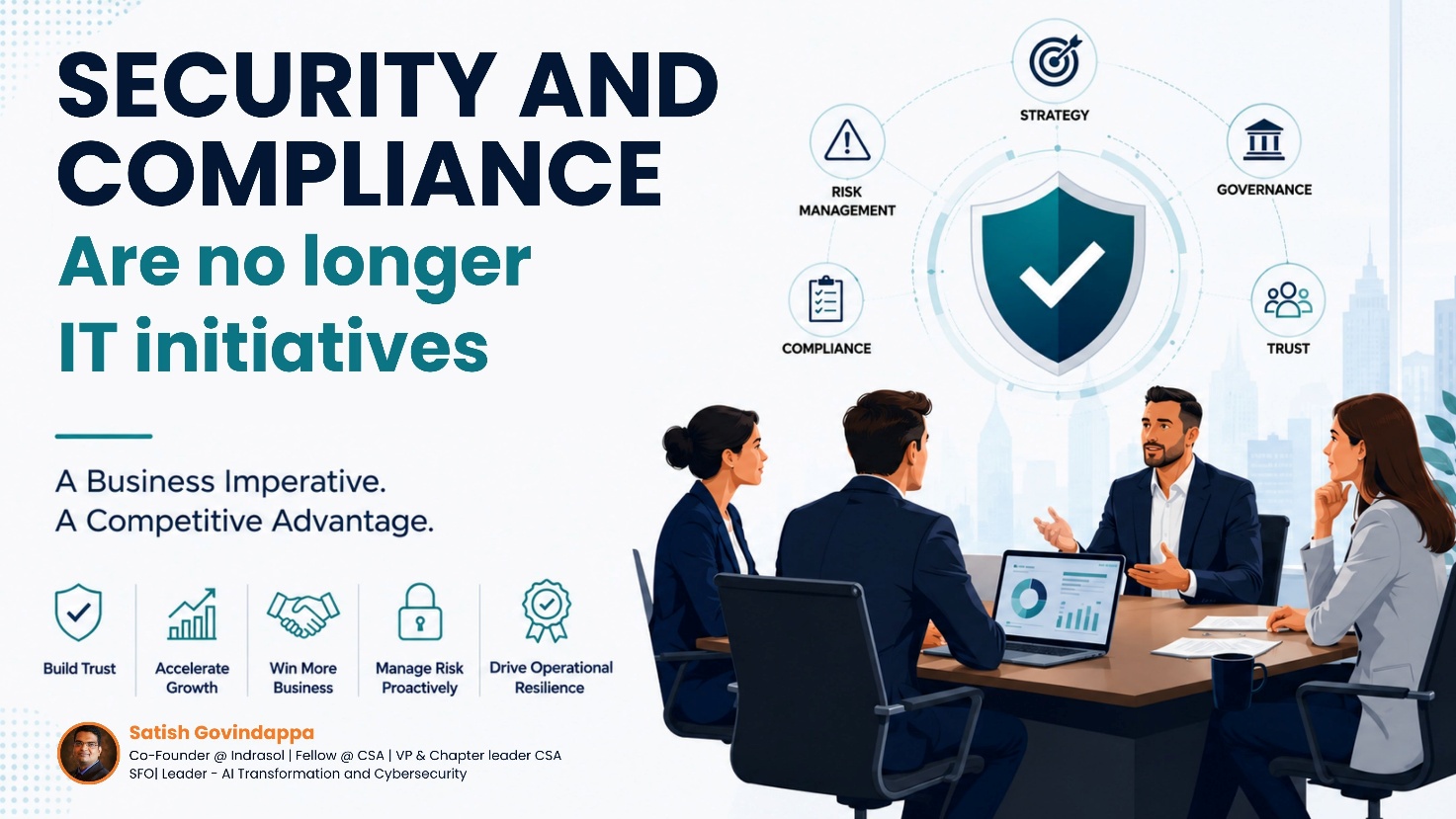
A noticeable shift is happening in boardrooms, procurement teams, and enterprise buying processes.
Security and compliance are no longer viewed as operational requirements.
They have become business requirements.
For years, organizations treated cybersecurity and compliance as responsibilities owned by IT and security teams. The goal was simple: reduce risk, avoid incidents, and satisfy auditors.
That mindset is rapidly becoming outdated.
Today, security and compliance influence revenue growth, customer acquisition, enterprise partnerships, investor confidence, and market expansion.
The conversation has changed.
The question is no longer:
"Are we compliant?"
The question is:
"Can we demonstrate the level of trust required to win and retain business?"
The New Enterprise Buying Reality
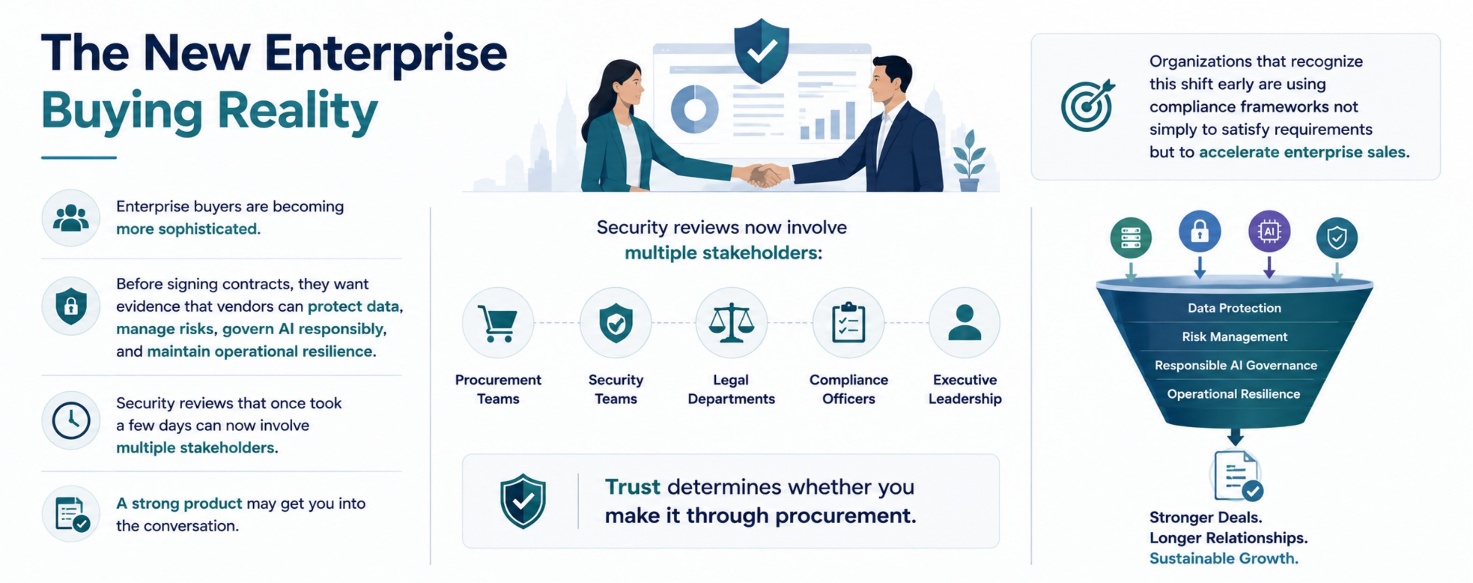
Enterprise buyers are becoming more sophisticated.
Before signing contracts, they want evidence that vendors can protect data, manage risks, govern AI responsibly, and maintain operational resilience.
Security reviews that once took a few days can now involve multiple stakeholders:
- Procurement teams
- Security teams
- Legal departments
- Compliance officers
- Executive leadership
A strong product may get you into the conversation.
Trust determines whether you make it through procurement.
Organizations that recognize this shift early are using compliance frameworks not simply to satisfy requirements but to accelerate enterprise sales.
Compliance Is Becoming a Competitive Differentiator
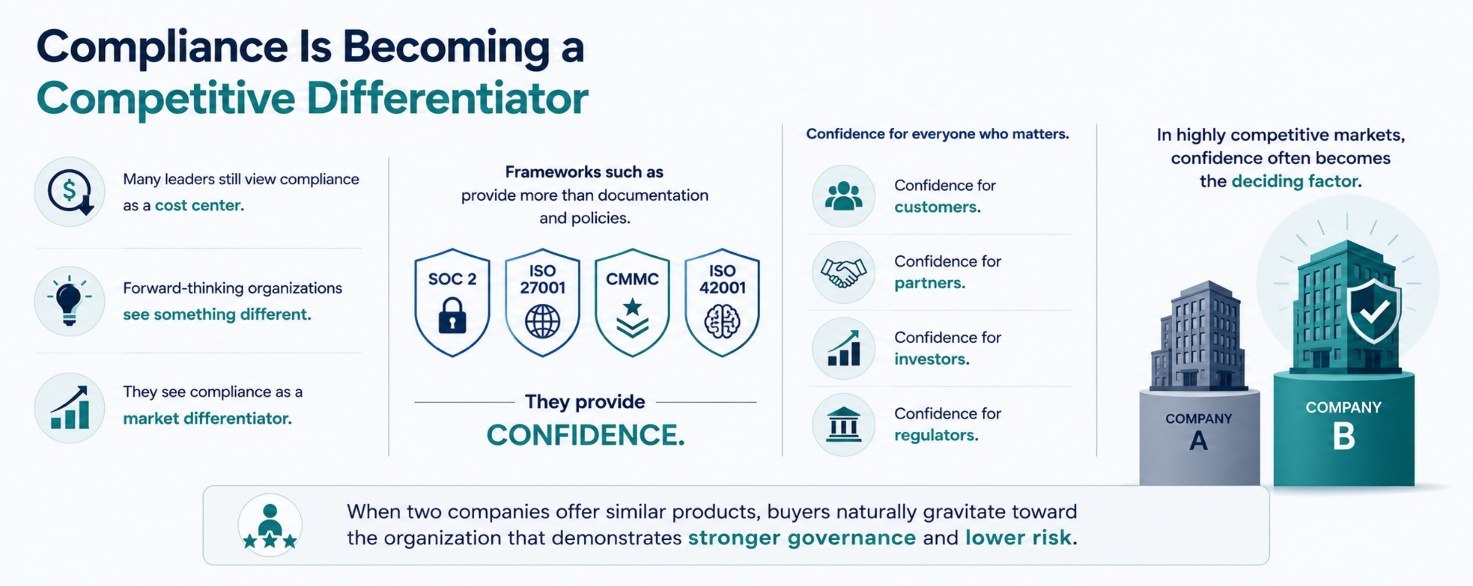
Many leaders still view compliance as a cost center.
Forward-thinking organizations see something different.
They see compliance as a market differentiator.
Frameworks such as SOC 2, ISO 27001, CMMC, and ISO 42001 provide more than documentation and policies.
They provide confidence.
Confidence for customers.
Confidence for partners.
Confidence for investors.
Confidence for regulators.
In highly competitive markets, confidence often becomes the deciding factor.
When two companies offer similar products, buyers naturally gravitate toward the organization that demonstrates stronger governance and lower risk.
AI Is Raising the Stakes
Artificial intelligence is introducing a new layer of complexity.
Organizations are deploying AI across products, operations, customer support, and decision-making processes at an unprecedented pace.
Innovation is moving quickly.
Governance is struggling to keep up.
Leaders are increasingly being asked difficult questions:
- How is AI governed?
- Who owns AI risk?
- How are decisions monitored?
- How is customer data protected?
- What safeguards exist to prevent misuse?
These questions are no longer theoretical.
Customers, boards, regulators, and investors are asking them today.
Organizations that establish AI governance programs early will be significantly better positioned than those attempting to catch up later.
The Cost of Waiting
One of the biggest mistakes leadership teams make is assuming compliance can wait until a customer requests it.
In reality, that approach often creates unnecessary friction.
Delayed deals.
Extended procurement cycles.
Missed contract opportunities.
Unexpected remediation costs.
Reputation challenges.
The most successful organizations build readiness before it becomes urgent.
They understand that trust compounds over time, while compliance debt becomes increasingly expensive.
A Leadership Perspective
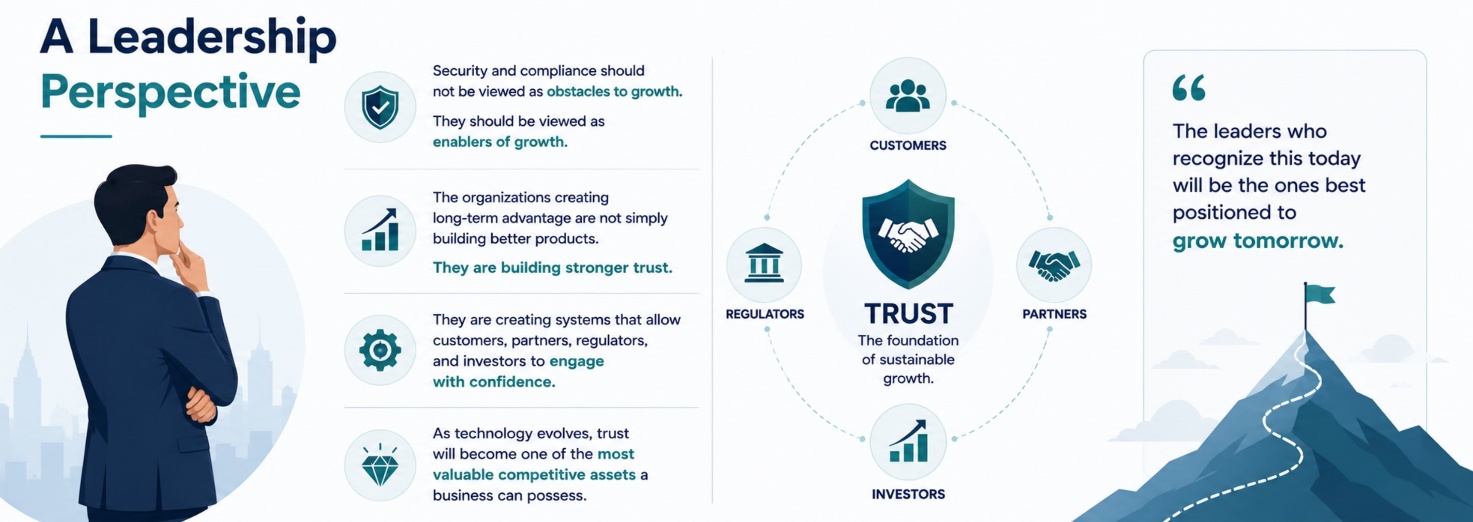
Security and compliance should not be viewed as obstacles to growth.
They should be viewed as enablers of growth.
The organizations creating long-term advantage are not simply building better products.
They are building stronger trust.
They are creating systems that allow customers, partners, regulators, and investors to engage with confidence.
As technology evolves, trust will become one of the most valuable competitive assets a business can possess.
The leaders who recognize this today will be the ones best positioned to grow tomorrow.
Final Thought
The next generation of market leaders will not be defined solely by innovation.
They will be defined by their ability to scale innovation responsibly, securely, and with confidence.
That is where security, compliance, and business growth converge.
About the Author
Satish Govindappa
Satish Govindappa is an Visionary technology leader with 15+ years of experience spearheading AI/ML transformations across complex enterprise environments. Proven ability to align AI initiatives with business goals, lead global cross-functional teams, and deliver scalable, cloud-native solutions using LLMs, predictive analytics, and anomaly detection. Skilled in building AI Centers of Excellence, developing architecture standards, and ensuring responsible AI adoption across the organization. Championed a multi-million dollar Generative AI program at Synopsys, leading the development and deployment of custom large language models (LLMs) to strengthen compliance, accelerate product innovation, and streamline critical operational workflows. Facilitated architectural design sessions with IT architects and engineering leaders to build scalable, cloud-native AI infrastructure, enabling smooth integration with Synopsys and ICE Mortgage Technology’s distributed enterprise systems. Orchestrated the creation of enterprise-wide AI architecture standards, standardizing the deployment of predictive analytics, real-time anomaly detection, and large language model (LLM) solutions across diverse business units. Directed cross-functional teams of global professionals, uniting IT, operations, and business units to drive successful adoption of Generative AI applications. Experienced Generative AI Security Architect with solid background in LLM security, AI threat modeling, and machine learning to protect AI systems from prompt injection, model poisoning, and data leakage. Proficient in Cloud AI security (AWS, Azure, GCP), MLOps security, and Zero-trust AI architectures. Securing AI applications for Fortune 500 enterprises, startups, and government agencies across the US, EU, and APAC. Committed to ensuring AI compliance (SOC 2, NIST AI RMF, GDPR, ISO 27001) and enterprise AI risk management Expert in securing Generative AI and Large Language Models (LLMs) against emerging threats such as prompt injection, model poisoning, and adversarial machine learning attacks. A J2EE Developer turned Application Security Professional with unique ability to understand both the worlds better (Development and Security). Working experience in top companies like Fidelity Investments, TD Ameritrade, DTCC, MindTree, Honeywell and AOL. Specialties: GenAI Security, LLM security, Threat Modeling, Secure Code Review, Web Penetration Testing, Server Audits, Security Training, Security Automation
View Satish Govindappa's profile