
Cybersecurity Trends Every CEO Should Know in 2026
What's Changing in Compliance, Ransomware, and Enterprise Security
Cybersecurity is no longer an IT problem.
It is a boardroom issue, a revenue issue, and increasingly a competitive advantage.
Over the last decade, CEOs viewed cybersecurity primarily as a risk management function. Today, cybersecurity influences enterprise sales, customer trust, regulatory compliance, mergers and acquisitions, cyber insurance, and investor confidence.
The organizations winning enterprise contracts in 2026 are not necessarily those with the most advanced technology. They are the organizations that can demonstrate security maturity, compliance readiness, and operational resilience.
As cyber threats continue to evolve, executives need to understand the trends reshaping the security landscape.
Here are the cybersecurity trends every CEO should be paying attention to.
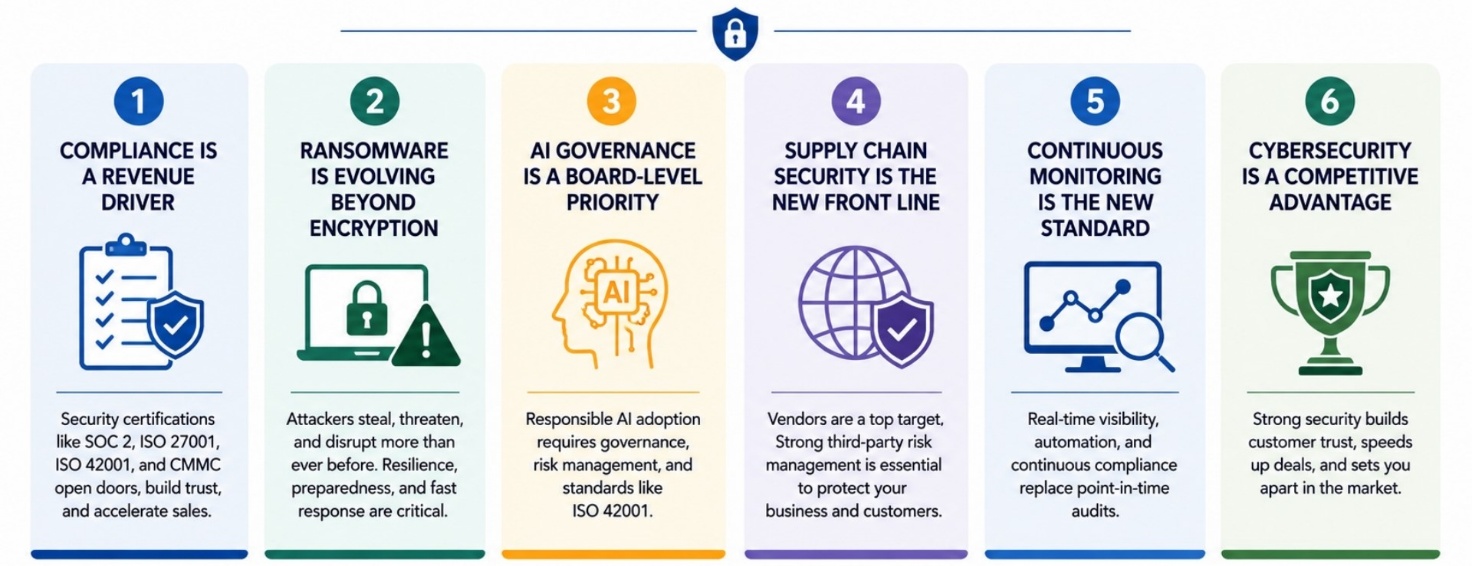
1. Compliance Is Becoming a Revenue Driver
For years, organizations viewed compliance as a cost center.
That mindset is rapidly changing.
Enterprise buyers increasingly require proof of security before signing contracts. Security reviews, vendor risk assessments, and compliance questionnaires have become standard parts of procurement.
Frameworks such as:
- SOC 2 Compliance
- ISO 27001 Certification
- ISO 42001 for AI Governance
- CMMC Compliance
- NIST Cybersecurity Framework
are now business enablers.
Organizations without these certifications often face longer sales cycles, delayed procurement approvals, and lost enterprise opportunities.
Key Takeaway for CEOs
Compliance is no longer about passing audits.
It is about accelerating revenue growth, reducing procurement friction, and building trust with customers.
High-Intent Keywords:
SOC 2 compliance, ISO 27001 certification, cybersecurity compliance, compliance automation, vendor risk management, enterprise security requirements
2. Ransomware Is Evolving Beyond Encryption
Traditional ransomware attacks focused on encrypting data and demanding payment.
Today's ransomware groups are using a far more sophisticated approach.
Attackers now:
- Steal sensitive information before encryption
- Threaten public data leaks
- Target third-party suppliers
- Exploit cloud environments
- Attack backup systems
This evolution has increased the financial and reputational impact of cyber incidents
For CEOs, the real risk is no longer just operational downtime.
It is customer trust, regulatory scrutiny, legal exposure, and revenue disruption.
Key Takeaway for CEOs
The question is no longer whether your organization can recover data.
The question is whether your organization can continue operating during a cyber crisis.
High-Intent Keywords:
ransomware protection, ransomware attacks, cyber resilience, incident response planning, ransomware recovery strategy
3. AI Governance Is Becoming a Board-Level Priority
Artificial Intelligence is transforming every industry.
Employees are using generative AI tools to write code, analyze data, create content, and automate workflows.
However, many organizations are adopting AI faster than they are governing it.
This creates risks involving:
- Sensitive data exposure
- Intellectual property leakage
- Regulatory violations
- Model bias
- Lack of accountability
As AI adoption accelerates, organizations are increasingly looking to ISO 42001 as the emerging standard for AI Management Systems.
Key Takeaway for CEOs
Organizations that govern AI effectively will gain enterprise trust faster than organizations that simply adopt AI quickly.
High-Intent Keywords:
AI governance, ISO 42001 certification, responsible AI, AI risk management, AI compliance framework
4. Supply Chain Security Is the New Front Line
Cybercriminals increasingly target vendors rather than the enterprise itself.
Why?
Because suppliers often provide a faster path into larger organizations.
This trend is driving stronger third-party risk management programs across industries.
Customers now want visibility into:
- Vendor security controls
- Security certifications
- Incident response capabilities
- Access management practices
This is one reason SOC 2 and ISO 27001 certifications have become critical for SaaS companies seeking enterprise growth.
Key Takeaway for CEOs
Your cybersecurity posture is only as strong as your weakest supplier.
High-Intent Keywords:
third-party risk management, supply chain cybersecurity, vendor security assessment, cybersecurity due diligence
5. Continuous Security Monitoring Is Replacing Point-in-Time Audits
Annual audits are no longer enough.
Modern organizations deploy code daily, integrate cloud services continuously, and adopt new technologies rapidly.
As a result, security must become continuous.
Leading organizations are investing in:
- Continuous compliance monitoring
- Vulnerability management
- Security posture management
- Automated evidence collection
- Continuous control validation
This shift is reducing audit preparation efforts while improving real-world security.
Key Takeaway for CEOs
Security maturity is increasingly measured by ongoing visibility rather than annual assessments.
High-Intent Keywords:
continuous compliance monitoring, vulnerability management, security posture management, cybersecurity automation
- Cybersecurity Is Becoming a Competitive Advantage
Historically, organizations invested in cybersecurity to avoid breaches.
Today, they invest to win business.
Enterprise buyers increasingly ask:
- Are you SOC 2 certified?
- Are you ISO 27001 certified?
- How do you manage AI risks?
- What is your incident response process?
- How do you protect customer data?
Organizations that can answer these questions confidently move through procurement faster.
Those that cannot often struggle to close enterprise deals.
Key Takeaway for CEOs
Security has become part of the buying decision.
Trust is becoming a measurable business asset.
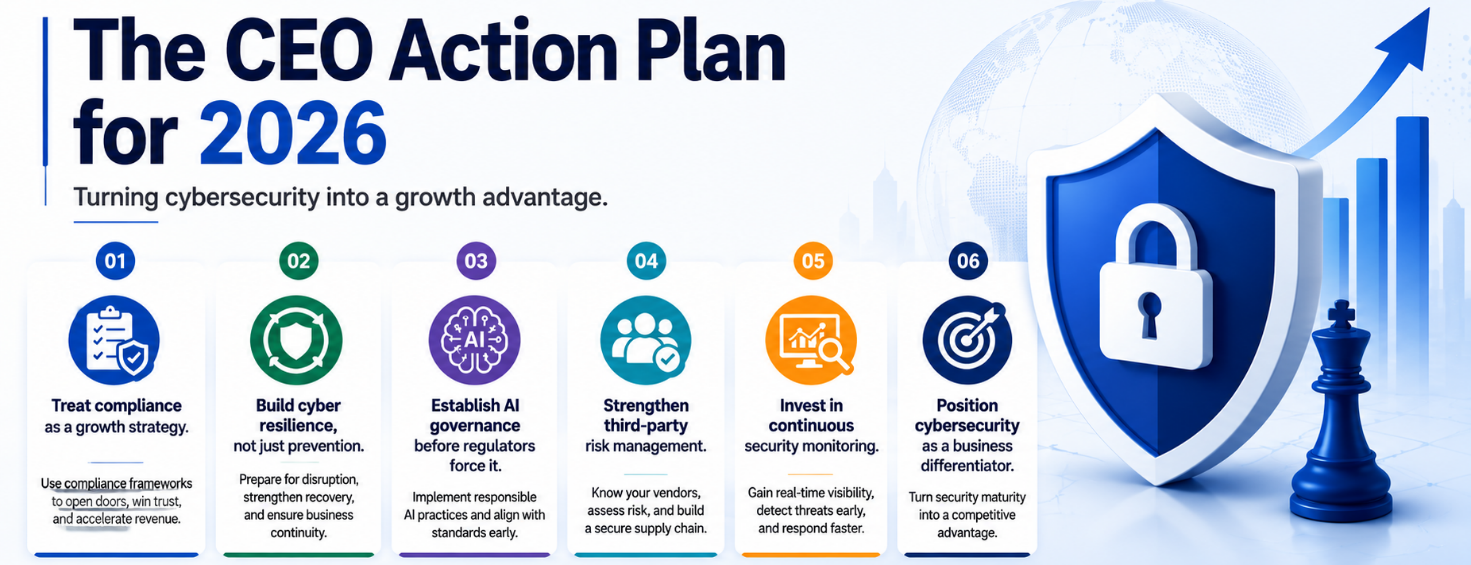
The CEO Action Plan for 2026
The cybersecurity landscape will continue evolving.
However, the priorities for executive teams are becoming clearer:
✔ Treat compliance as a growth strategy.
✔ Build cyber resilience, not just prevention.
✔ Establish AI governance before regulators force it.
✔ Strengthen third-party risk management.
✔ Invest in continuous security monitoring.
✔ Position cybersecurity as a business differentiator.
The organizations that succeed over the next decade will not be the ones that spend the most on security.
They will be the ones that integrate cybersecurity, compliance, and trust into their business strategy.
Because in 2026, customers are not simply buying products.
They are buying confidence that their data, operations, and business relationships are secure.
Discussion Question
Which cybersecurity trend do you believe will have the biggest impact on enterprise growth over the next three years: AI governance, ransomware resilience, compliance requirements, or third-party risk management?
About the Author
Satish Govindappa
Satish Govindappa is an Visionary technology leader with 15+ years of experience spearheading AI/ML transformations across complex enterprise environments. Proven ability to align AI initiatives with business goals, lead global cross-functional teams, and deliver scalable, cloud-native solutions using LLMs, predictive analytics, and anomaly detection. Skilled in building AI Centers of Excellence, developing architecture standards, and ensuring responsible AI adoption across the organization. Championed a multi-million dollar Generative AI program at Synopsys, leading the development and deployment of custom large language models (LLMs) to strengthen compliance, accelerate product innovation, and streamline critical operational workflows. Facilitated architectural design sessions with IT architects and engineering leaders to build scalable, cloud-native AI infrastructure, enabling smooth integration with Synopsys and ICE Mortgage Technology’s distributed enterprise systems. Orchestrated the creation of enterprise-wide AI architecture standards, standardizing the deployment of predictive analytics, real-time anomaly detection, and large language model (LLM) solutions across diverse business units. Directed cross-functional teams of global professionals, uniting IT, operations, and business units to drive successful adoption of Generative AI applications. Experienced Generative AI Security Architect with solid background in LLM security, AI threat modeling, and machine learning to protect AI systems from prompt injection, model poisoning, and data leakage. Proficient in Cloud AI security (AWS, Azure, GCP), MLOps security, and Zero-trust AI architectures. Securing AI applications for Fortune 500 enterprises, startups, and government agencies across the US, EU, and APAC. Committed to ensuring AI compliance (SOC 2, NIST AI RMF, GDPR, ISO 27001) and enterprise AI risk management Expert in securing Generative AI and Large Language Models (LLMs) against emerging threats such as prompt injection, model poisoning, and adversarial machine learning attacks. A J2EE Developer turned Application Security Professional with unique ability to understand both the worlds better (Development and Security). Working experience in top companies like Fidelity Investments, TD Ameritrade, DTCC, MindTree, Honeywell and AOL. Specialties: GenAI Security, LLM security, Threat Modeling, Secure Code Review, Web Penetration Testing, Server Audits, Security Training, Security Automation
View Satish Govindappa's profile