
AI Governance Is Becoming a SOC 2 Requirement — Most Companies Aren’t Ready
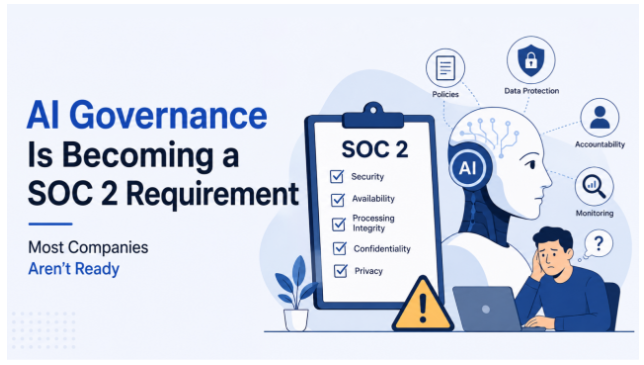
SOC 2 audits are no longer just about security controls — they’re quietly becoming AI audits. Over the last 12–18 months, something has fundamentally shifted in audit conversations.
What used to be:
- Access controls
- Encryption policies
- Incident response
has expanded into something far more complex:
“Show us how your AI systems are governed.”
Auditors are no longer satisfied with traditional controls when AI is involved.
If your teams are using:
- ChatGPT or internal LLMs
- AI copilots in engineering
- Automated decision systems
- AI-driven analytics on customer data
then your SOC 2 scope has already changed, whether you’ve acknowledged it or not002E
In recent audit cycles, companies are increasingly being asked:
- Does AI process customer or sensitive data?
- How are prompts and outputs logged?
- Who approves AI system usage?
- Are AI decisions explainable and monitored?
- What controls prevent data leakage via AI tools?
This isn’t a future problem. It’s already happening.
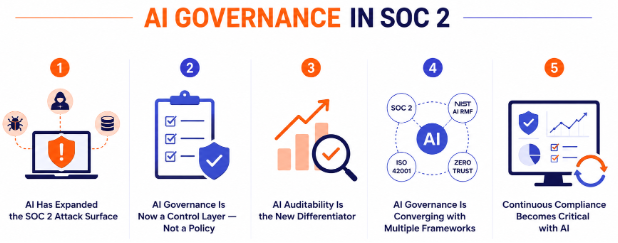
1. AI Has Expanded the SOC 2 Attack Surface
AI systems introduce non-traditional risk vectors:
- Prompt injection attacks
- Data leakage via LLMs
- Model hallucinations impacting decisions
- Unauthorized AI tool usage (shadow AI)
Traditional SOC 2 controls were not designed for these risks.
This is forcing auditors to reinterpret:
- CC6 (Access Controls) → Who can use AI tools?
- CC7 (Monitoring) → Are AI outputs monitored?
- CC8 (Change Management) → How are models updated?
- A1 (Processing Integrity) → Can AI outputs be trusted?
2. AI Governance Is Now a Control Layer — Not a Policy
Most companies still treat AI governance as, A policy document or internal guideline.
But auditors are now expecting:
- Enforced controls, not just policies
- Audit trails, not assumptions
- System-level visibility, not manual declarations
That means:
- Logging prompts and responses
- Tracking AI usage across teams
- Enforcing data access boundaries
- Monitoring outputs for anomalies
Without this, AI becomes a blind spot in SOC 2 compliance.
3. AI Auditability Is the New Differentiator
In enterprise deals, buyers are starting to ask:
“Can you prove your AI systems are controlled?”
This is where most companies struggle.
Because AI systems often lack:
- Explainability
- Traceability
- Deterministic outputs
Which directly impacts:
- Trust
- Compliance posture
- Deal velocity
According to recent industry estimates:
- Over 65% of SaaS companies now use AI in production workflows
- But less than 30% have formal AI governance controls integrated into compliance frameworks
That gap is becoming a risk — and a competitive disadvantage.
4. AI Governance Is Converging with Multiple Frameworks
SOC 2 is no longer operating in isolation.
AI governance is pulling it into alignment with:
- **Zero Trust Architecture **→ strict identity & access control for AI usage
- GRC (Governance, Risk, Compliance) → centralized risk visibility
- NIST AI Risk Management Framework → risk classification & mitigation
- ISO 27001, 42001 → emerging global standard for AI management systems
This convergence is creating a new expectation:
“Unified, continuous, and auditable AI control systems.”
5. Continuous Compliance Becomes Critical with AI
AI systems are dynamic:
- Models evolve
- Prompts change
- Usage expands rapidly
Which makes **point-in-time audits ineffective. **
You cannot validate AI risk with:
- Screenshots
- Static documentation
- Periodic reviews
Instead, companies need:
- Real-time monitoring
- Automated evidence collection
- Continuous validation of AI controls
This is where AI governance and continuous compliance intersect.
AI is no longer “out of scope” for SOC 2. It is becoming one of the most scrutinized areas in modern audits.
The companies that move early will:
- Close enterprise deals faster
- Reduce audit friction
- Build stronger trust with buyers
The ones that don’t will face:
- Delayed audits
- Failed controls
- Increased scrutiny from customers and auditors
At Indrasol, we help companies evolve SOC 2 from a static audit process into a continuous, AI-aware compliance system.
We work with teams to:
- Map AI usage into SOC 2 scope
- Design AI governance controls aligned with audit expectations
- Implement automated evidence collection
- Enable real-time monitoring of AI and security controls
- Align SOC 2 with frameworks like ISO 27001, 42001 and NIST AI RMF
**You don’t just pass SOC 2 — you build a scalable trust infrastructure for the AI era. **
If you're currently preparing for SOC 2 or scaling AI usage internally, now is the time to reassess your compliance strategy.
Because the question is no longer:
“Are you SOC 2 compliant?”
It’s: “Is your AI compliant — and can you prove it?”
About the Author
Satish Govindappa
Satish Govindappa is an Visionary technology leader with 15+ years of experience spearheading AI/ML transformations across complex enterprise environments. Proven ability to align AI initiatives with business goals, lead global cross-functional teams, and deliver scalable, cloud-native solutions using LLMs, predictive analytics, and anomaly detection. Skilled in building AI Centers of Excellence, developing architecture standards, and ensuring responsible AI adoption across the organization. Championed a multi-million dollar Generative AI program at Synopsys, leading the development and deployment of custom large language models (LLMs) to strengthen compliance, accelerate product innovation, and streamline critical operational workflows. Facilitated architectural design sessions with IT architects and engineering leaders to build scalable, cloud-native AI infrastructure, enabling smooth integration with Synopsys and ICE Mortgage Technology’s distributed enterprise systems. Orchestrated the creation of enterprise-wide AI architecture standards, standardizing the deployment of predictive analytics, real-time anomaly detection, and large language model (LLM) solutions across diverse business units. Directed cross-functional teams of global professionals, uniting IT, operations, and business units to drive successful adoption of Generative AI applications. Experienced Generative AI Security Architect with solid background in LLM security, AI threat modeling, and machine learning to protect AI systems from prompt injection, model poisoning, and data leakage. Proficient in Cloud AI security (AWS, Azure, GCP), MLOps security, and Zero-trust AI architectures. Securing AI applications for Fortune 500 enterprises, startups, and government agencies across the US, EU, and APAC. Committed to ensuring AI compliance (SOC 2, NIST AI RMF, GDPR, ISO 27001) and enterprise AI risk management Expert in securing Generative AI and Large Language Models (LLMs) against emerging threats such as prompt injection, model poisoning, and adversarial machine learning attacks. A J2EE Developer turned Application Security Professional with unique ability to understand both the worlds better (Development and Security). Working experience in top companies like Fidelity Investments, TD Ameritrade, DTCC, MindTree, Honeywell and AOL. Specialties: GenAI Security, LLM security, Threat Modeling, Secure Code Review, Web Penetration Testing, Server Audits, Security Training, Security Automation
View Satish Govindappa's profile