
Scalable Time Series Modeling on Databricks: Architectures for Forecasting, Anomaly Detection, and Real-Time Prediction
ABSTRACT
These days, businesses produce enormous amounts of time-based data from sources like financial transactions, application logs, IoT sensors, and customer activity streams. Forecasting demand, identifying anomalous activity, and facilitating prompt decision-making all depend on deriving valuable insights from this constant stream of data. Traditional time series systems, on the other hand, frequently have trouble scaling, processing streaming data effectively, and producing forecasts with minimal latency. Delays in insights, inefficiencies in operations, and elevated business risk can result from these constraints.
To enable unified batch and streaming analytics at scale, this whitepaper introduces scalable frameworks for time series modeling utilizing the Databricks Lakehouse platform. It describes doable strategies for utilizing distributed processing, Delta Lake storage, and automated machine learning lifecycle management to create forecasting systems, real-time anomaly detection pipelines, and low-latency prediction processes. Organizations may increase forecasting accuracy, identify important abnormalities more quickly, and provide real-time intelligence across digital, operational, and financial platforms by implementing these designs.
INTRODUCTION
Organizations in today's digital environment produce enormous volumes of data every second from sources like financial systems, IoT sensors, application logs, and customer activity streams. This data is intrinsically time-indexed, which means that every observation is connected to a certain moment in time. When combined, these observations create what is referred to as time series data, which is a chronologically ordered sequence of data points utilized in a variety of industries, including financial markets and weather forecasting. Organizations may identify trends, patterns, and seasonal behaviors from past data using time series analysis, which is essential for comprehending how systems change over time and forecasting the future [3].
Time series modeling is being used by businesses increasingly to support critical decision areas, including predicting future demand, spotting anomalous behavior, and driving real-time analytics. While anomaly detection is essential for spotting fraud, system errors, or operational anomalies as they happen, forecasting assists firms in anticipating future consequences like demand fluctuations or energy usage. Additionally, real-time forecasts enable businesses to respond quickly in dynamic contexts by acting as soon as new data becomes available. According to research, time series analysis's primary tasks, monitoring, forecasting, and anomaly detection, benefit greatly from real-time or very real-time processing capabilities [2].
However, traditional analytics systems frequently suffer from scalability, latency, and the need to maintain both historical and streaming data simultaneously as data volumes and operational demands increase. Unified analytics systems that incorporate distributed processing, scalable storage, and machine learning lifecycle management are offered by contemporary data platforms such as Databricks. Organizations may create scalable infrastructures that easily enable forecasting, anomaly detection, and real-time prediction processes by utilizing technologies like Apache Spark for distributed analytics, structured streaming for real-time ingestion, and Delta Lake for dependable storage [1].
LITERATURE REVIEW
Time series forecasting methods: from classical statistics to deep learning
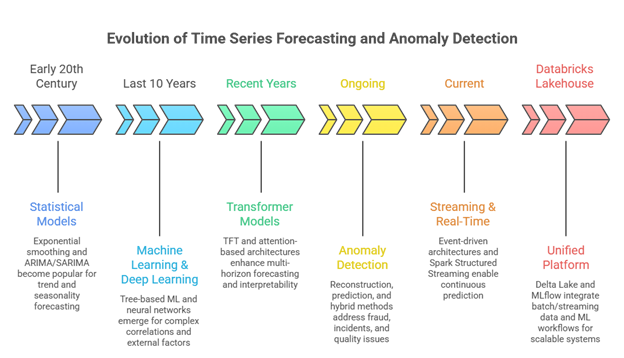
Early and popular forecasting techniques are statistical models that make the assumption that relatively simple features like trend, seasonality, and autocorrelation may be utilized to describe the future based on the past. Examples include exponential smoothing families and ARIMA/SARIMA-style models, which are still widely used in many corporate contexts due to their speed, interpretability, and robust baselines. These traditional techniques are still seen as fundamental in contemporary surveys, particularly for short-horizon forecasting or situations where data is scarce [4], [5].
The last ten years have seen a significant movement in forecasting research toward machine learning and deep learning techniques that can learn intricate non-linear correlations, consider a variety of external factors (such as promotions, weather, price, and events), and scale over enormous collections of linked time series. According to recent studies, when data is vast, noisy, and high-dimensional, tree-based machine learning (ML) and neural techniques frequently perform better than classical models. However, they come up with increased operational complexity and stricter criteria for data quality and monitoring [5], [6].
Transformer-style models for multi-horizon forecasting
For many sequence issues, deep learning models like RNN variants (LSTM/GRU) enhanced forecasting; however, more recent research has investigated attention-based architectures for multi-step prediction and long-range dependencies. The Temporal Fusion Transformer (TFT), which was designed to facilitate multi-horizon forecasting and provide interpretability signals (such as feature importance and attention across time), is a frequently mentioned example. Because it attempts to strike a compromise between accuracy and "explainability," which is frequently necessary for operational adoption, this field of work is crucial for corporate forecasting [7].
Time series anomaly detection: definitions, taxonomy, and evaluation challenges
A fundamental supplementary task to forecasting is time series anomaly detection (TSAD), which addresses situations like fraud, system incidents, sensor failures, and quality problems. The TSAD landscape is categorized into reconstruction-based methods (autoencoders), prediction-based methods, statistical detectors, and hybrid pipelines by recent high-quality tutorials and surveys, which also highlight enduring gaps like weak labeling, domain shift, and the cost of false alerts [5], [8], [9].
Furthermore, research on TSAD evaluation highlights how benchmark design has a significant impact on reported performance; some studies contend that many benchmarks are defective and suggest more comprehensive, methodical evaluation frameworks that cover a wide range of datasets and anomaly kinds. These results encourage production systems that use ongoing calibration, human-in-the-loop evaluation, and robust monitoring instead of "set-and-forget" criteria [10].
Streaming and “real-time” prediction architectures
Beyond modeling decisions, system architecture is increasingly treated as a first-class necessity in the literature and industry guidelines, particularly when predictions need to be generated continually as new events occur. Near real-time feature updates and scoring are made possible by streaming architectures, which are frequently characterized by event-driven or Kappa-style processing. Low-latency pipelines at scale frequently use distributed stream processing with Apache Spark Structured Streaming, and Databricks offers implementation guidelines for Structured Streaming workloads [11].
Databricks Lakehouse building blocks for scalable time series systems
Combining batch and streaming data, analytics, and machine learning workflows on a single platform is a crucial industry trend to decrease pipeline fragmentation and boost dependability. For time series ingestion and replayable training datasets, Databricks documentation demonstrates how Delta Lake works with streaming reads/writes to offer incremental processing patterns and greater guarantees than file-based streaming alone [12].
MLflow is positioned by Databricks as a standard layer for experiment tracking, model packing, and registration in production machine learning, enabling repeated training and deployment across pipelines for forecasting, anomaly detection, and real-time scoring [13], [14].
ARCHITECTURES FOR SCALABLE TIME SERIES MODELING ON DATABRICKS
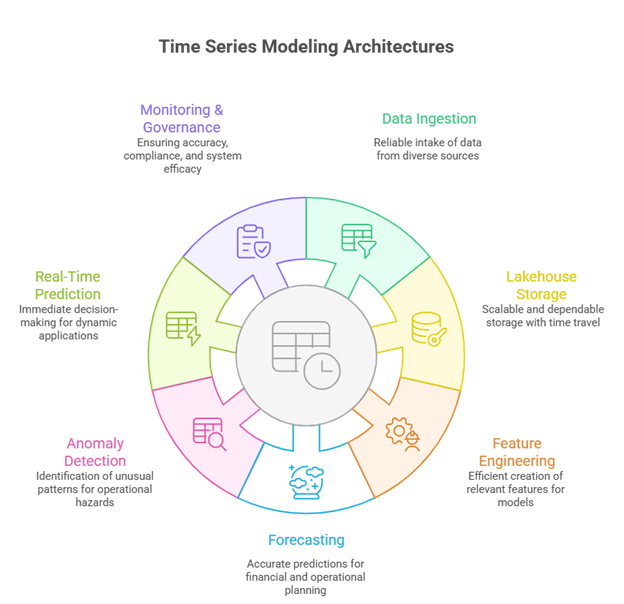
Building scalable time series systems necessitates an architecture that can analyze massive historical datasets, ingest continuous data streams, and produce forecasts with low latency, in addition to choosing appropriate models. To retain dependability, governance, and performance at scale, modern architectures must accommodate both batch and real-time workflows. This is made possible by the Databricks Lakehouse platform, which integrates machine learning lifecycle management, unified storage, and distributed data processing into a single environment.
Data Ingestion and Streaming Pipelines
Reliable data intake from sources including IoT devices, financial systems, application logs, and event streams is the first step in the development of time series systems. While batch ETL pipelines manage historical backfills and recurring updates, streaming technologies such as Apache Kafka, Azure Event Hubs, or AWS Kinesis provide continuous ingestion. Organizations can handle incoming data in almost real time with Databricks Structured Streaming, guaranteeing that new data is instantly accessible for analytics and prediction of workflows.
Lakehouse Storage and Data Management
Delta Lake is used by Databricks to offer scalable, dependable time series data storage. The bronze-silver-gold architecture arranges datasets that are ready for analytics (gold), cleaned and enriched data (silver), and raw ingested data (bronze). Reproducibility and dependable retraining of models using historical snapshots are made possible by Delta Lake's support for time travel, ACID transactions, and schema enforcement.
Feature Engineering at Scale
Engineered elements, including lag values, rolling averages, seasonal indicators, and trend components, are critical to time series modeling. Large-scale feature computing spanning millions of time series is made possible by distributed processing using Apache Spark. While feature stores provide consistency and reuse of engineering features across training and real-time inference pipelines, window functions and aggregations enable the efficient production of rolling statistics.
Forecasting Architectures
Training and inference across thousands or millions of related time series must be supported by scalable forecasting systems. Distributed model training with Spark ML, AutoML, and Python-based frameworks is made possible by Databricks. Multi-horizon forecasts, hierarchical forecasting, and retraining pipelines driven by fresh data availability are all supported by architectures. This enables businesses to produce precise estimates for financial projections, capacity optimization, and demand planning.
Anomaly Detection Pipelines
To identify odd patterns as they emerge, anomaly detection frameworks integrate statistical thresholds, machine learning models, and streaming analytics. Databricks facilitate both real-time detection with Structured Streaming and batch anomaly scoring for historical analysis. When anomalies surpass predetermined thresholds, alerting systems can be coupled with monitoring tools to notify teams, allowing for quick reaction to operational hazards, fraud, or system breakdowns.
Real-Time Prediction and Model Serving
Low-latency inference pipelines that can score events as they happen are necessary for real-time prediction. Databricks facilitates both REST-based model serving endpoints for real-time applications and streaming inference operations. In use cases like dynamic pricing, fraud protection, predictive maintenance, and recommendation systems, these pipelines allow for immediate decision-making.
Monitoring, Governance, and Lifecycle Management
For production systems to remain accurate and dependable, ongoing monitoring is necessary. While data lineage and governance tools guarantee compliance and transparency, Databricks incorporates MLflow for model tracking, versioning, and deployment management. Retraining procedures to sustain system efficacy over time might be triggered by monitoring pipelines that identify data drift, model performance decline, and data quality problems.
PERFORMANCE, SCALABILITY, AND OPERATIONAL CONSIDERATIONS
Enterprise-scale time series systems require designs that can manage millions of separate time series with minimal latency and dependability. It is feasible to train and score models well on extremely big datasets using distributed computing frameworks like Apache Spark, which allows parallel processing across clusters [19]. Training models across thousands of related series at once are frequently necessary in large-scale forecasting scenarios, such as retail demand planning, smart grids, and IoT monitoring. This approach has been demonstrated to increase scalability and forecast performance. Organizations may retain performance while maximizing infrastructure utilization using Databricks autoscaling clusters, which dynamically distribute compute resources based on workload requirements [16].
Data partitioning and storage design also play a major role in performance improvement. During distributed processing, partitioning time series data by date, entity identification, or logical grouping increases query efficiency and lowers shuffle overhead. Through file compaction, ACID transactions, and optimized storage architectures, Delta Lake improves performance and reliability, allowing for effective batch and streaming applications [15]. For real-time prediction pipelines, other methods including caching frequently accessed data, adjusting cluster topologies, and isolating workloads further increase throughput and lower latency [16].
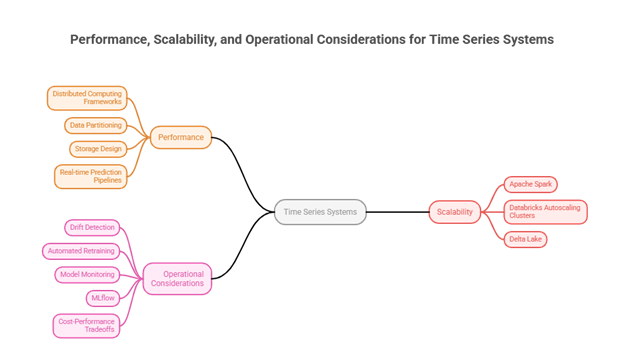
Drift detection, automated retraining, and ongoing model monitoring are necessary for operational sustainability. When data distributions shift over time, time series models are especially vulnerable to concept drift, which lowers prediction accuracy [17]. It is possible to identify degradation early and initiate retraining processes by keeping an eye on forecast error trends, feature distribution shifts, and anomaly rates. To provide reproducibility and governance across production systems, tools like MLflow support model versioning, lifecycle management, and controlled deployment strategies. To develop scalable and financially viable time series solutions, organizations must also assess cost-performance tradeoffs, balancing compute utilization, model complexity, retraining frequency, and latency requirements.
INDUSTRY APPLICATIONS & USE CASES
In retail and supply chain management, time series modeling is essential because precise demand forecasting enables businesses to avoid excess stock, decrease stockouts, and maintain ideal inventory levels. Forecasting systems help businesses plan procurement and logistics more effectively by examining past sales trends, seasonality, promotions, and outside variables like holidays or weather. According to research, sophisticated forecasting techniques lower operating costs and greatly enhance supply chain performance. In a similar vein, utilities and energy providers depend on time series forecasting to forecast electricity demand and balance supply and consumption, hence preserving grid stability and averting outages.
By continuously monitoring sensor data from machinery and equipment, time series analysis makes predictive maintenance possible in manufacturing and industrial IoT environments. Early indicators of equipment failure can be seen in patterns in vibration, temperature, or pressure readings, which enable businesses to plan maintenance before malfunctions happen. It has been demonstrated that predictive maintenance lowers maintenance costs, increases equipment longevity, and minimizes downtime. The same streaming analytics concepts are used to increase operational reliability and identify anomalies in real time in connected infrastructure systems and smart factories.
In financial services and digital platforms, where anomaly detection and real-time prediction enable risk management, fraud protection, and customized user experiences, time series modeling is especially crucial. To spot suspicious activity and stop fraud losses, financial institutions examine transaction patterns. In the meantime, ride-sharing and e-commerce systems utilize real-time prediction to power personalized suggestions and dynamic pricing, enabling companies to modify rates or offers in response to user behavior and demand trends. While preserving operational effectiveness, these real-time decision systems enhance client engagement and revenue optimization.
CONCLUSION
The capacity to derive timely and useful insights from the massive volumes of time-stamped data that enterprises continue to produce has become a crucial competitive advantage. Businesses may recognize trends, predict future results, identify anomalous behavior, and react swiftly to shifting circumstances using time series modeling. However, processing continuous data streams, scaling to millions of records, and producing the low-latency forecasts needed for contemporary operations are often challenges for classic analytics systems.
The Databricks Lakehouse platform's scalable designs offer a cohesive strategy for resolving these issues. Organizations may create forecasting models, anomaly detection pipelines, and real-time prediction systems that function effectively at enterprise scale by integrating distributed processing, dependable storage, and integrated machine learning lifecycle management. Faster decision-making increased operational resilience, and improved customer experiences are made possible by these systems' support for both historical analysis and streaming intelligence.
Future developments in AI-driven forecasting, real-time feature engineering, and automated machine learning will increase the usefulness of time series intelligence. Businesses that implement scalable, well-managed time series systems now will be better equipped to handle changing data environments, lower risk, and seize new chances for development and expansion.
REFERENCES
[1] “Time Series Analysis: What it is and why it is important,” Digitalsense.ai, 2026. https://www.digitalsense.ai/blog/what-is-time-series-analysis (accessed Mar. 02, 2026).
[2] A. Almeida, S. Brás, S. Sargento, and Filipe Cabral Pinto, “Time series big data: a survey on data stream frameworks, analysis and algorithms,” Journal of Big Data, vol. 10, no. 1, May 2023, doi: https://doi.org/10.1186/s40537-023-00760-1.
[3] Wikipedia Contributors, “Time series,” Wikipedia, Jul. 30, 2019. https://en.wikipedia.org/wiki/Time_series
[4] “A Comprehensive Survey of Time Series Forecasting: Architectural Diversity and Open Challenges,” Arxiv.org, 2016. https://arxiv.org/html/2411.05793v1#S1 (accessed Mar. 02, 2026).
[5] X. Kong et al., “Deep learning for time series forecasting: a survey,” International Journal of Machine Learning and Cybernetics, Feb. 2025, doi: https://doi.org/10.1007/s13042-025-02560-w.
[6] T. Hall and K. Rasheed, “A Survey of Machine Learning Methods for Time Series Prediction,” Applied Sciences, vol. 15, no. 11, p. 5957, May 2025, doi: https://doi.org/10.3390/app15115957.
[7] B. Lim, S. O. Arik, N. Loeff, and T. Pfister, “Temporal Fusion Transformers for Interpretable Multi-horizon Time Series Forecasting,” arXiv:1912.09363 [cs, stat], Sep. 2020, Available: https://arxiv.org/abs/1912.09363
[8] Q. Liu, P. Boniol, Themis Palpanas, and J. Paparrizos, “Time-Series Anomaly Detection: Overview and New Trends,” Proceedings of the VLDB Endowment, vol. 17, no. 12, pp. 4229–4232, Aug. 2024, doi: https://doi.org/10.14778/3685800.3685842.
[9] Z. Zamanzadeh Darban, G. I. Webb, S. Pan, C. Aggarwal, and M. Salehi, “Deep Learning for Time Series Anomaly Detection: A Survey,” ACM Computing Surveys, Aug. 2024, doi: https://doi.org/10.1145/3691338.
[10] “Anomaly Detection in Time Series: A Comprehensive Evaluation,” Anomaly Detection in Time Series: A Comprehensive Evaluation, 2022. https://timeeval.github.io/evaluation-paper/(accessed Mar. 02, 2026).
[11] mssaperla, “Run your first Structured Streaming workload - Azure Databricks,” Microsoft.com, Oct. 08, 2025. https://learn.microsoft.com/en-us/azure/databricks/structured-streaming/tutorial
(accessed Mar. 02, 2026).
[12] “Go to GoGuardian App,” Delta.io, 2026. https://docs.delta.io/delta-streaming/
(accessed Mar. 02, 2026).
[13] “MLflow for gen AI agent and ML model lifecycle | Databricks Documentation,” Databricks.com, Jan. 13, 2025. https://docs.databricks.com/aws/en/mlflow
[14] “Log, load, and register MLflow models | Databricks on AWS,” Databricks.com, Jun. 10, 2025. https://docs.databricks.com/aws/en/mlflow/models(accessed Mar. 02, 2026).
[15] M. Armbrust et al., “Delta Lake: High-Performance ACID Table Storage over Cloud Object Stores,” doi: https://doi.org/10.14778/3415478.3415560.
[16] “Databricks documentation | Databricks Documentation,” Databricks.com, Feb. 14, 2025. https://docs.databricks.com/aws/en
[17] J. Gama, I. Žliobaitė, A. Bifet, M. Pechenizkiy, and A. Bouchachia, “A survey on concept drift adaptation,” ACM Computing Surveys, vol. 46, no. 4, pp. 1–37, Apr. 2014, doi: https://doi.org/10.1145/2523813.
[18] S. Makridakis, E. Spiliotis, and V. Assimakopoulos, “The M4 Competition: 100,000 time series and 61 forecasting methods,” International Journal of Forecasting, vol. 36, no. 1, pp. 54–74, Jan. 2020, doi: https://doi.org/10.1016/j.ijforecast.2019.04.014.
[19] Zaharia, M., et al. (2016). Apache Spark: A Unified Engine for Big Data Processing. Communications of the ACM https://spark.apache.org/research.html
[20] H. Chen, R. H. L. Chiang, and V. C. Storey, “Business intelligence and analytics: From big data to big impact,” MIS Quarterly, vol. 36, no. 4, pp. 1165–1188, Dec. 2012, doi: https://doi.org/10.2307/41703503.
About the Author
Dheekshitha Kamisetty
Dheekshitha Kamisetty is a Software/Data Engineer with experience building scalable data pipelines, cloud analytics solutions, and AI-driven systems. I specialize in Python, SQL, and Databricks to design end-to-end ETL workflows, analytics dashboards, and optimized data pipelines, and I have built backend services using FastAPI and GraphQL. My work includes integrating LLM-based applications, automation agents, and machine learning workflows, supported by cloud deployments and CI/CD pipelines, to deliver reliable, production-ready data solutions.
View Dheekshitha Kamisetty's profileNeed more information?
Our team of experts can provide custom guidance on implementing the strategies outlined in this whitepaper for your organization.