
The End of Data Silos: How Lakehouse + Lakebase are Redefining the Enterprise Data Stack
ABSTRACT
Modern enterprises continue to struggle with fragmented data architectures that separate transactional (OLTP) and analytical (OLAP) systems. This divide creates persistent data silos, high-latency ETL pipelines, rising operational costs, and an inability to support emerging real-time AI workloads. While the Lakehouse architecture unified analytical data and improved governance, it remained limited by its batch-oriented nature and dependency on external operational databases.
This blog examines the next evolution in data architecture—the Unified Data Platform, powered by the convergence of Lakehouse and Lakebase capabilities. By integrating OLTP, OLAP, AI, and governance layers into a single, metadata-unified platform, organizations can eliminate data fragmentation, achieve real-time decisioning, reduce TCO, and enable high-fidelity AI applications across industries. This blog explores the architectural evolution, key advantages, and strategic implementation roadmap for adopting a Unified Data Platform that redefines the modern enterprise data stack.
INTRODUCTION
The contemporary enterprise data stack has a built-in structural flaw, which is the separation between real-time transactions and analytics. The two-tier system of having important data being created in one environment and analyzed in another has been used by organizations over the decades. This dependency on disjointed architectures leads to silos of data, slows down operational agility, insight, and needlessly escalates operational costs. The inability to integrate the traditional and fragmented model to meet the modern, real-time requirements is now the pivot problem of all data-driven businesses [1].
The dilemma lies in the software design’s artificial divide between the Online Transactional Processing (OLTP) systems, which support fast and live customer interactions, and the Online Analytical Processing (OLAP) systems, which consolidate the massive historical data of business intelligence. This required movement and transformation of data in and out of these environments, which is often implemented through laborious ETL pipelines that introduce latency and inconsistency, generating persistent data lag. This architectural isolation can directly bar the implementation of high-value use cases, e.g., Real-Time AI, in which choices are required to be taken in real-time relying on the most recent operational information [2].
Architectural convergence is the better solution that can be adopted; not greater data movement or more tools. The Unified Data Platform, which is developed on the concepts of the high-performance and open-standard Lakehouse architecture, is the next step the industry is experiencing now. This one unified architecture can support all types of data and all the workloads simultaneously. This blog discusses that the ultimate transition of fragmented systems to a completely unified data platform removes the essential data transactional and analytics rift, entirely transforming the process of managing data, opening a new frontier in data intelligence.
THE FIRST CONVERGENCE: FROM WAREHOUSE TO DATA LAKEHOUSE
The way to a Unified Data Platform is to address the issue of the great data paradox: the trade-off between speed and structure. In the past, Data Warehouse (DW) provided structure, strong Data Governance, and reliability; however, its rigidity, slowness of ingesting various data, and cost of scaling were restrictive [3]. The Data Lake, in turn, offered low prices and flexibility to unstructured information but did not provide the level of trust and transactional consistency and schema enforcement needed to support reliable datasets, and could frequently lead to so-called “data swamps”.
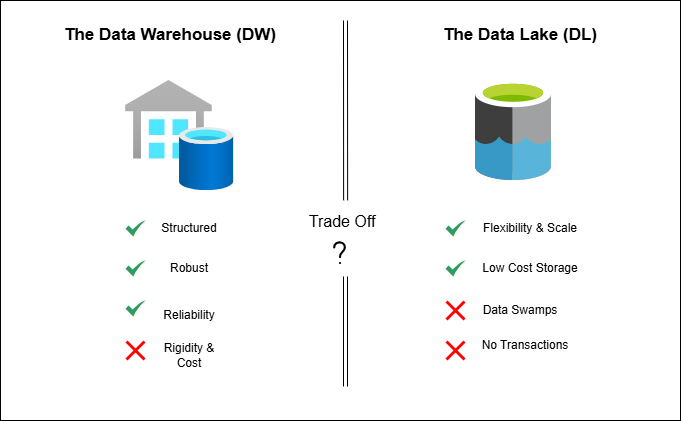
Figure 1: The Data Paradox: Core Trade-Offs Between the Data Warehouse and the Data Lake.
The Lakehouse architecture offered the much-needed bridge, which was the first significant meeting point. This architecture has been able to effectively leverage the fact that the data lake is cheap and scalable and overlay a sophisticated metadata management system. One of these elements is the utilization of open formats and transaction protocols, including the ones offered by Delta Lake. The advantages of Delta Lake are that it supports full ACID properties, schema evolutions, and time travel on the data files in the cloud object storage. This innovation makes metadata unification achievable - the schema, relationships, and transactional history are centrally managed, thus removing the analytical silo, and enabling the provision of reliable workloads in OLAP. It has been able to leverage Compute-Storage Separation and afford flexibilities and massive scalability in deep business intelligence and deep training of large-scale Machine Learning (ML).
Nevertheless, the underlying lakehouse architecture, regardless of its many enhancements, is largely batch and analytical-oriented. Its architecture is not necessarily optimized to the challenging nature of operational systems: the burdens of thousands of simultaneous, small, low-latency updates and point lookups inherent to high-volume OLTP transactions. Businesses continue to need individual traditional databases to operate their fundamental applications, and this means that the two main silos of data, which are non-negotiable, remain; one is used for live transactions, and the other is used to analyze data. The necessity to have one, centralized, integrated data platform containing transactions, analytics, AI, and governance was thus not fulfilled.
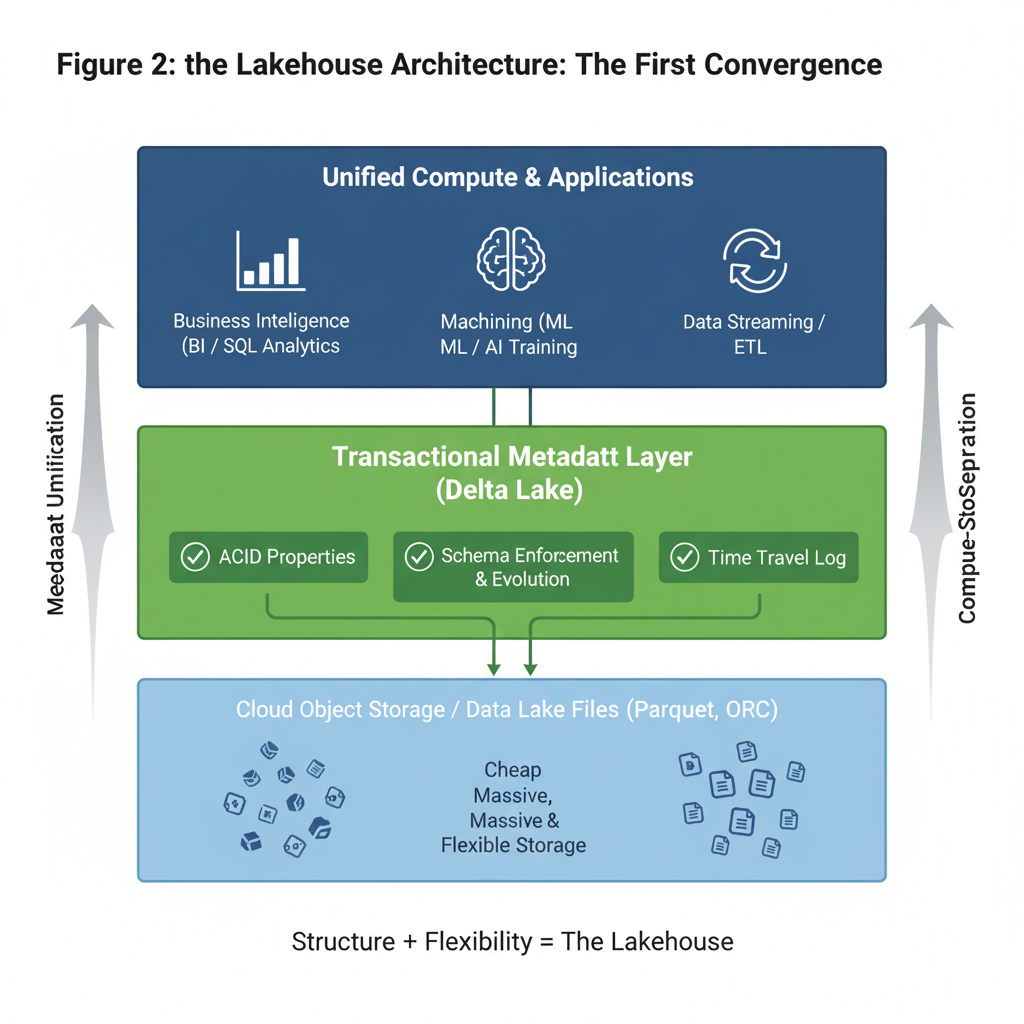
Figure 2: The Lakehouse Architecture : The First Convergence
THE FINAL EVOLUTION: INTRODUCING THE UNIFIED LAKEHOUSE ARCHITECTURE
The Unified Lakehouse Architecture builds upon the foundational Lakehouse to make it a global data lifecycle across analytics, AI, and governance layers. The transactional database, data lake, and data warehouse are integrated into one entity. This new architecture is purposely designed to deal with the entire range of interactions, from fine-grained, fast OLTP writes to intricate, petabyte-scale OLAP queries, on the same data copy. The outcome is therefore one, indeed truly integrated data platform that has the ability to support any application with guaranteed data freshness.
The integrated treatment is the defining factor. The conventional systems required a trade-off between the speed of transaction and the depth of analytics. Unified Data Platform removes this option, offering guaranteed ACID compliance and milliseconds response-time on the transactional operations and, at the same time, supporting high-throughput analytical scans. The key enabler is metadata unification, whereby one catalog manages the access of streaming ingestion, historical batch querying, and live transactional updates. This dramatically simplifies the security model and offers an ultimate single source of truth for the organization.
There are substantial technical implications of the realization of this Unified Data Platform. First, it removes the need to have sophisticated and fragile ETL Pipelines that are designed to move data and transform data between operational and analytical systems. This reduces the maintenance overhead and, more importantly, eliminates data latency. Second, it addresses the fundamental problem of two systemic Data Silos that will offer a solid single source of truth to the whole enterprise.
Above all, this integrated architecture ultimately opens high-fidelity Real-Time AI. The Machine Learning (ML) models that were once trained on outdated, copied data can be trained and served in the live transactional store. Having a common data platform to support both transactional and analytical workloads is not just an efficiency benefit, but a layer to data intelligence. This has a comprehensive solution that defines a contemporary, robust business data stack.
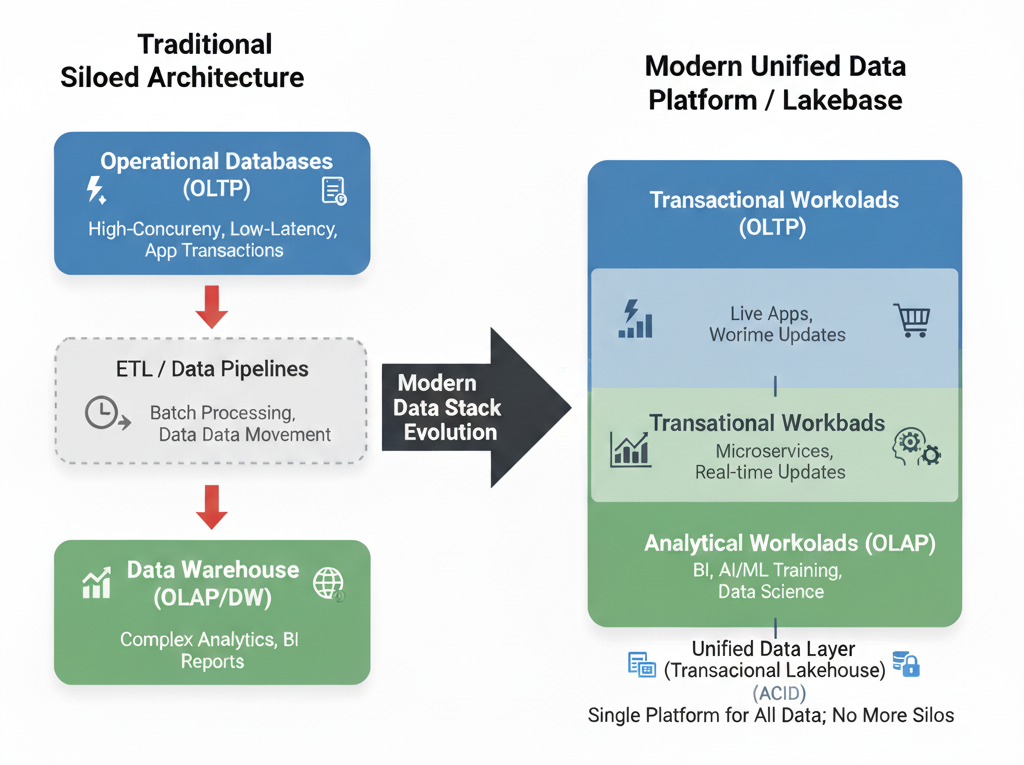
Figure 3: A comparison between the traditional architecture, which separates operational (OLTP) databases, ETL pipelines, and data warehouses (OLAP/DW), and a modern Unified Data Platform (often referred to as a Lakebase) that integrates both transactional and analytical workloads on a single data layer
THE KEY ADVANTAGES OF THE INTRODUCTION OF A UNIFIED DATA PLATFORM
The results of a Unified Data Platform go beyond simplifying the architecture; they completely transform business prospects and business economics by permanently solving fragmentation.
Real-Time AI and Efficiency in Operations Across Industries. The most disruptive aspect of the real-time operation is in highly regulated industries, where, currently, data fragmentation prevents successful AI implementation[4]:
BFSI (Banking, Financial Services, and Insurance): Traditional fraud-based models use aggregated, delayed data. The cost and latency of integrating credit score data, transactional history (OLTP), and user behavioral data (OLAP) are too high to make decisions instantly in a fragmented environment. The Unified Data Platform will allow real-time risk scoring and fraud identification, reducing the lag between a transaction and the response of the analytics [5].
Healthcare: It involves the integration of live EMR data (transactional) and historical clinical trial outcomes and genome data (analytical) to predict patient deterioration or optimal advancement of treatment pathways [6]. The presence of Data Silos makes this fusion almost impossible in point of care. The integrated design enables models to project patient trajectories in real-time upon the existing live data stream, which leads to precision medicine.
Public Sector: Public sector agencies tend to use fragmented and out-of-date databases. Fragmentation prevents the implementation of AI in the implementation of such important services as predictive resource allocation or threat modeling [7]. Data Intelligence is taken to a new level in that a Unified Data Platform enables security intelligence to compare real-time event feeds with large historical datasets.
Simplified Architecture and Lower Total Cost of Ownership (TCO) The traditional enterprise data stack is typically an extremely large and complicated cost centre containing a myriad of databases, streaming systems, and governance tools. Organizations achieve the TCO reductions that are dramatic when they replace this sprawl by having a single, Unified Data Platform. Examples of cost reduction encompass 40-50% overall reduction in the complexity of ETL Pipelines, removal of high-cost traditional data warehouse license charges, and reduction in the cost of storage through the removal of duplicate copies of data ( Data Duplication ). Teams are entirely committed to value creation by not investing engineering resources in data logistics, simply ensuring they maximize the usefulness of the single, managed data asset in the Unified Data Platform [8]. This is a single, unified system that scales and is easy to manage. Indrasol focuses on guiding clients through this transition, architecting, and constructing related enterprise data ecosystems that provide clients with immediate TCO value and long-term flexibility.
Superior Data Governance and Compliance. Fragmented systems result in giant blind areas to security and compliance that require data to be secured and governed individually in each silo. This is addressed by a Unified Data Platform, which creates a single point of control[9]. Features such as a Unity Catalog approach offer metadata management and access control policies on a fine-grained basis to all data and any workload. This cohesion turns Data Governance into a responsive issue into a proactive, inherent ability.
Data Team Empowerment. In addition, one Unified Data Platform encourages actual collaboration. Data Engineers, Analysts, and Scientists do not find version control or system-to-system data reconciliation challenging anymore. They have the freedom to operate on the very same, best fidelity copy of data. This speeds up all phases of the data lifecycle, including fast feature engineering of Machine Learning (ML) models and real-time self-service Business Intelligence (BI) reports so that strategic projects can be iterated on and deployed faster.
STRATEGIC IMPLEMENTATION: MOVING TO A UNIFIED DATA PLATFORM
Moving to a Unified Data Platform is a modernization project that must be well planned, not a hasty technical lift-and-shift. The initial essential measure is an in-depth evaluation. Businesses need to determine the current transactional (OLTP) and analytics (OLAP) load with particular attention to those places where latency is the most harmful (e.g., personalization, fraud detection). This is what is meant by the extent of the necessary Unified Data Platform [2].
The upgrade to the full Unified Data Platform is an extension of the use of a basic Lakehouse that some organizations already use. It is no longer just a matter of analytical consolidation but an attempt to merge the operating layer as a substitute for the old OLTP databases. This usually includes a staged Migration plan, which initially includes fewer mission-critical applications to demonstrate that the model is stable and functioning with both transactional and analytical loads.
The change process should focus on data integrity and the least amount of disruption. One of the opportunities is to use the Compute-Storage Separation that is inherent in the new platform and scale out the resources independently as the workloads are onboarded[9]. Finally, the effective introduction of a Unified Data Platform is not only the issue of the acquisition of a new technology; it is an issue of future-proofing the enterprise data stack. Firms that adopt this new generation architecture will have gained a decisive competitive advantage and will no longer be limited to the speed of the old information silos, and will actually be operating at remarkable operational speed. Indrasol also has the profound understanding required to steer such a tricky strategic change.
CONCLUSION
The development of the enterprise data stack has been a conclusive movement towards fragmentation. Starting with the need for the Data Warehouse, it came to the semi-unified Lakehouse that resolved the analytical silo, and now has been resolved into the ultimate Unified Data Platform constructed on the basis of Lakehouse. The structure manages to solve the unnatural separation between OLTP and OLAP systems that have plagued data professionals for decades, at once combining the governance and AI layers.
The strategic reason is obvious: the era of the existence of parallel, separate operational and analytical environments cannot be prolonged. These two data silos are chronic sources of prohibitive costs, complexity, and latency that competitive businesses can no longer afford to maintain, especially in data-intensive industries such as BFSI and Healthcare.
The Unified Data Platform provides one unified platform where data is created, processed, and examined in real-time. It is the core of the next-generation Real-Time AI applications and pervasive Data Governance with its ability to deliver fresh and consistent data in real-time. The implementation of this architecture is not merely an upgrade; it is the precondition to the attainment of operational excellence and attainment of the actual data-grounded intelligence in the contemporary market. Going forward, the Unified Data Platform refers merely to the platform.
REFERENCES
[1] J. Patel, “Overcoming Data Silos through Big Data Integration,” International Journal of Database Management Systems (IJDMS), vol. 11, no. 3, pp. 1–10, June 2019, doi: 10.5121/ijdms.2019.1301.[online]. Available: https://www.researchgate.net/publication/339088516_OVERCOMING_DATA_SILOS_THROUGH_BIG_DATA_INTEGRATION
[2] S. S. Conn, “OLTP and OLAP Data Integration: A Review of Feasible Implementation Methods and Architectures for Real-Time Data Analysis,” in Proc. IEEE SoutheastCon 2005, Ft. Lauderdale, FL, USA, Apr. 2005, pp. 515–522. doi: 10.1109/SECON.2005.1423297.[Online]. Available: https://www.researchgate.net/publication/4140602_OLTP_and_OLAP_data_integration_A_review_of_feasible_implementation_methods_and_architectures_for_real_time_data_analysis
[3] M. Armbrust, A. Ghodsi, R. Xin, and M. Zaharia, “Lakehouse: A New Generation of Open Platforms that Unify Data Warehousing and Advanced Analytics,” Databricks, blog, 2021. [Online]. Available: https://www.databricks.com/research/lakehouse-a-new-generation-of-open-platforms-that-unify-data-warehousing-and-advanced-analytics
[4] IBM, "Three ways a unified data and AI platform saves time, costs and reduces risk," IBM Think Blog, Oct. 7, 2025. [Online]. Available:https://www.ibm.com/think/insights/three-ways-a-unified-data-and-ai-platform-saves-time-costs-and-reduce-risk
[5] IDC, Elastic, and Amazon Web Services, “The Rise of Intelligent Banking: Unifying Fraud, Security, and Compliance in the Era of AI,” IDC Spotlight, 2024. [Online]. Available:https://www.elastic.co/resources/idc-intelligent-banking
[6]Stanford Institute for Human-Centered Artificial Intelligence (HAI), “Advancing Responsible Healthcare AI with Longitudinal EHR Datasets,” Stanford HAI, 2025. [Online]. Available: https://hai.stanford.edu/news/advancing-responsible-healthcare-ai-longitudinal-ehr-datasets
[7] C. van Ooijen, B. Ubaldi, and B. Welby, A Data-Driven Public Sector: Enabling the Strategic Use of Data for Productive, Inclusive and Trustworthy Governance, OECD Working Papers on Public Governance, no. 33, OECD Publishing, Paris, 2019. [Online]. Available: https://www.oecd.org/en/publications/a-data-driven-public-sector_09ab162c-en.html
[8] IBM, "Three ways a unified data and AI platform saves time, costs and reduces risk," IBM Think Blog, Oct. 7, 2025. [Online]. Available: https://www.ibm.com/think/insights/three-ways-a-unified-data-and-ai-platform-saves-time-costs-and-reduce-risk
[9] D. Mazumdar, J. Hughes, and J. B. Onofré, “The Data Lakehouse: Data Warehousing and More,” arXiv preprint arXiv:2310.08697 [cs.DB], Oct. 2023. [Online]. Available:https://arxiv.org/abs/2310.08697
About the Author
Aishwarya Menon
Aishwarya Menon is a Data Engineer Trainee specializing in data engineering and analytics. She has hands-on experience in building and optimizing data pipelines, developing data models, and orchestrating workflows using tools such as Python, SQL, Airflow, dbt, Azure, and Databricks. Aishwarya is passionate about transforming raw data into actionable insights and thrives in agile environments that encourage learning and collaboration. In her current role, she contributes to end-to-end data solutions with a focus on automation, scalability, and performance. As an early-career professional, she is committed to expanding her technical expertise in cloud data engineering and applying data-driven approaches to solve real-world business problems.
View Aishwarya Menon's profile